


The Lowdown
Would I recommend it? If you want peace of mind in a world where the lights don’t always stay on, the DJI Power 2000 Portable Power Station makes a very compelling case. It’s not glamorous, but when the power cuts out and your house stays bright while the neighbors are fumbling for candles, you won’t care about glamour. You’ll just be glad you have it.
Overall
Pros
- Strong 2048Wh capacity with 3000W continuous output
- Ultra-fast AC charging
- Seamless UPS mode with a 0.01s switchover
- Quiet operation at ~30dB
- Durable build with flame-retardant casing, 26 sensors, 21 fuses
- LFP (LiFePO?) battery rated for ~4,000 cycles (about a decade of daily use)
- Compact footprint (about the size of a PC tower)
- Plenty of ports, including dual 140W USB-C, four AC outlets, and proprietary DJI SDC ports for expansion or drone batteries
- Warranty extends from three years to five if connected via DJI’s app
- Competitively priced
Cons
- Heavy at nearly 50 pounds, with no built-in wheels
- Front-facing input ports are awkward for UPS setups
- Uses a proprietary AC cable that isn’t currently sold separately, so losing it could be problematic
- Expansion requires DJI’s proprietary SDC accessories, limiting flexibility with standard solar or car charging gear
- No built-in LED light, unlike some rivals
- Costs climb quickly if you add solar panels, extra batteries, or charging accessories
When the lights flicker during a summer brownout or vanish in the middle of a winter storm, the difference between chaos and calm comes down to one thing: backup power. Portable power stations have become essential, and the DJI Power 2000 enters this market with the confidence of a small-scale power plant. It may seem odd that a company known for drones is tackling blackouts, but inside this sleek box is unmistakable DJI DNA, with a sharp design, fast performance, and a few quirks. The real question? Is the DJI Power 2000 the backup your home can count on?
First Impressions: What’s in the Box
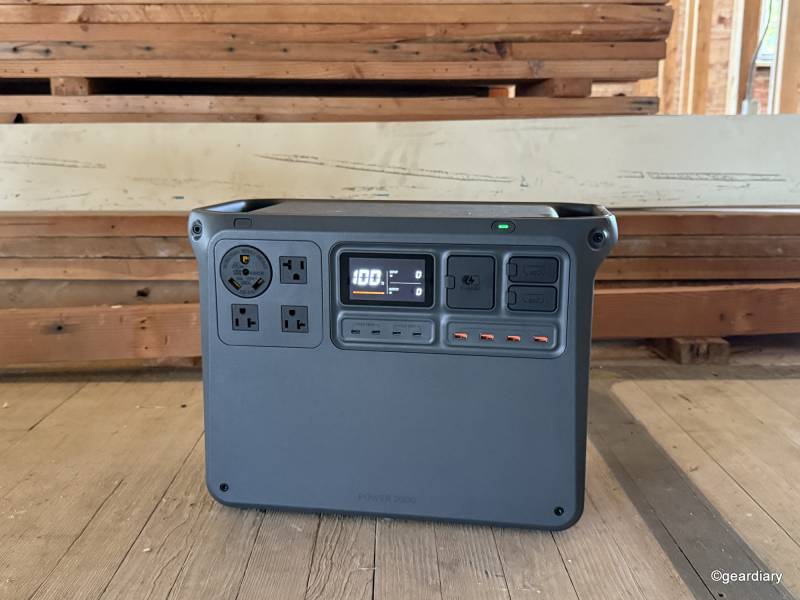
The DJI Power 2000 arrives in a single, well-padded box that feels sturdy enough to withstand a delivery driver’s worst day, and the unboxing process is refreshingly straightforward. Inside, you get the hefty unit itself and an AC power cable.
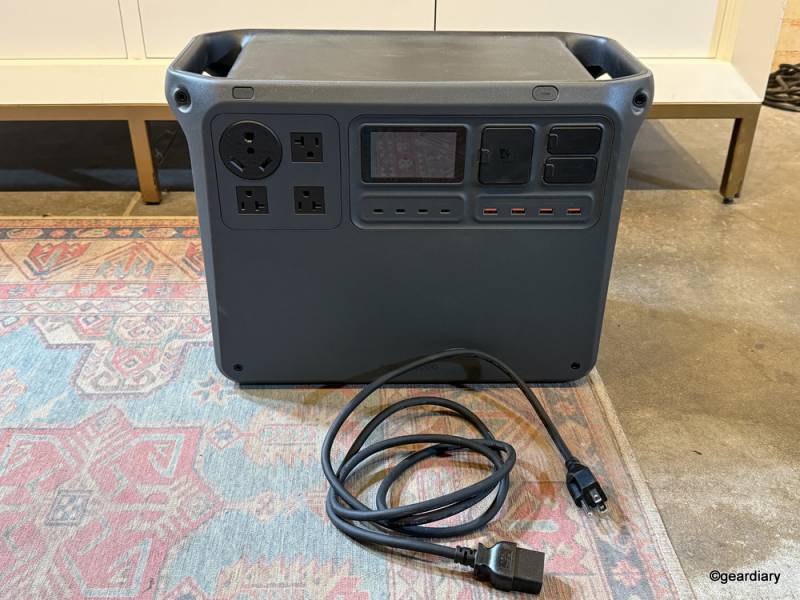
Other than that, there’s no swag bag of random adapters. DJI assumes you’re here for serious power in a contained unit, but if you want to turn this into a more complex off-grid system with expansion batteries or solar panels, they’ll happily sell you those parts separately.
This brings us to one of the few cons I need to point out. While it is cool that no large power brick is necessary, DJI went with a proprietary three-pronged model that, as of this writing, is not available as a separately purchased accessory on their site, so you’ll want to make sure that you don’t lose it.
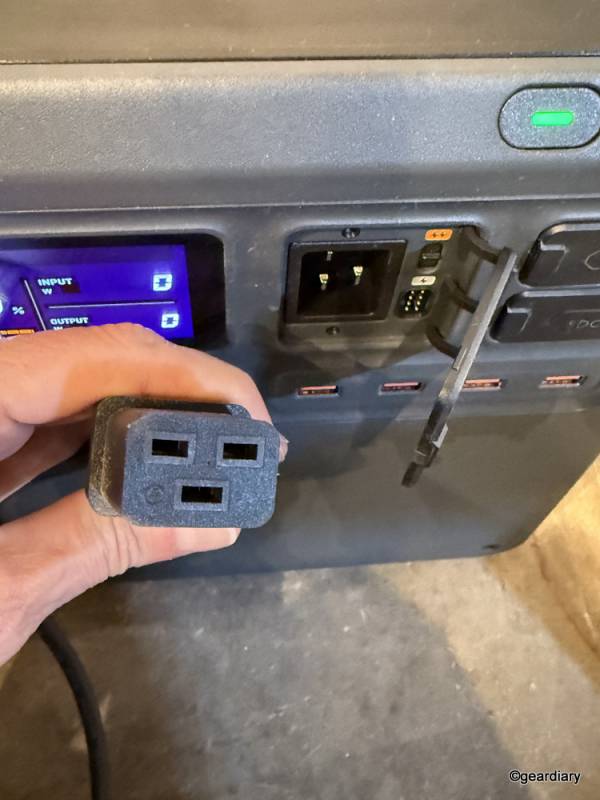
The other con is that the power input ports are located on the front of the DJI Power 2000, rather than on the back or side. This is an awkward placement if, like me, you plan to use the power station as a UPS and keep it plugged in at all times.
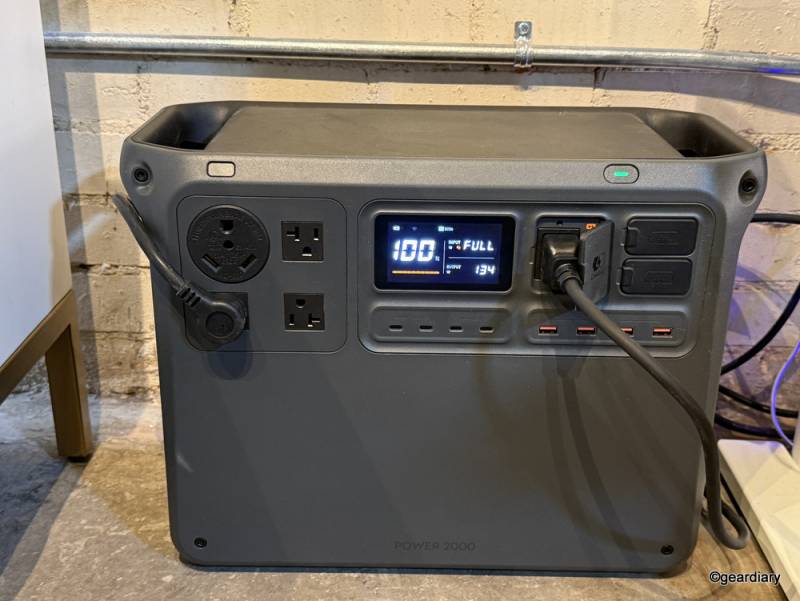
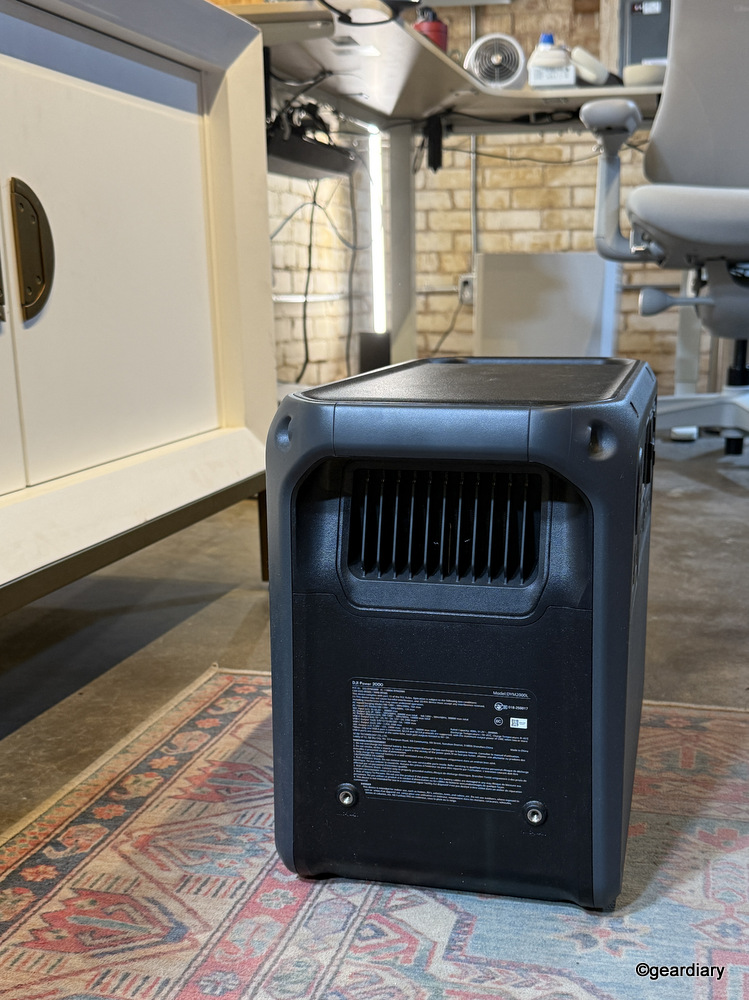
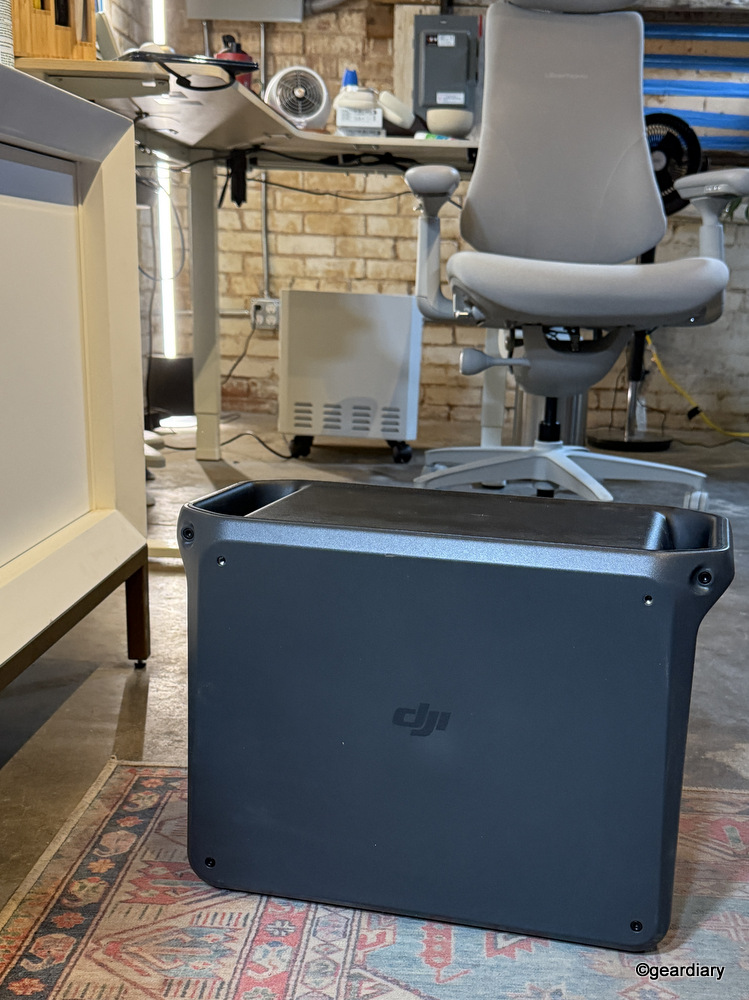
Measuring roughly 13″ tall, 9″ wide, and 17.5″ long and weighing just under 50 pounds, the DJI Power 2000 Portable Power Station is technically portable but only if you’ve got a good back or a helpful friend. The two chunky built-in handles make it possible to lug, but if you’re imagining tossing it around like a lunch cooler, think again.
DJI does sell a trolley, bundled with an expansion battery, for nearly a grand, but there’s no standalone hand-truck option yet. For a product pitched as “portable,” that feels like a miss.
So the DJI Power 2000 is not light enough to easily schlep from room to room, but it’s compact enough to tuck into a closet, under a desk, next to a bed, or in an RV without needing to rearrange your life. Think of it as the size of a small desktop PC tower, with a design that actually looks like it belongs inside a modern home rather than the back of a workshop.
Design and Build: Sturdy, Smart, and Very DJI
If you’ve ever handled a DJI drone, gimbal, or controller, you’ll recognize the family resemblance. The Power 2000 is cleanly designed, wrapped in a flame-retardant casing with subtle vents and sturdy ports that don’t feel flimsy when you plug into them. DJI claims it can withstand up to a ton of static pressure, which sounds like something only lab engineers would test, but it means you don’t have to handle it with care during transport.
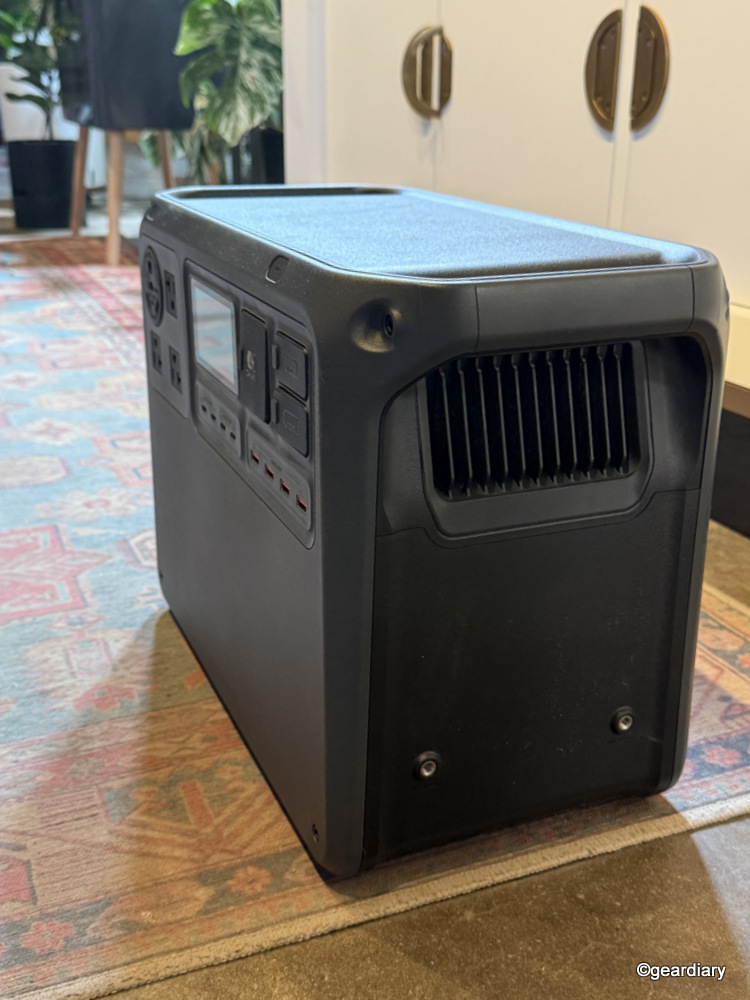
Port layout matters more than you’d think, and DJI almost nails it here. The Power 2000 gives you four AC outlets, four USB-C ports (two rated at 140 watts, which is beefy enough to charge high-end laptops directly), four USB-A ports, and the two DJI SDC ports.
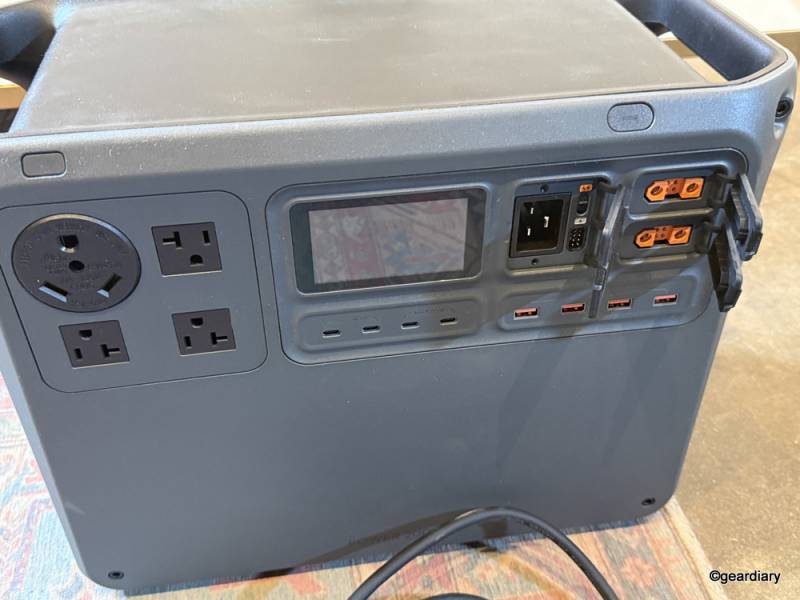
Those SDCs are where DJI shows off its proprietary side; they’re great if you’re in DJI’s drone ecosystem, since you can directly fast-charge flight batteries or plug in expansion packs, but they’re not as flexible if you’ve already invested in standard connectors like MC4 solar panels or XT60 adapters.
For a UPS-focused buyer, the real draw here isn’t exotic ports but the straightforward AC outlets and the peace of mind that the Power 2000 can push 3000 watts continuously without drama. That’s enough to handle nearly everything you’d reasonably want to keep alive in a blackout: refrigerators, routers, lamps, medical equipment, and even the microwave when you want hot food instead of cold sandwiches.
Power Capacity: What It Really Means in a Blackout
Specs are just numbers until you see what they translate to in daily life. A 2048Wh (watt-hour) capacity, paired with a 3000W continuous output, makes the Power 2000 a workhorse. To put that in real-world terms:
If the power cuts out tonight, you could run your Wi-Fi router for more than six straight days. Your refrigerator? About 40 hours, which is plenty of time to ride out a two-day outage without worrying about spoiled groceries. Plug in a lamp, and you’ll have light for nearly 180 hours, which is almost a week of nights without candles.

The DJI Power 2000 Portable Power Station is powering a string of LED lights on a non-powered demo site.
What stood out to me is how flexible it is in balancing multiple loads. I had my modem, router, and a few lamps plugged in, and it barely dented the battery after a couple of hours. When I tested it with heavier loads, such as the microwave, the unit handled it without hesitation. No dimming, no panic, no sudden shut-off. Just steady power, the way a good UPS should behave.
This is where the DJI Power 2000 earns its keep. Unlike smaller power stations intended for casual use, this one is designed to keep household essentials running when you need them most. You’re not just charging phones here; you’re preserving normalcy when everything outside your window is chaos.
UPS Mode: The Secret Weapon
Here’s the feature that makes the DJI Power 2000 particularly compelling: UPS mode, or uninterruptible power supply. That’s tech-speak for “it takes over instantly when the grid fails.” The Power 2000 can switch from wall power to battery in about 0.01 seconds. That’s not marketing fluff; it’s fast enough that your computer doesn’t notice. Your router doesn’t blink. Your CPAP machine keeps humming.
If you’ve ever lost unsaved work because the lights flickered, or if you rely on medical equipment that simply cannot shut off, this matters. Many cheaper portable power stations can act as backups, but they don’t react fast enough to prevent those micro-outages that wreak havoc on sensitive electronics. DJI clearly understood this use case and leaned into it.
I use the DJI Power 2000 Portable Power Station as a UPS at my desk, so I tested this mode by leaving my desktop computer, desk lamp, fan, air purifier, UGREEN 500W power block, and other assorted desktop equipment plugged into a surge protector power strip that is plugged into the Power 2000 during a deliberate breaker trip. The result? Seamless. The lights cut, but everything else kept humming as though nothing had happened. That’s the difference between a glorified battery pack and a true UPS.
Charging: Quick Turnarounds Matter
In a prolonged outage, the ability to recharge quickly is almost as important as the size of the battery. Here’s where the DJI Power 2000 shines. Plug it into AC power, and it will jump from zero to 80 percent in about 55 minutes, and fully top off in 90.
That speed isn’t just a neat spec; it’s game-changing in real life. Imagine the grid comes back for a short window between rolling blackouts. With some competing power stations, you’d be lucky to add 30 percent in a couple of hours. With the Power 2000, you can recover nearly a full charge in less time than it takes to cook dinner.
Of course, you can also feed it with solar panels or a car charger if the outage stretches into days, but those require DJI’s proprietary accessories. This is one of those times where DJI’s ecosystem lock-in feels restrictive. If you’ve already got standard solar panels, you’ll need adapters. But for most people relying on AC wall charging between outages, that 90-minute full recharge speed is going to be the hero feature.
DJI has a whole ecosystem of charging options if you want to go beyond wall outlets. Their solar panels range from $299 for a single 100W panel up to $1,900 for a six-panel 1000W bundle. There’s also the $319 1.8kW Solar/Car Super Charger that lets you pull from both sunlight and your vehicle’s alternator at once. These work well, but they push the total system cost up quickly. By comparison, the included AC wall cable is your only out-of-the-box charging method.
Living with It: Quiet, Safe, and Practical
A lot of power stations sound like a jet engine once the fans kick in. The DJI Power 2000, by contrast, runs at about 30 decibels in standard recharge mode. That’s quieter than most refrigerators. You can keep it in a corner of your living room without feeling like you’re living next to an HVAC system.
Safety is another area where DJI throws the kitchen sink at the problem. The Power 2000 uses lithium iron phosphate (LFP) cells, which are widely considered the safest and most stable option for high-capacity batteries. They also last longer; DJI claims about 4,000 cycles (or a decade of daily charges) before significant degradation, which means you could charge and drain it every day for a decade and still get solid capacity. Add in the 26 temperature sensors, 21 fuses, and flame-retardant housing, and you’ve got something I’d trust indoors without hesitation.
In real-world blackout testing, it easily kept a full-size refrigerator running for over 11 hours with plenty of capacity left over to handle some smaller essentials, including my phone, and a tablet, and a lamp. The lamp was necessary because the unit lacks a built-in LED light, unlike several similarly sized portable power stations from brands like Anker or OUPES.
During my own tests, it never once gave me cause for concern. Even when running near its upper output, it stayed cool and stable. No odd noises, no hot surfaces, no hiccups. That’s what you want when you’re counting on it in an emergency.
How It Compares
The portable power market is crowded, but three models stand out for home backup: the DJI Power 2000, EcoFlow Delta Pro, and Jackery Explorer 2000 Plus.
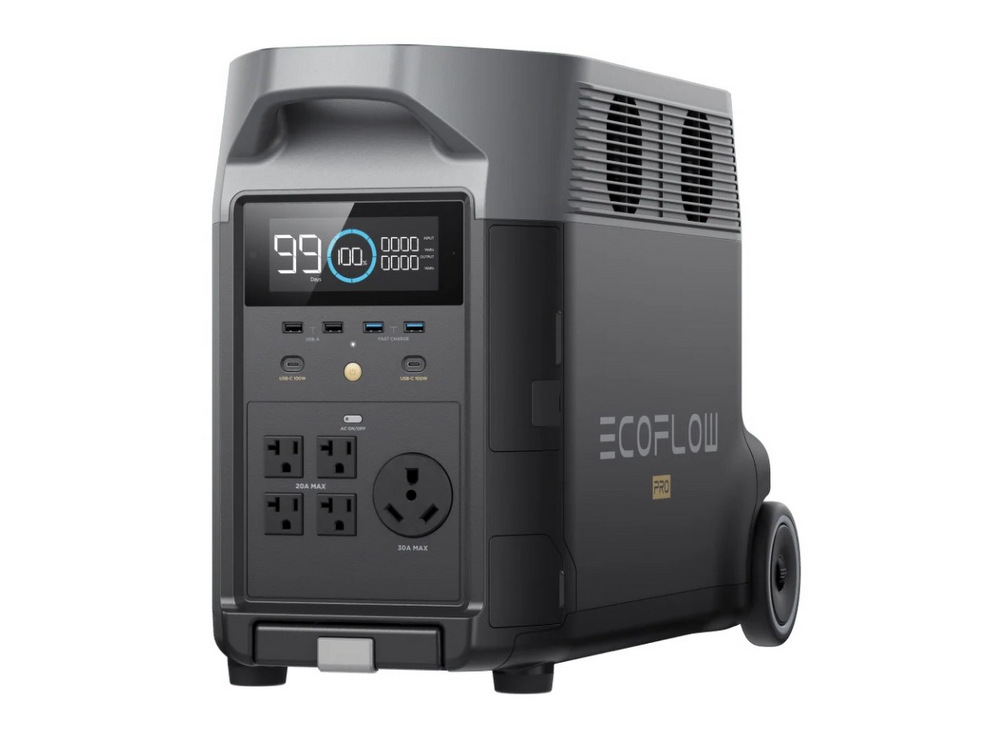
The EcoFlow Delta Pro is the giant of the group. At 99 pounds and 3600Wh capacity, it’s more than twice as large as the DJI Power 2000’s 2048Wh. It delivers a continuous output of 3600W (surge: 7200W) and can be expanded up to 25kWh with additional batteries. That makes it a whole-home backup contender. However, charging takes about two hours via AC, while DJI’s sprints to 80% in just 55 minutes. EcoFlow also excels in lifespan, with 6,500 cycles to 50% capacity, but portability is where it falls short; it’s essentially furniture on wheels.
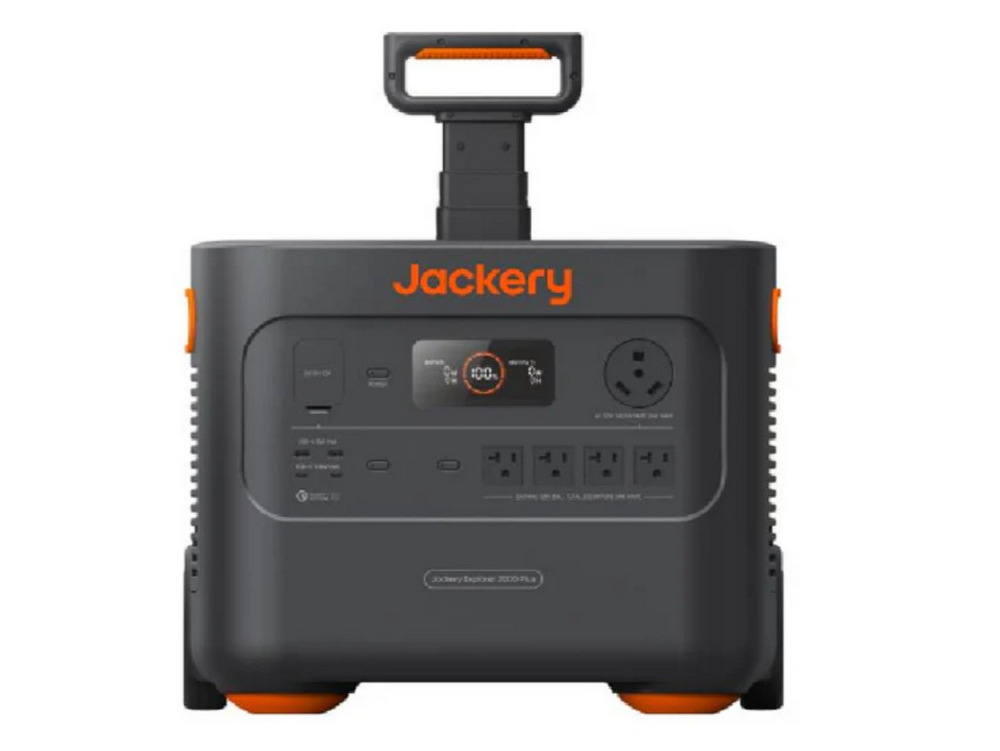
The Jackery Explorer 2000 Plus is much closer to DJI’s league. Both offer around 2048Wh capacity and 3000W continuous output, and both use LiFePO4 cells rated for 4000 cycles. Jackery tips the scale at 61.5 pounds versus DJI’s 47.9, making DJI the easier lift. The real difference is charging: Jackery takes about two hours to refill, while DJI can nearly fully charge in 90 minutes. Jackery’s expansion packs are straightforward, though, while DJI’s ecosystem depends on proprietary and pricey SDC accessories.
Price-wise, the Power 2000 has a retail price of $1,899 (as shown on the DJI site), but Amazon lists the retail price as $1,299.
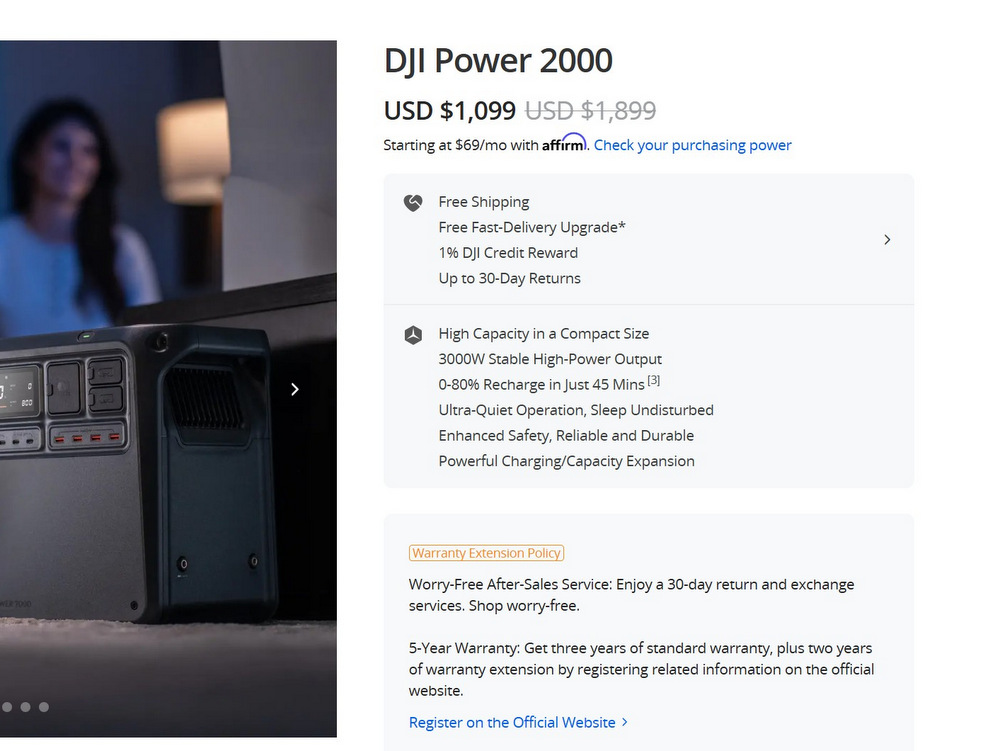
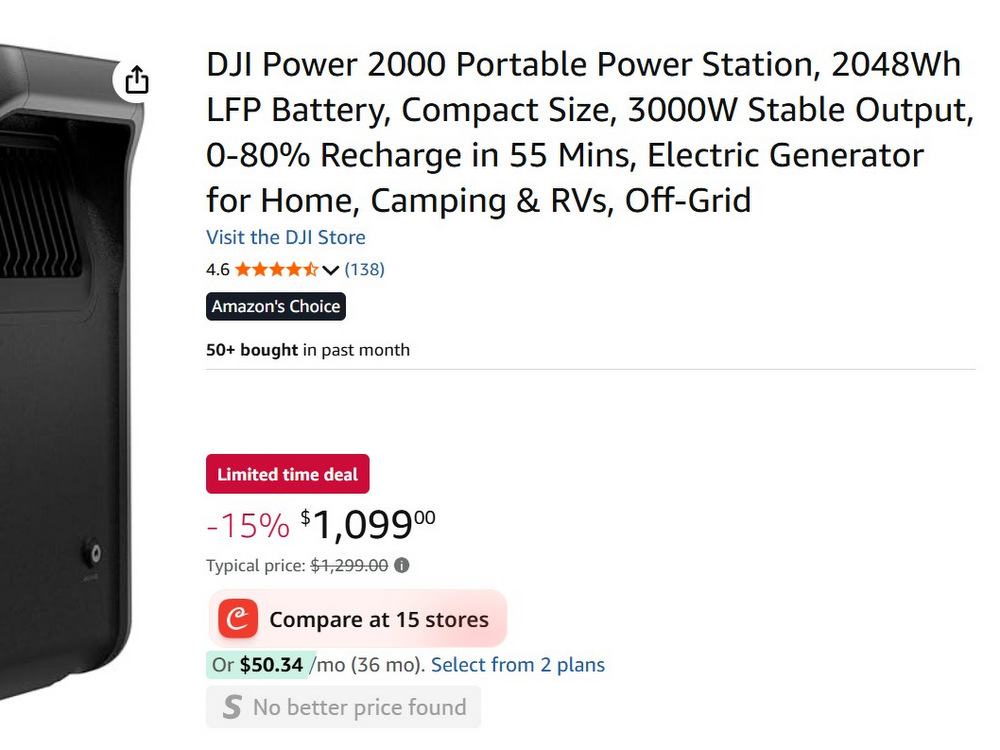
Whatever the actual retail price, the DJI Power 2000 is often discounted to $1,099, putting it solidly in the mid-range. Jackery sits higher at $2,199, while the EcoFlow’s $3,699 retail price often dips to $1,799 on sale.
In short, the EcoFlow is the capacity king if you need whole-home power and don’t mind bulk. Jackery offers expansion and ecosystem simplicity. However, for households facing outages where recharge speed and seamless UPS switching are most important, the DJI Power 2000 edges ahead. It’s the model designed to be a bit more portable, and perfect for anyone who just wants the lights — and the fridge — to stay on.
Who Should Consider It
If you’re looking for a battery to bring on camping trips, there are lighter, cheaper options. If you want an all-in-one solution to replace a gas generator during outages, though, the DJI Power 2000 hits a sweet spot. It’s powerful enough to keep critical appliances running for days, smart enough to switch seamlessly in UPS mode, and fast enough to recharge before the next blackout strikes.
For families who live in storm-prone regions, the math is simple. The Power 2000 can mean the difference between spoiled food, no internet, and restless nights, and a home that feels mostly normal, even while the neighborhood is dark. For professionals working from home, it’s equally practical. Your modem and router won’t cut out, your desktop won’t crash, and your workday won’t come to an abrupt halt.
The DJI Power 2000 isn’t flashy. It doesn’t beg you to take it camping or market itself as a lifestyle accessory. What it does is deliver stable, reliable power in a package designed to slot quietly into your home and save the day when the grid goes dark.
It’s not without drawbacks. Yes, it has handles, but at nearly 50 pounds, this isn’t something you casually carry from room to room, so calling it “portable” is going to depend on how strong the user happens to be. It makes more sense as a semi-stationary backup for your home, a quiet corner of a workshop, or a base you leave in place rather than something you’re constantly moving. And while the $1,299 base price is competitive, once you start adding solar panels or car-charging kits, the cost climbs quickly into “serious investment” territory.
The reliance on proprietary connectors for solar and car charging is annoying. And the lack of built-in wheels feels like an oversight in a product this heavy. But those gripes fade quickly when you see how fast it charges, how seamlessly it switches to UPS mode, and how long it can keep your essentials alive during a blackout.
At its current price — hovering around $1,299 but occasionally dipping lower — it represents solid value compared to rivals like EcoFlow and Jackery. If you can find it closer to $1,200, it becomes an even stronger contender. Notably, DJI offers a three-year warranty by default, but extends it to five years if you connect the device to the app.
Would I recommend it? If you want peace of mind in a world where the lights don’t always stay on, the DJI Power 2000 makes a very compelling case. It’s not glamorous, but when the power cuts out and your house stays bright while the neighbors are fumbling for candles, you won’t care about glamour. You’ll just be glad you have it.
The DJI Power 2000 Portable Power Station retails for $1,899 (currently on sale for $1,099); it is available directly from the manufacturer and other retailers, including Amazon.
Source: Manufacturer-supplied review sample
What I Like: Strong 2048Wh capacity with 3000W continuous output; Ultra-fast AC charging; Seamless UPS mode with a 0.01s switchover; Quiet operation at ~30dB; Durable build with flame-retardant casing, 26 sensors, 21 fuses; LFP (LiFePO?) battery rated for ~4,000 cycles (about a decade of daily use); Compact footprint (about the size of a PC tower); Plenty of ports, including dual 140W USB-C, four AC outlets, and proprietary DJI SDC ports for expansion or drone batteries; Warranty extends from three years to five if connected via DJI’s app; Competitively priced
What Needs Improvement: Heavy at nearly 50 pounds, with no built-in wheels; Front-facing input ports are awkward for UPS setups; Uses a proprietary AC cable that isn’t currently sold separately, so losing it could be problematic; Expansion requires DJI’s proprietary SDC accessories, limiting flexibility with standard solar or car charging gear; No built-in LED light, unlike some rivals; Costs climb quickly if you add solar panels, extra batteries, or charging accessories