


When we think about smart homes, we tend to focus on the big ideas: automation, security, and devices talking to each other like they’re plotting something. But it’s often the smaller refinements that make a smart home feel genuinely smart, and Philips Hue is leaning into that philosophy with a new feature called Hue SpatialAware.
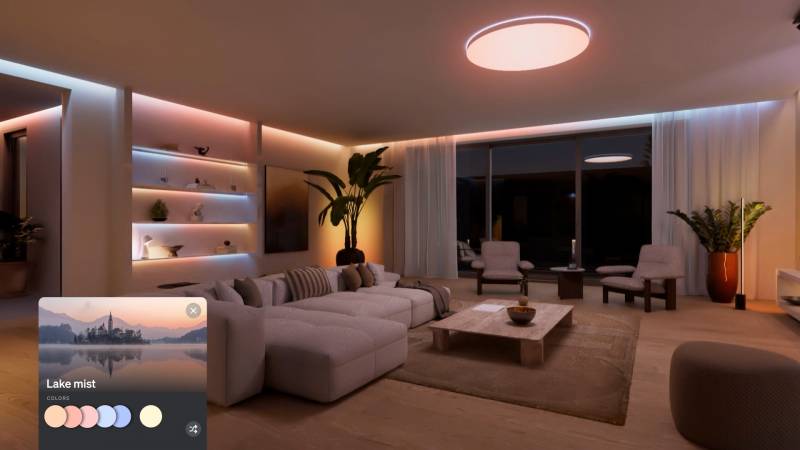
Today, Philips Hue lets you apply preset scenes like Savanna sunset, Lake Placid, or Mountain Breeze, but those scenes don’t actually know where your lights are placed. Hue SpatialAware changes that by understanding the physical layout of your room and the exact positions of each light, then intentionally distributing colors and brightness across the space.
Setup is refreshingly straightforward. Using augmented reality and the camera on your phone or tablet, the Hue app guides you through scanning the room to map where each light lives. Once that’s done, SpatialAware uses an algorithm to orchestrate scenes across all your lights so they work together in harmony. Ask for a sunset scene, and instead of every bulb doing the same thing, lights on one side of the room glow with warm, sunlit tones while others fade into deeper shades, creating a more natural, immersive effect.
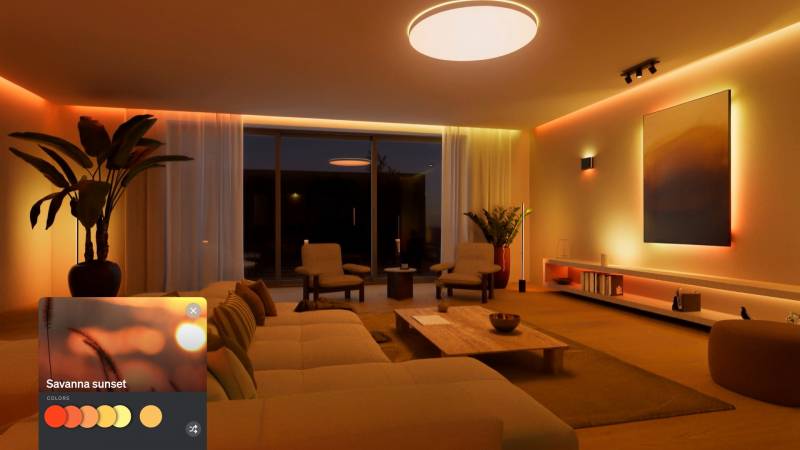
You’re not locked into your first layout either. If you add new lights or rearrange a room, a quick rescan updates the spatial model so scenes continue to flow correctly. It’s mood lighting that finally understands the room it’s in, which feels like a subtle but meaningful leap forward.
Hue SpatialAware is designed primarily for nature-inspired scenes and will be compatible with about half of the remastered options in the Scene Gallery at launch. When the feature rolls out, users will be able to choose between an optimized SpatialAware version of a scene or revert to the current, non-spatial mode.
There are plenty of other Hue updates on the way as well. Philips Hue is expanding Apple Home support to include the wired Hue Secure camera, the Secure video doorbell, and Hue contact sensors. In the coming months, users will be able to stream live camera feeds in Picture-in-Picture mode on Apple TV and receive real-time alerts through the Apple Home app.
The Hue Bridge Pro is also getting more flexible. Users can now migrate multiple Bridges to a single Bridge Pro during installation or later, as long as capacity allows. On the software side, the AI assistant is becoming more capable, supporting the creation of automations using natural language, such as setting different wake-up times on specific days. Troubleshooting support is also expanding to include Dutch, German, and Spanish.
Finally, Philips Hue is improving how content is displayed in Rooms and Zones within the app, making it easier to see and adjust automations for specific spaces and personalize how those screens are organized.
Hue SpatialAware will be available to Bridge Pro users in spring 2026. Expanded Apple Home support and the improved app visualization are expected in the first quarter of 2026, while AI-powered automations and multi-Bridge migration are already rolling out. If this is the direction smart lighting is headed, it’s less about flashy tricks and more about lights that finally know what they’re doing.