
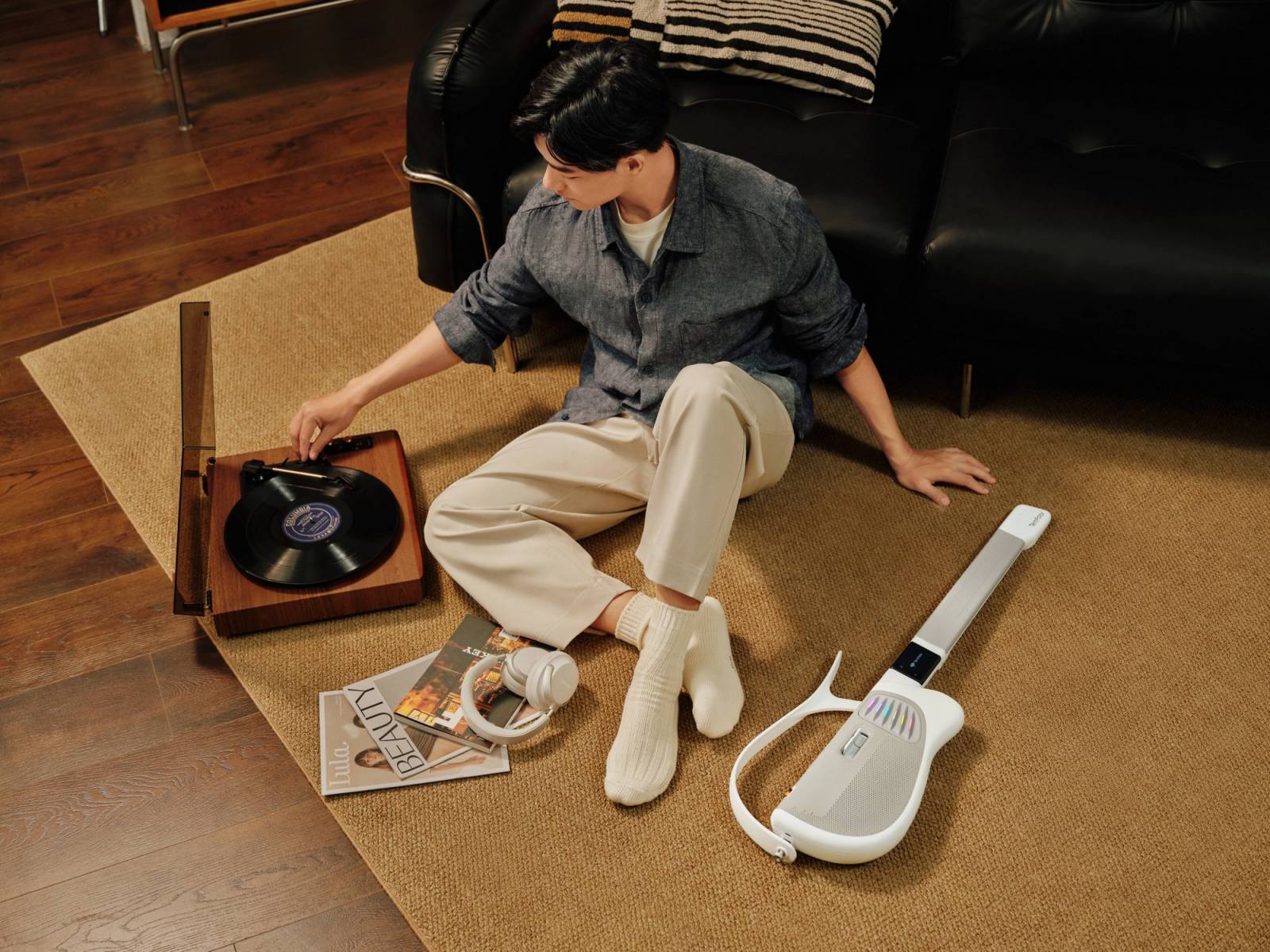


The TemPolor Melo-D is a foldable generative AI guitar aimed at people who have musical ideas but not necessarily the finger strength, theory background, or patience to wrestle with a traditional instrument. The company is pitching the TemPolor Melo-D as the world’s first generative AI guitar, capable of turning humming, text prompts, style tags, chord progressions, and uploaded audio into original songs or playable guitar parts. That’s a big claim, and the real test will be how musical the results feel, but the concept is easy to understand: make songwriting and guided playing less intimidating.

A Guitar Built for People Who Haven’t Learned Guitar
Melo-D isn’t trying to replace a Martin, Fender, or Taylor hanging on the wall of someone who already knows their way around a fretboard. It’s closer to a smart music creation device shaped like a travel guitar, designed for people who want to make something musical without starting at the usual square one: sore fingertips, awkward chord shapes, and the quiet terror of music theory.

The instrument uses TemPolor’s TemPolor.AI engine to turn simple inputs into music. Hum a melody, and Melo-D can convert it into a guitar solo. Type in a text prompt, and it can generate a full song with arrangement, lyrics, and AI vocals. Start with a chord progression, and Melo-D can build that into a more complete track. That won’t automatically make anyone a songwriter, of course. A generated song still has to be worth listening to, and “AI vocals” can be a mixed bag. But for someone who has an idea and no easy way to sketch it out, Melo-D could be a useful bridge between inspiration and a listenable demo.

That’s probably the most interesting part here. Melo-D seems less like a shortcut to musicianship and more like a way to reduce the friction of experimentation. If you’ve ever hummed a melody into your phone and then forgotten what you meant to do with it, this is the kind of product that’s clearly chasing you.
The Touchscreen Means It Doesn’t Need Your Phone for Everything
Melo-D has a built-in 2.4″ LCD touchscreen, so its core features don’t depend on keeping a phone attached. That matters because many “smart” instruments become less charming the moment they require an app, an account, a Bluetooth pairing ritual, and three firmware updates before you can play a C chord.
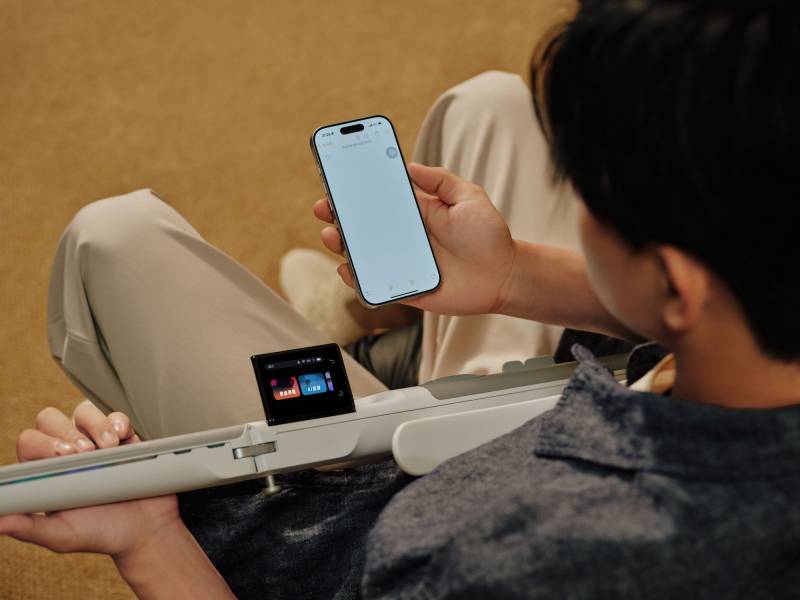
The screen handles mode selection, visual guidance, lyric display, and chord information. TemPolor also built in light-guided play through its RGB Rainbow Strings, which aim to preserve the physical feel of strumming and picking while providing visual cues for what to play. Instead of staring at a chord chart and hoping your hand has become fluent in geometry, you can follow along as the instrument shows you where to go.

For learning, Melo-D includes a Rhythm Game Mode with real-time scoring. There’s a 7-chord beginner mode and a 21-chord advanced mode, so the experience can start simple without staying stuck there. The gaming angle could sound gimmicky, but it makes sense. Beginners often quit because practice feels vague and unrewarding. A score, a clear target, and visible feedback can turn “I’m bad at this” into “I missed that beat, let me try again,” which is a much healthier place to be.
It Can Turn Songs Into Tabs, Assuming the Transcription Holds Up
One of Melo-D’s more practical features is AI Tab. You can paste a song link or upload an audio file, and the instrument can transcribe it into fingerstyle tabs or chord charts in under 60 seconds. Tabs are a simplified way to show where to place your fingers on the strings, rather than asking you to read traditional sheet music. Chord charts show the chord changes so you can strum along.

That could be genuinely helpful for casual players, especially if you’re the sort of person who wants to play along with a favorite song without falling into the swamp of random internet tabs. The caveat is accuracy. Automatic music transcription is hard, especially with dense arrangements, unusual tunings, layered vocals, or muddy recordings. If Melo-D handles straightforward pop, folk, and acoustic tracks well, that may be enough for its target audience. If it promises studio-level transcription from any audio file, eyebrows should remain politely raised.
Foldable Hardware Makes the Portability Claim More Believable
The physical design is unusually travel-friendly. Melo-D uses a patented mechanical hinge that lets it fold down to 18.4″, compact enough to fit into a standard backpack without disassembly. Folded, it measures 468.5 × 243 × 81mm, and unfolded, it measures 894.5 × 274.5 × 81mm. It weighs 2.2kg, or about 4.85 pounds, so it’s portable in the “throw it in a backpack” sense, not the “forget it’s there” sense.

The materials include PC+ABS plastic, stainless steel, and aluminum alloy. That combination suggests TemPolor is balancing weight, durability, and cost, though long-term hinge reliability is one of those questions that only extended use can answer. Folding instruments are clever right up until the folding part becomes the weak link.
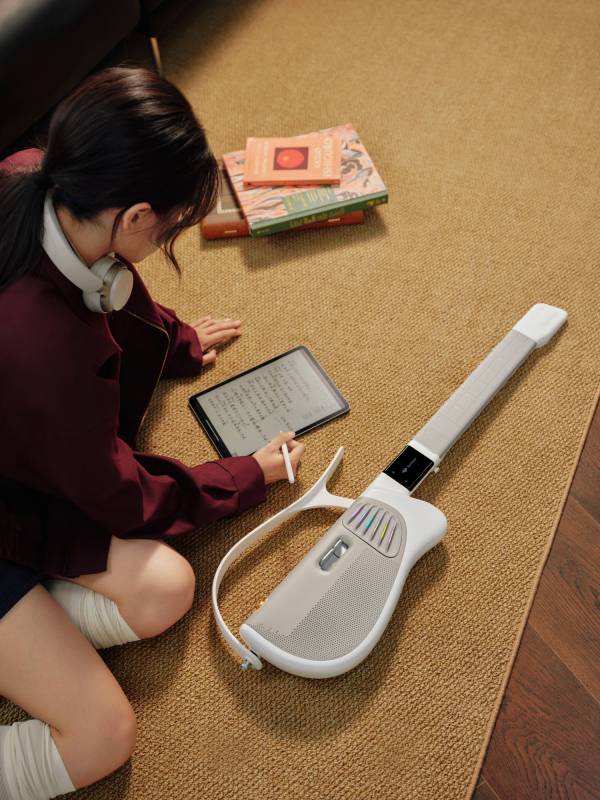
Battery life is rated at more than 5 hours with the internal speakers and more than 10 hours with external output. Charging takes about 2.5 hours over USB-C. Those numbers should cover practice sessions, travel, and casual songwriting without making the charger a constant companion.
Ports, Audio, and Updates Give It Room to Grow
Melo-D includes Wi-Fi 4 for cloud-based AI updates and over-the-air software and firmware updates. It also supports Bluetooth 5.0 for connecting to external speakers or devices, two USB-C ports, a 3.5mm headphone jack, and a 3.5mm wireless microphone jack.
One USB-C port is for charging, while the other supports OTG, or “On-The-Go,” which lets compatible devices exchange data directly. Here, that matters for real-time audio transmission and digital recording. In plain English, Melo-D should be able to send audio out digitally for recording instead of forcing you to capture sound through a microphone in the room.

The built-in audio system uses DSP, or digital signal processing, to shape the sound. DSP is software-based audio tuning, the same broad idea behind many smart speakers and compact audio products that sound bigger than their size suggests. The spec sheet lists “20W maximum” audio output while also referencing a 10W tweeter and 20W woofer, so that’s one detail worth confirming before retail launch. Melo-D also includes 10 built-in tones, including Acoustic, Electric, Piano, Guzheng, and Drums, with tone updates through DFU, or device firmware update. Rhythm patterns start at more than 160 and can be expanded through future updates.
A Kickstarter Launch with the Usual Caveats
Melo-D is now on Kickstarter, where early backers will have several pledge options. The $399 TemPolor Melo-D in Pearl White is listed as saving backers $200 and includes one Melo-D for people who want to start playing songs, explore ideas, and create music with guided support from the first touch. TemPolor says early backers in the US and Canada will receive free shipping on that Pearl White tier.

There will also be a Kickstarter-exclusive Obsidian Black version. The $415 Melo-D in Obsidian Black is listed as saving backers $214 and offers the same core instrument in the campaign-exclusive finish. That tier also includes free shipping for early backers in the US and Canada.
TemPolor is also offering two US-exclusive Father’s Day bundles that include a guitar stand. The $428 Father’s Day Special includes one Pearl White TemPolor Melo-D and one guitar stand, with TemPolor listing the savings at $230. The $439 Father’s Day Offer includes one Obsidian Black TemPolor Melo-D and one guitar stand, with the listed savings increasing to $249. Both Father’s Day bundles are US shipping only, which is worth noting before anyone outside the US gets too attached to the gifting angle.
For households, collaborators, or anyone who likes the idea of learning with someone else, TemPolor will also offer double-pack tiers. The $788 Double Pack includes two Pearl White TemPolor Melo-D AI guitars and is listed as saving $410, while the $819 Kickstarter Exclusive Double Pack includes two Obsidian Black Melo-D units and is listed as saving $439. Both double-pack options include free shipping for early backers in the US and Canada.

As always with Kickstarter, the most important buying advice is the usual refrain: back the idea only if you’re comfortable with some uncertainty. Crowdfunding isn’t the same as buying from a store, even when the product looks polished, and “savings” claims are best treated as campaign context rather than guaranteed future street pricing.
TemPolor notes that Melo-D was developed by the R&D team behind Tunee and has already received design recognition, including the iF Design Award 2026, MUSE Design Award Gold, and London Design Award Gold. The instrument carries a 1-year manufacturer warranty and lists certifications including CE LVD, CE RED, RoHS, REACH, FCC ID, FCC SDOC, UN38.3+MSDS+DGM, CA65, and SRRC.
For beginners, creators, and travelers who want a portable way to sketch songs, practice chords, or turn a hummed idea into something more structured, Melo-D could be compelling. Whether it feels like an instrument, a songwriting assistant, or a very clever gadget will depend on how well the AI, guided play, and hardware hold together once people start using it outside a demo video.