


The Lowdown
The ROKR Dinosaur Lab Pinball is a smart piece of design that does something we haven’t seen done well at this price. It looks great, it sounds better than it needs to, and the mechanical bumper is a small piece of over-engineering that we appreciate every time it fires. The DINOSAURS scoring system is the one place where the design gets in its own way, and adding a real score display would push this from very good to excellent.
Overall
Pros
- Working mechanical bumper that actively kicks the ball back into play
- Fun, spooky Jurassic Park-style music that doesn’t get old
- Excellent sound effects and lighting
- Looks great on a desk and even better in a dark room
- Two game modes with genuine mission progression
- Solid build quality with real flippers and clean ramps
- USB-C powered with no batteries required
- Multiple volume levels including silent mode
- Reasonable $120 price for a build project plus a working game
- Appeals to both kids and adults
Cons
- DINOSAURS light-up letter scoring is harder to read than a numeric display
- No high-score tracking, so there’s nothing to chase between games
- No multiball
- Requires constant USB-C power to function at all
- The best version of this experience is probably building it yourself, which our pre-assembled sample didn’t allow us to evaluate
ROKR has taken its model-kit expertise and pointed it at something most people don’t expect from a 3D puzzle company: a working pinball machine. The ROKR Dinosaur Lab Pinball MGP01 is a 319-piece kit that turns into a fully playable desktop pinball game with mechanical flippers, a real bumper that fires the ball back at you, lighting effects, and a soundtrack that borrows liberally from a certain island theme park movie.
ROKR sent us a fully assembled sample, so we can’t speak to the build itself, but we can tell you the finished machine is a lot of fun. Our one real complaint is the scoring: it’s tracked with light-up letters instead of a digital readout, which makes it harder than it should be to see where you stand or brag about a high score afterward.
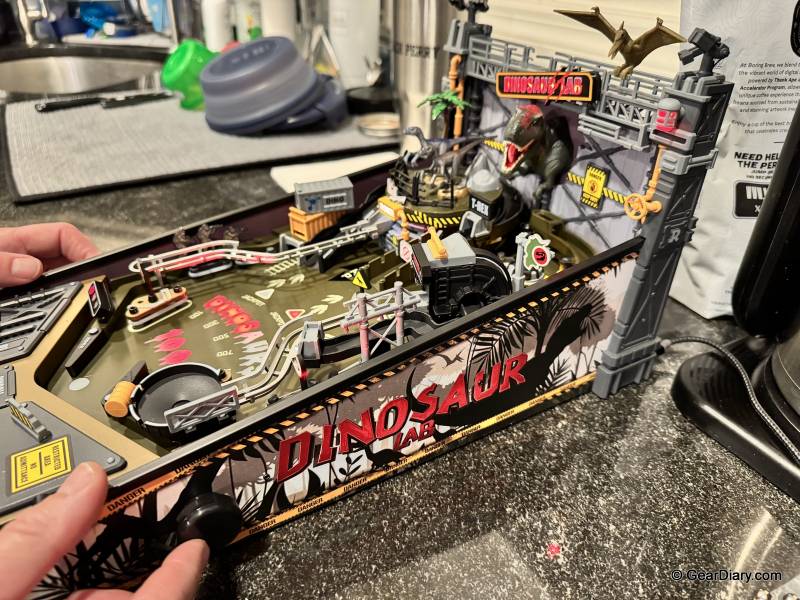
ROKR is best known for intricate wooden model kits — typewriters, marble runs, music boxes, the kind of things that might end up on a shelf looking impressive. The Dinosaur Lab Pinball MGP01 is a different proposition. You still build it, but when you’re done you have something you can actually use instead of dust.
The premise is straightforward: a T. rex has escaped the island lab, alarms are going off, and your job is to bring the situation under control one shot at a time. It’s the sort of setup that works because it doesn’t overexplain itself. The lab flashes red, the music turns ominous, and you start flipping.
ROKR ran the Dinosaur Lab Pinball on Kickstarter from June 9 through July 9, 2026, where it closed with 4,063 backers and $450,994 pledged against a goal of roughly $25,000. Retail availability on ROKR’s site is expected in late August 2026; late pledges are still being accepted on Kickstarter for about $120.
One important note up front: ROKR sent us a pre-assembled unit rather than a kit. That’s a meaningful caveat for a product where assembly is half the pitch, so treat everything below as an assessment of the finished machine and how it plays.
Quick Specs:
- Model: MGP01
- Piece Count: Approximately 319
- Estimated Assembly Time: 5–6 hours
- Assembly: Snap-fit and screws, glue-free, no soldering, tools included
- Materials: ABS plastic, high-density fiberboard (HDF), metal components
- Dimensions: 240mm W x 380mm D x 215mm H (approx. 9.4″ x 15″ x 8.5″)
- Power: USB-C (no batteries)
- Gameplay: Mechanical flippers, multi-lane ramps, targets, mechanical bumper
- Scoring: Automatic electronic scoring, tracked via illuminated letters
- Game Modes: Easy (casual scoring) and Hard (mission-based with final showdown)
- Multiball: No — single-ball play
- Audio: Multiple volume levels including silent mode
- Recommended Age: 14+
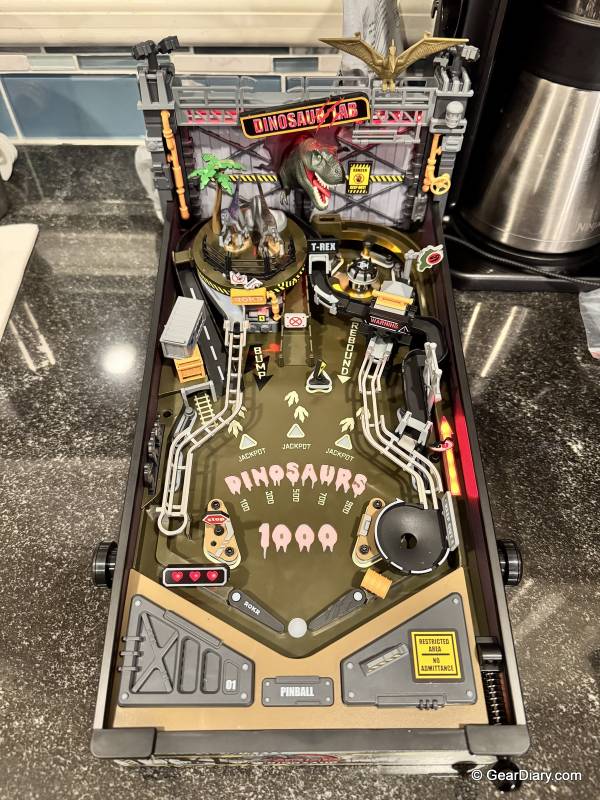
The finished machine is genuinely good-looking. It’s roughly 15 inches deep and about 8.5 inches tall at the backbox, so it takes up about the footprint of a large hardcover book stood on a desk. Small enough to leave out, big enough to feel like an object rather than a toy.
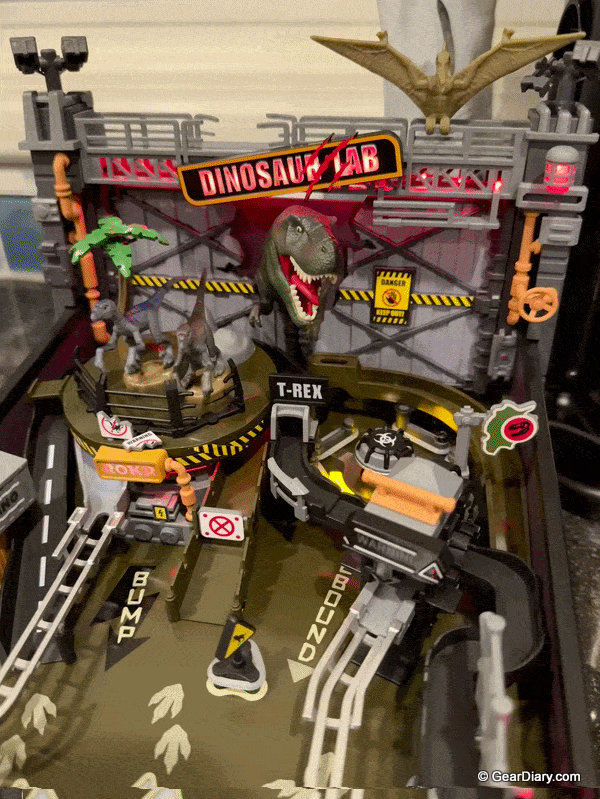
The construction is a mix of ABS plastic for the themed elements, HDF board for the structure, and metal where the mechanics need strength. The playfield is dense with detail — lab structures, foliage, dinosaurs positioned around the ramps — and the whole thing reads as a diorama that happens to have flippers attached. Turn the lights down, and it looks even better, with the illuminated signage and playfield elements doing a lot of work.
Nothing about it feels cheap, which matters at the $109.99 asking price. The flippers have a satisfying snap, the ball rolls true, and the ramps guide cleanly without the ball hanging up in odd places.
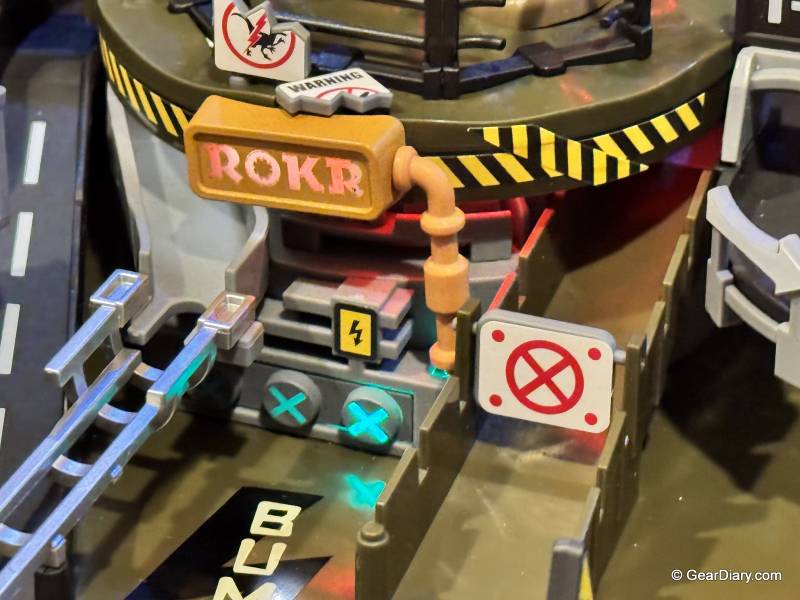
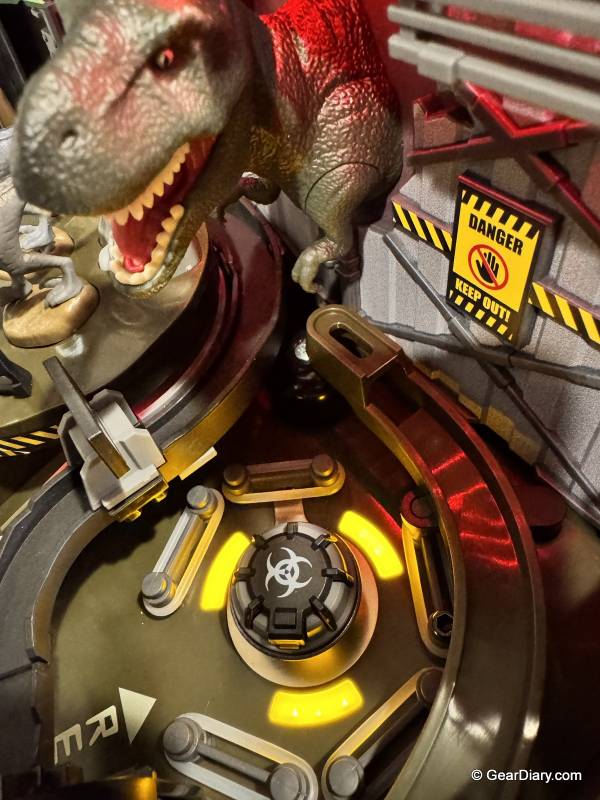
There’s a working mechanical bumper on the playfield, and it’s the detail that sells the whole thing. This isn’t a passive rubber post that the ball bounces off. It actively kicks the ball back into play with a real thump, exactly like the bumpers on a full-size machine.
It’s a small piece of engineering that ROKR absolutely did not have to include, and it changes how the game feels. Shots that catch the bumper get unpredictable in a good way, and there’s a physical, tactile payoff every time it fires. If you’ve spent time on real pinball machines, this is the moment where you realize the Dinosaur Lab isn’t just a themed marble run with lights.
There are two modes. Easy mode is the casual option, where you’re trying to hit 1,000 points before your health runs out. It’s the mode you’ll start with while you learn where the shots are and how the ball behaves coming off the ramps.
Hard mode is where it gets interesting. You’re working through timed missions with six specific targets to hit, and clearing the objectives triggers a final showdown sequence. It gives the game actual progression instead of just accumulating points, and it’s why the ROKR Dinosaur Lab Pinball holds up past the first evening.
We played it on and off for about three weeks. It’s a single-ball game — no multiball — which keeps things simpler than a real machine, but the mission structure fills that gap. Ramps become escape routes, the bumper becomes a collision, and the lights function as alarms telling you where to shoot next. It hangs together better than we expected from a kit at this price.
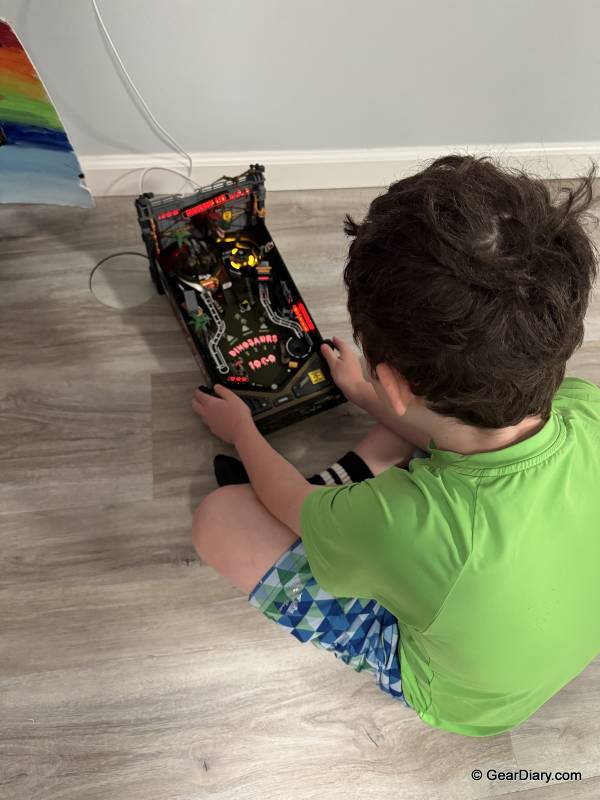
Where the ROKR Dinosaur Lab Pinball really shines is as a shared object. It’s the kind of thing that sits on a desk or a game room table and gets picked up whenever someone walks past it. Hand it to a kid, hand it to an adult who grew up on arcade pinball, and both of them will play a round.
The audio is a highlight. The music is fun and appropriately spooky, and it leans hard into Jurassic Park territory in a way that made us smile rather than roll our eyes. The sound effects are well done too — alarms, hits, mission cues — and they layer in without turning into noise.
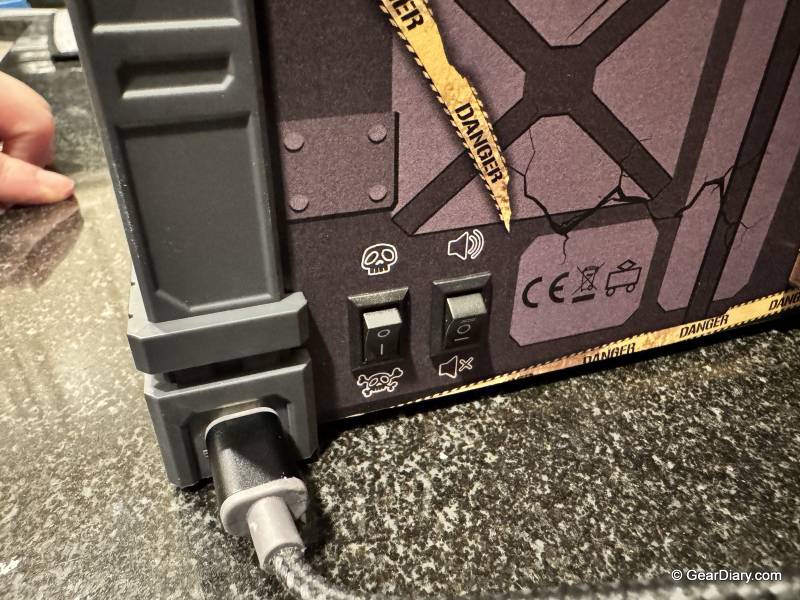
The real test of a machine like this is whether the audio gets annoying by the tenth game. It doesn’t. Three weeks in, we still had it turned up. That’s not nothing for a product with a looping soundtrack. If you do want it quieter, there are multiple volume levels including a silent mode, though the mechanical sounds of the ball and flippers will keep going regardless.
The lighting is equally well done. The playfield elements illuminate to guide you toward mission targets, and the whole machine glows in a dark room. It’s part of why this doubles as a display piece when nobody’s playing it.
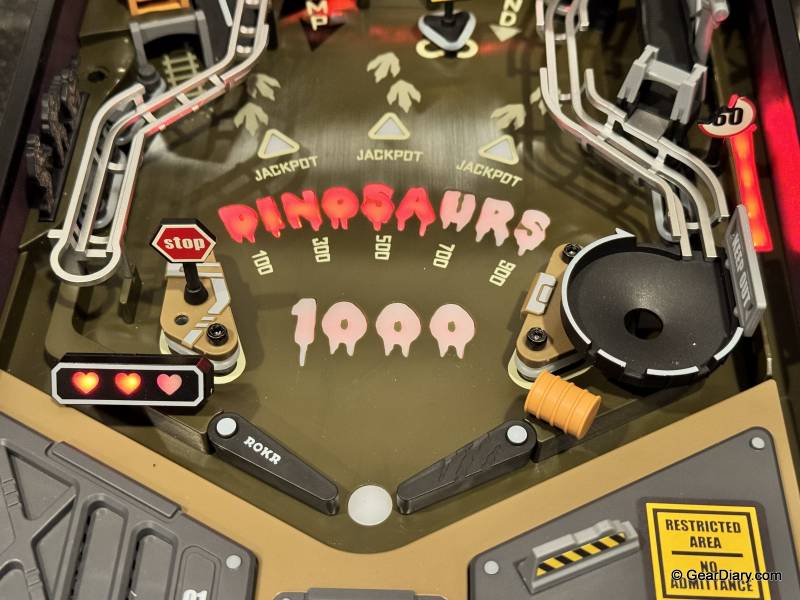
Here’s our one real minor complaint. The Dinosaur Lab tracks your score using light-up letters that spell out DINOSAURS across the machine. As you rack up points, letters illuminate.
It works, and it’s a clever bit of design that fits the theme. But it’s harder to read at a glance than a straightforward numeric display, and you never have a precise number in front of you. Mid-game, you’re squinting at letters trying to work out how close you are to the next milestone rather than just glancing at a score.
The bigger issue is what it means for replay value. There’s no high-score tracking, so there’s no way to say “beat 8,400” when you hand the machine to someone else. A simple LCD or LED segment display showing a running score, plus a stored high score, would transform this from a fun thing you play into a competitive thing you keep coming back to. As it stands, every game exists in isolation.
For a first-generation product, we’ll take it. But if ROKR does a version two, this is the single change that would matter most. Even if there is an add-on designed for it, that would be amazing.
We have to be honest about what we can’t tell you. ROKR sent us a fully assembled sample, so we didn’t put the machine together ourselves, and the build is arguably the main event here.
What we can say is that ROKR has published the following parameters: roughly 319 pieces; an estimated five to six hours of assembly; snap-fit and screw construction with no glue and no soldering; and all the required tools in the box. ROKR rates it for ages 14 and up, which tracks with a kit that includes electronic components alongside the mechanical assembly.
Based on our time with the finished product, we suspect building it is the better version of this experience. Assembling a machine over an afternoon and then immediately playing it is a fundamentally more satisfying arc than having one show up ready to go. If you’re buying this, buy the kit and build it — ideally with someone else. We’d expect that to be where most of the value lives.
The ROKR Dinosaur Lab Pinball runs on USB-C, which is the right call. No batteries to replace, and you can power it off a phone charger, a laptop, or a battery bank if you want to move it somewhere without an outlet nearby.
The tradeoff is that it needs power to do anything. The lights, sound, and scoring all depend on it, so there’s no unplugged mode where you just flip the ball around. Plan for a cable running to wherever you put it.
You’ll probably be happy with the Dinosaur Lab if you enjoy model kits and want one that stays useful once it’s finished. At $109.99, you’re getting a five-to-six-hour build project and a working pinball machine with real flippers, a functioning bumper, lighting effects, a great soundtrack, and two modes with actual mission structure. For a parent-and-kid weekend project that turns into a game you both play afterward, it’s hard to argue with.
You might regret buying it if you’re expecting anything close to real pinball. There’s no multiball, the playfield is small by necessity, and the scoring system will frustrate anyone who wants precise numbers and a leaderboard. If competitive high-score chasing is the reason you’d buy a pinball machine, this isn’t going to scratch that itch.
The ROKR Dinosaur Lab Pinball is a smart piece of design that does something we haven’t seen done well at this price. It looks great, it sounds better than it needs to, and the mechanical bumper is a small piece of over-engineering that we appreciate every time it fires. The DINOSAURS scoring system is the one place where the design gets in its own way, and adding a real score display would push this from very good to excellent.
The ROKR Dinosaur Lab Pinball (MGP01) will launch on ROKR’s website in late August 2026; It is still available now for late pledges on Kickstarter at approximately $120.
Source: Manufacturer-supplied review sample (fully assembled)
What I Like: Working mechanical bumper that actively kicks the ball back into play; Fun, spooky Jurassic Park-style music that doesn’t get old; Excellent sound effects and lighting; Looks great on a desk and even better in a dark room; Two game modes with genuine mission progression; Solid build quality with real flippers and clean ramps; USB-C powered with no batteries required; Multiple volume levels including silent mode; Reasonable $120 price for a build project plus a working game; Appeals to both kids and adults
What Needs Improvement: DINOSAURS light-up letter scoring is harder to read than a numeric display; No high-score tracking, so there’s nothing to chase between games; No multiball; Requires constant USB-C power to function at all; The best version of this experience is probably building it yourself, which our pre-assembled sample didn’t allow us to evaluate