
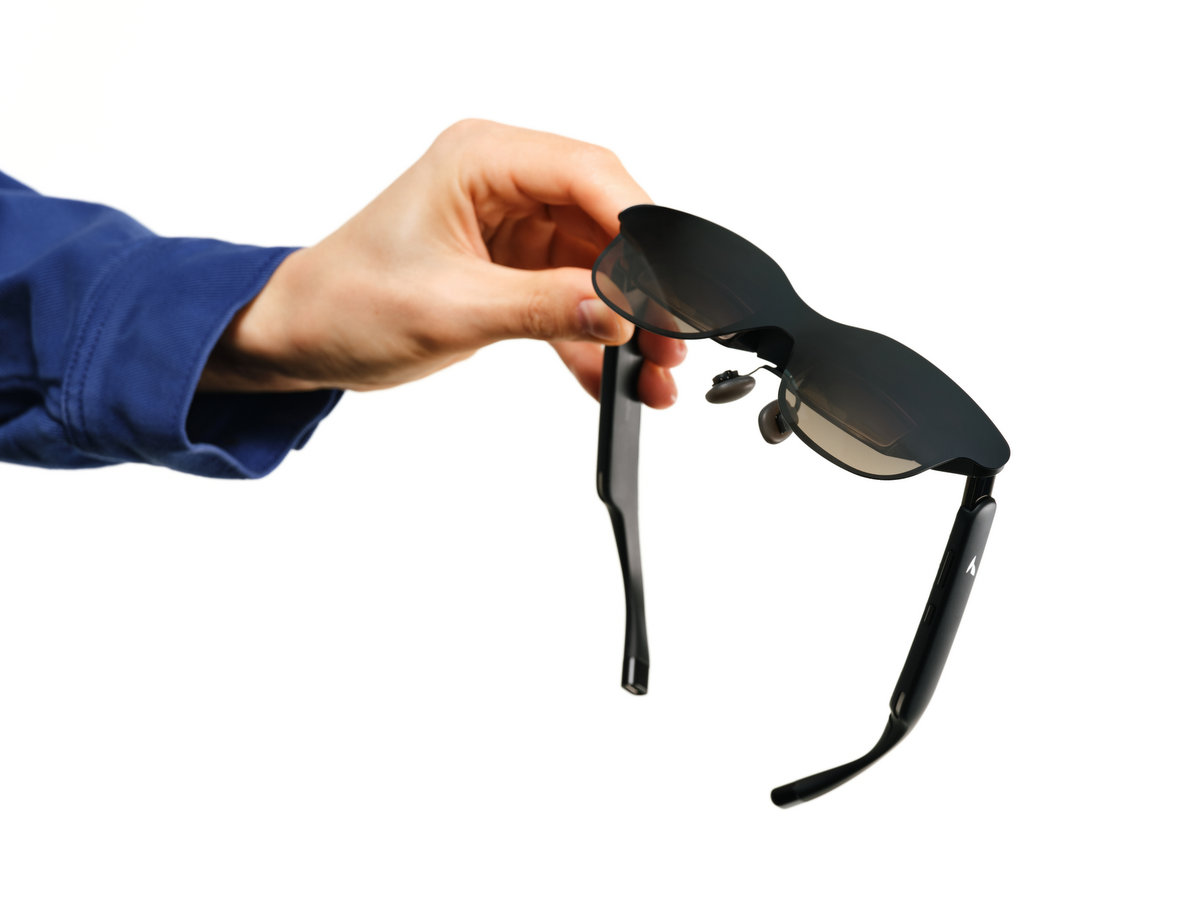


RayNeo is heading to IFA 2026 with a smart glasses lineup that’s less interested in finding one pair to do everything than in splitting the job three ways. The RayNeo iO Smart Glasses focus on lightweight, glanceable information and translation, while the RayNeo GT and GT Max aim at private big-screen entertainment. A new Pocket TV Pro supplies Google TV and Dolby Vision playback for the GT models. Together, the products cover work, travel, presentations, gaming, and streaming, though each asks you to accept a different balance of weight, visibility, battery life, and price.

RayNeo iO Smart Glasses
One Pair for Work, Two Pairs for Movies
There’s a certain logic to RayNeo’s decision not to cram every conceivable smart glasses feature into a single frame. The 33-gram RayNeo iO is meant to be worn for long stretches and quietly feed information into your peripheral vision. The 68-gram RayNeo GT and 78-gram GT Max are built around a much larger virtual display, quad-speaker audio, and spatial tracking for watching movies, playing games, or giving yourself a very large private screen while traveling.
According to Counterpoint Research’s first-quarter 2026 data, as cited by RayNeo, the company held 23.7% of the global consumer AR smart glasses market by shipment volume. The new models broaden that lineup in two rather different directions, rather than pretending that discreet work glasses and portable cinema glasses have exactly the same requirements.
That distinction may prove more useful than another pair of glasses promising to replace every screen you own.
The RayNeo iO Smart Glasses Keep Information in Your Peripheral Vision
The RayNeo iO Smart Glasses look more like conventional retro-inspired eyewear than a headset. Their 33-gram chassis uses a 50:50 front-to-rear weight distribution intended to keep the frames from feeling nose-heavy during longer sessions.


Inside is RayNeo’s 0.1cc Firefly Nano Engine, which uses a monochrome green MicroLED display and a 0.6mm diffractive waveguide. A waveguide is the transparent optical layer that carries projected information toward your eye without putting a conventional screen directly in front of it. RayNeo rates the viewing area at 97% optical transparency, with text capable of reaching 1,300 nits of in-eye brightness. The company also designed the projected information to remain difficult for people around you to see.
The iO isn’t trying to place a 300″ movie screen in front of your face. Instead, it’s meant for information that benefits from being visible without reaching for your phone, such as a translation, a reminder, a presentation prompt, or a meeting note.
Live translation supports 40 languages, while speech transcription covers 112 languages. An Auto-Teleprompter can follow your spoken presentation and advance text line by line, an appealing idea if your relationship with memorized talking points could best be described as complicated.
RayNeo’s Ambient AI Life Log runs in the background, tracking schedule information and conversational context. After a meeting, it can identify potential action items and suggest calendar updates, and you can confirm them with a head nod.
Core AI functions use RayNeo AI and Gemini 3.1 Flash Lite. An optional $9.99-per-month Multi-Model AI subscription provides access to ChatGPT 5.1, Gemini 2.5 Pro, Claude, and DeepSeek via the companion app. Whether access to several models is genuinely useful will depend on how much you enjoy choosing an AI assistant before asking the AI assistant to save you time.
Notably, the RayNeo iO Smart Glasses have no speakers. A four-microphone array handles voice input, assisted by a VPU bone-conduction sensor that detects vocal-cord vibrations to help separate your speech from surrounding noise. Control comes from a physical Smart Crown rotary dial on the right temple, as well as head gestures. A hardwired LED illuminates when microphones or translation features are active, giving nearby people a visible indication that listening functions are in use.
The GT and GT Max Go After the Big Screen
The RayNeo GT Series trades the iO’s lightweight, glanceable approach for much larger augmented reality displays. Both models use a Vision 4000 display chip alongside RayNeo’s Zone 360 3DoF chip.


Three degrees of freedom, or 3DoF, means the glasses can detect when you turn, tilt, or rotate your head. That allows the virtual screen to behave differently depending on the selected mode. Steady Mode reduces unwanted display movement during something like a train ride, Pinned Mode keeps the screen anchored to a position in virtual space, and Follow Mode keeps the image aligned with your view.
The 68-gram GT uses a birdbath-style optical system. This common AR design reflects display imagery through angled optical elements, with a 46-degree field of view and a virtual display of up to 231″. The 78-gram GT Max moves to RayNeo’s Peacock Optical Engine 3.0 Max, increasing the field of view to 59 degrees and the claimed virtual screen size to as much as 307″.
Those dimensions don’t mean there’s a physical 307″ television hovering in your hotel room, of course. They describe how large the image appears at a simulated viewing distance. Still, a broader field of view can make the difference between feeling as though you’re looking at a floating display and feeling more immersed in it.
Both GT models use four Bang & Olufsen-co-tuned speakers, with head-tracked spatial audio. Whisper Mode directs sound more narrowly toward the wearer to reduce how much escapes into the surrounding room, an important consideration when your seatmate on a six-hour flight has no interest in joining your movie.




The GT Max will also be offered in three physical interpupillary distance, or IPD, sizes. That measurement is the distance between the centers of your pupils, and aligning the optics correctly can improve clarity and comfort. Size S is intended for measurements below 64mm, Size M covers 64mm to 67mm, and Size L is for measurements above 67mm.
Both GT models support prescription lens inserts.
Pocket TV Pro Does the Streaming Heavy Lifting
RayNeo’s Pocket TV Pro is designed specifically as a companion to its glasses rather than as another standalone screen. It runs Google TV and connects to the GT Series to provide Dolby Vision playback, streaming apps, storage, and battery power without requiring a phone to handle everything.
Dolby Vision expands the range between dark and bright portions of an image while carrying scene-by-scene or frame-by-frame picture information. The Pocket TV Pro also supports real-time conversion of standard dynamic range (SDR) video to high dynamic range (HDR) content when used with the GT Series.
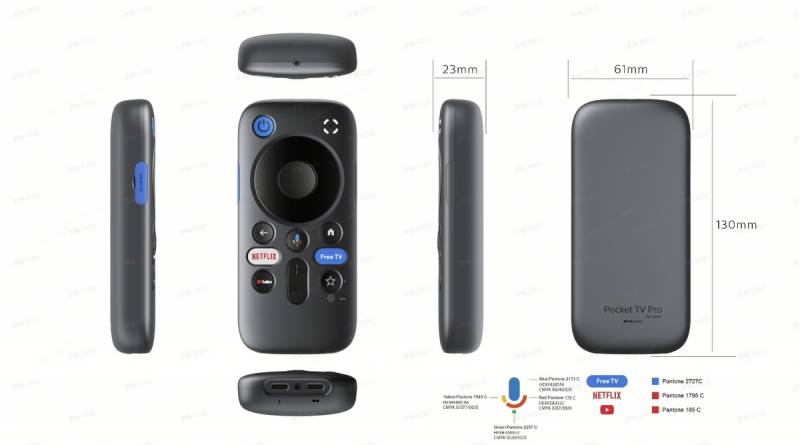
PocketTVPro
The device is built around an Amlogic S905X5M-J chipset with 3GB of DDR memory and 64GB of built-in eMMC storage. A microSD card can expand storage by as much as 2TB, which could be particularly useful if you’d rather load movies before a trip than gamble on airplane Wi-Fi.
The Pocket TV Pro supports Google TV apps including YouTube, Netflix, Prime Video, and Disney+. Its 6,500mAh battery is rated for up to 5.5 hours of continuous viewing.
Video support includes VP9 and H.265/HEVC content up to 4K at 60 frames per second, along with H.264 content up to 4K at 30 frames per second. Video output uses DisplayPort 1.2.
Dolby Vision playback is supported with the GT and GT Max. RayNeo Air 2 and newer Air-series glasses can also work with the Pocket TV Pro for SDR playback, but RayNeo notes that the device isn’t compatible with AR glasses from other brands. That closed compatibility is worth keeping in mind before treating the Pocket TV Pro as a universal pocket streaming box.
Pricing and Availability Leave One Big Question
The RayNeo iO Smart Glasses will come in Polar Night gray and Dune gold. The standard package is priced at $479, with a $30 launch discount bringing it to $449. A bundle with a charging case will cost $529. The iO is also officially MFi licensed for use with Apple devices.
RayNeo hasn’t disclosed pricing for the GT or GT Max yet. Those prices are scheduled to be announced when sales begin on September 4, 2026, and they’ll matter quite a bit in judging the appeal of the larger-screen models. Pocket TV Pro pricing wasn’t included in the announcement materials either.
RayNeo’s new lineup makes a reasonably sensible argument that smart glasses don’t all need to chase the same goal. The iO could appeal to someone who wants translations, prompts, and small bits of information without spending the day staring at a phone, while the GT Series targets people who want an enormous private display they can carry in a bag. Whether either approach earns a permanent place on your face will come down to comfort, software reliability, and, for the GT models in particular, the prices RayNeo is — so far, at least — keeping to itself.