


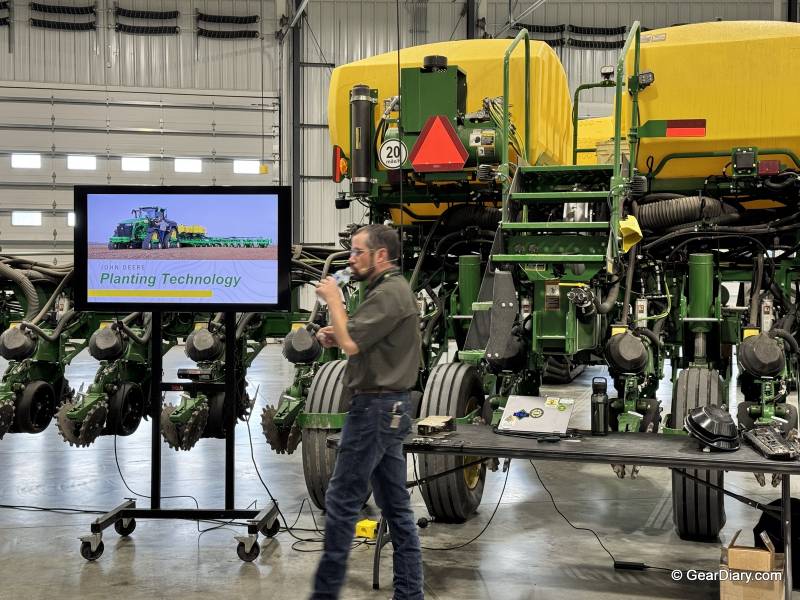
At John Deere‘s media day at the Agriculture Innovation Lab at Iowa State University, the headline was JD, the new AI assistant inside Operations Center. But an assistant is only as good as what it knows, and the more interesting half of the day was spent on the machines that do the knowing. Boom height sensors, cameras buried in the seed trench, combines that read the field ahead and decide how fast to drive. This is the layer underneath the announcement, and it is the part that explains why Deere increasingly resembles a technology company that happens to build tractors.
One phrase came up repeatedly across sessions, and it functions as the thesis for everything else: “if you can’t monitor it, you can’t control it.” Every product below is an answer to that sentence. Each one takes a variable that used to live in an experienced operator’s judgment — how high is the boom, how fast should I drive, did that seed land where I wanted it, even controlling the number of seeds dropped at once — and turns it into something a machine can measure continuously and act on immediately.
The judgment does not disappear. It gets encoded, scaled, and applied at a rate no human can sustain for a twelve-hour day.
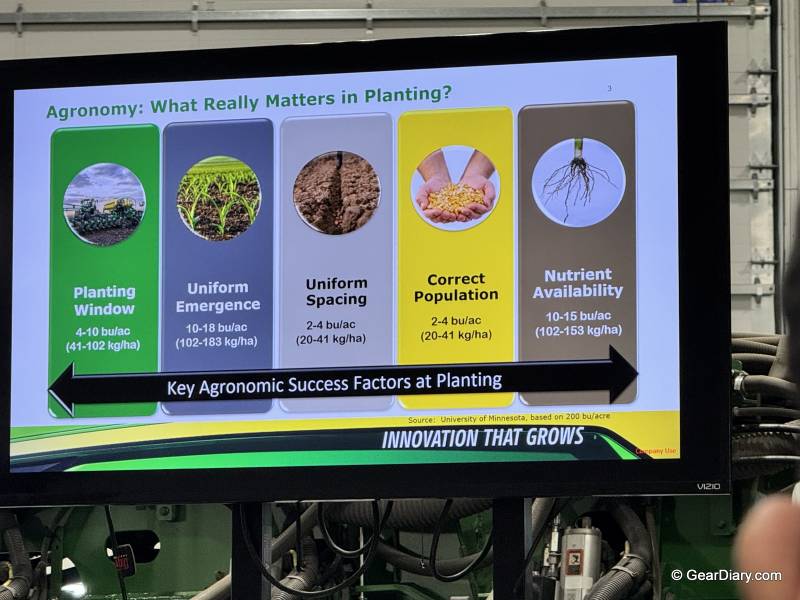
Forgetting whether an experienced operator can do it as well as John Deere’s technology is proving to perform; what happens when you can’t find the skilled labor to run these powerful and pricey machines? Skilled labor shortages are here, and they are serious. This advanced technology lets farmers hire temporary labor that may or may not be experienced in planting, herbicide application, harvesting, etc., while farmers focus on other tasks that may be more important at the time.
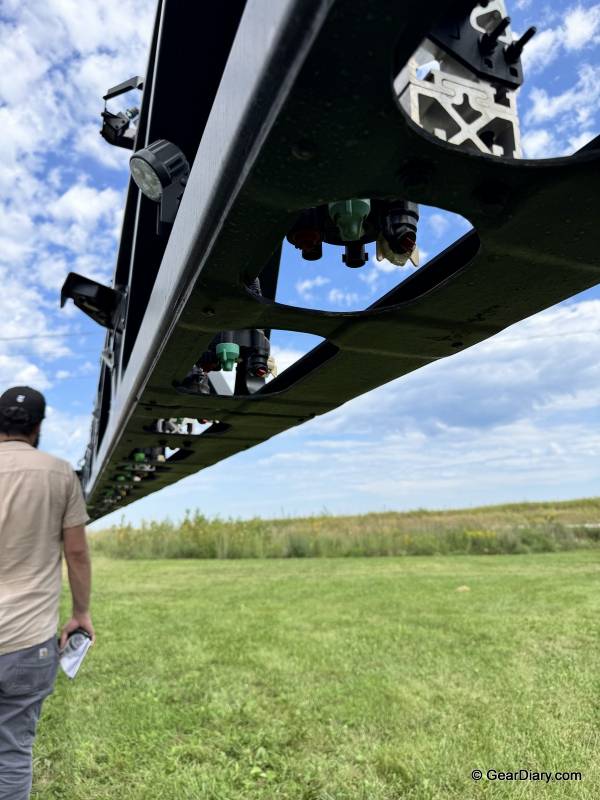
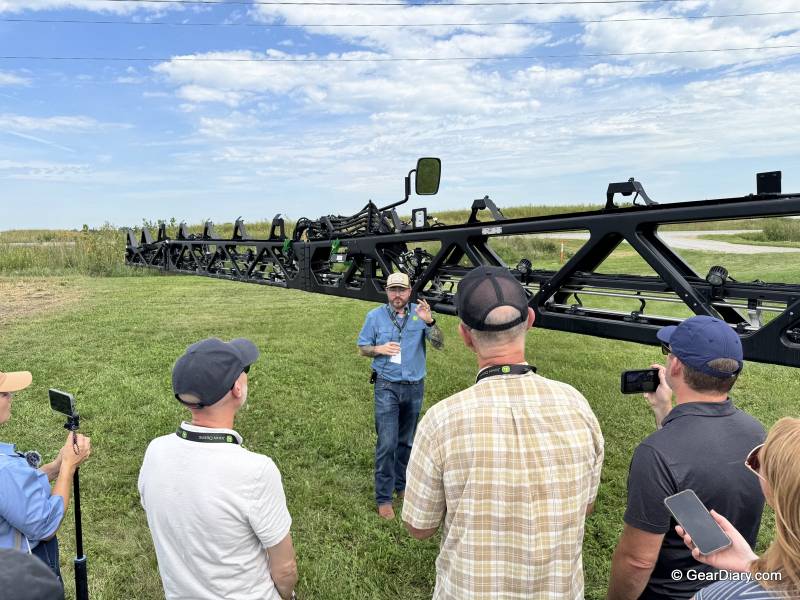
Let’s start with the simplest one, because it makes the pattern obvious. BoomTrac automatically keeps a sprayer’s boom arms at the correct height above the ground, sensing terrain and adjusting the boom as the machine moves. That sounds mundane until you consider what boom height controls.
Too high and the spray pattern widens, the droplets have farther to travel, and more of the chemical drifts off target — onto the neighbor’s field, into the air, anywhere but the plant it was bought for. Too low and coverage goes uneven, or you catch the ground.
A boom that maintains its correct height across an entire pass puts more of the product where it was aimed and less of it where it causes problems, which is simultaneously an environmental story, a regulatory story, and a cost story. Deere sells BoomTrac in both factory and retrofit forms, which matters more than it sounds like it should; a benefit available only on new machines reaches a fraction of the fields that could use it.
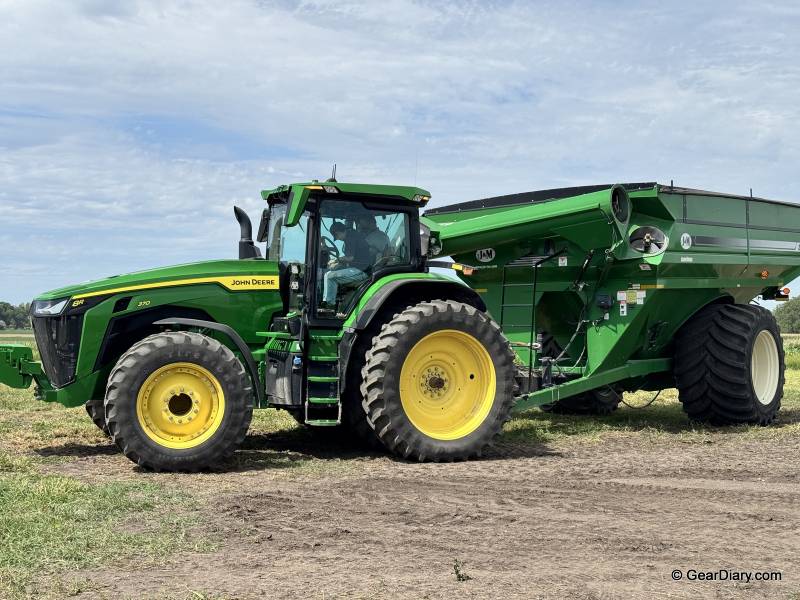
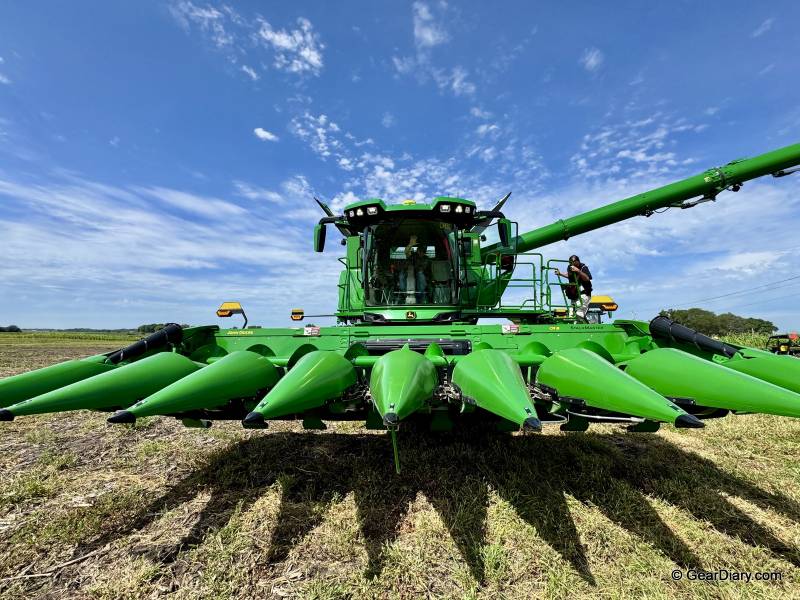
Harvest Settings Automation and Predictive Ground Speed Automation are the combine equivalents, and they are the clearest example of the day’s real theme: taking the expertise of a great operator and putting it into a model. Anyone who has run a combine knows that a good operator is constantly adjusting — concave clearance, fan speed, sieve settings — reading grain loss and sample quality and making small corrections all day.
Harvest Settings Automation makes those adjustments automatically, using crop type, geolocation, and operator-defined limits for grain loss and quality. The operator still sets the goalposts. The machine does the constant tuning inside them.
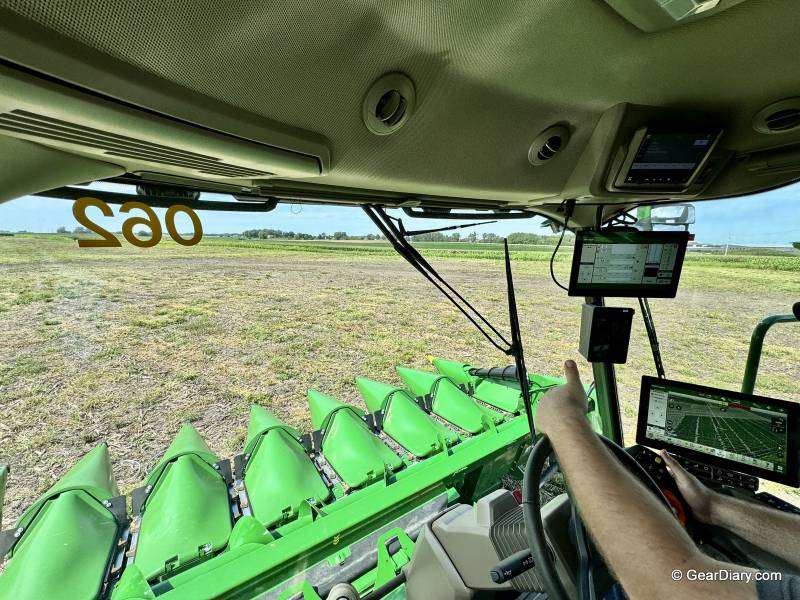
Predictive Ground Speed Automation handles the other variable: how fast to drive. It uses satellite data, terrain maps, and cameras to look ahead and adjust ground speed before the machine gets there, rather than reacting after the fact. Deere has described it as adaptive cruise control for a combine, which is the right analogy but undersells it slightly—adaptive cruise control reacts to the car ahead, while this is closer to reading the road a quarter mile out.
Newer versions add green crop detection, identifying green plant material inside a mature crop and slowing down for it, and let operators set throughput targets so speed decisions are tied to grain quality rather than raw acres per hour. The two systems now talk to each other instead of operating independently, which is when a collection of features starts behaving like a single automated machine.
I had the opportunity to ride inside a combine as well as the bin truck while the operator was driving using AutoTrac, and it was an amazing experience seeing the combine, for all intents and purposes, driving itself, even turning around by itself at the end of the row. In addition, the bin truck will automatically follow the combine, ensuring precise dumping of the harvest with no waste. The combine driver can even nudge the bin truck forward or backward as needed to fill the bin evenly.
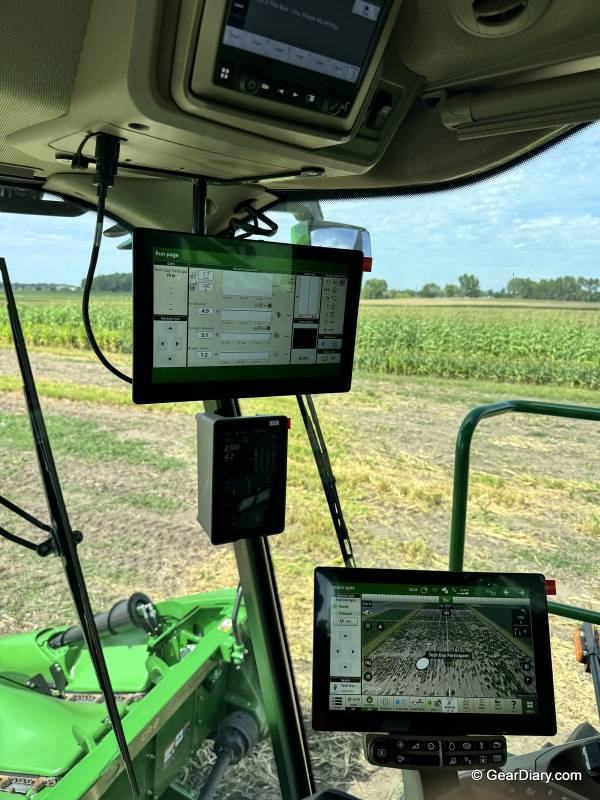
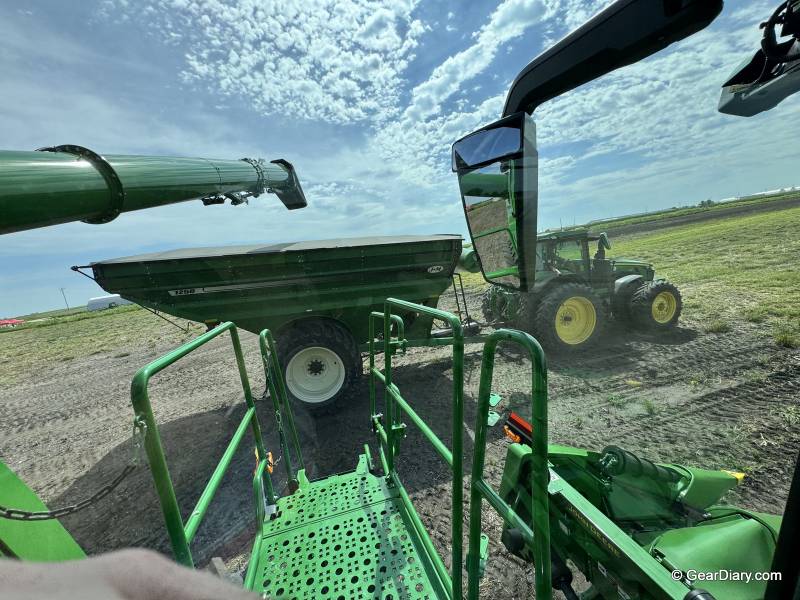
The value proposition is not that the automation beats the best operator on their best day. It is that it matches a very good operator continuously, at hour eleven of a long harvest, on a machine that might otherwise be running with a less experienced person in the seat. Labor availability is a real constraint on most operations, and a system that narrows the gap between the best operator on the farm and everyone else is worth serious money.
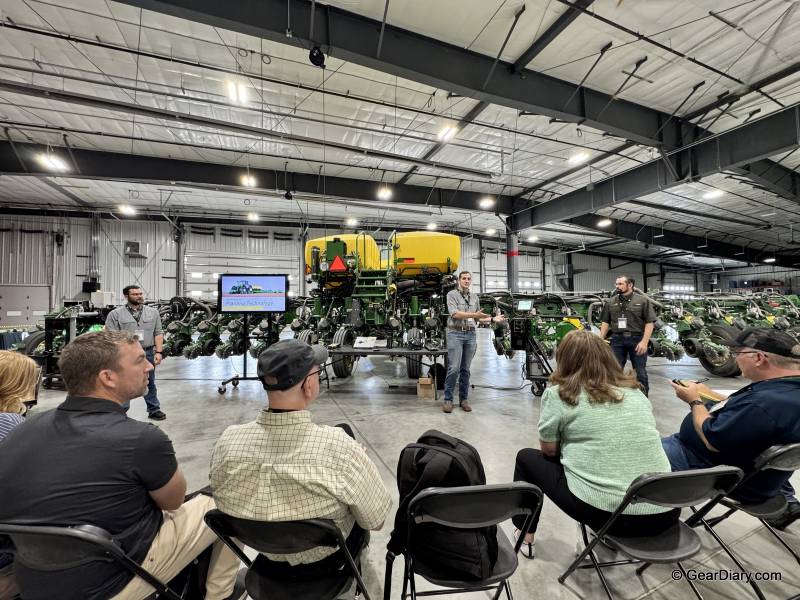
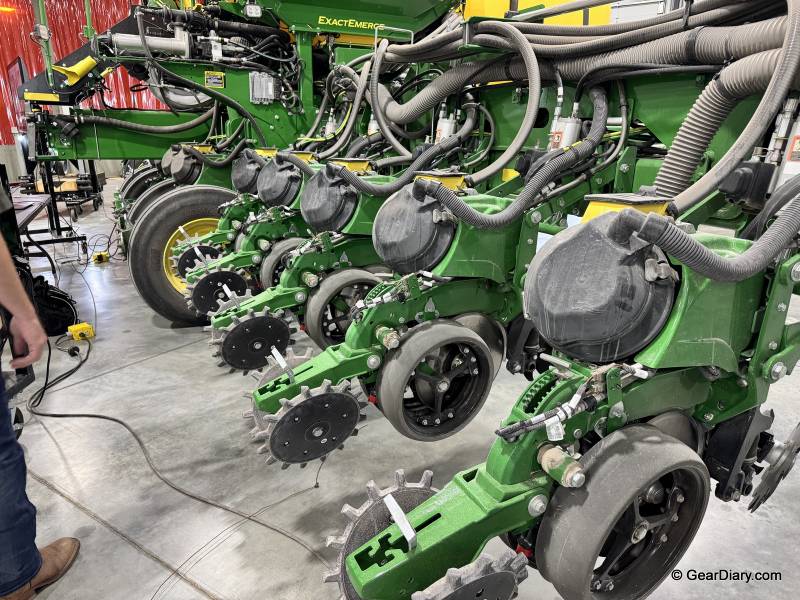
ExactEmerge is where the numbers get dramatic. It automates high-speed planting—seed spacing, depth, and placement—and does so at roughly double conventional planting speed, with Deere citing uniform seeding at 10 mph. The obvious reaction is that faster planting means sloppier planting, and ExactEmerge’s engineering point is that it doesn’t.
Their patented brush belt carries each seed down and releases it into the trench at a speed that cancels out the planter’s forward motion, so the seed is effectively placed rather than dropped into a moving furrow. We saw it in action at Iowa State University, and I was seriously impressed at how the seeds are dead-dropped, straight down into the furrow even at 10 mph.
What that buys is not only speed. It is calendar. Planting has a window; the window is set by weather and soil temperature rather than by anything a farmer controls, and every operation is trying to get an entire season’s acres into the ground during the handful of good days that window contains.
Doubling the rate at which you can plant properly means fitting substantially more of your acreage into the optimal stretch — the figure cited at the event was farmers getting roughly 80 percent more work done in the critical planting timeframe. That is not an efficiency improvement. It is risk reduction, and it applies to the single decision that most determines the year’s yield. Calling it game-changing for agriculture is one of the few times that phrase gets used accurately.
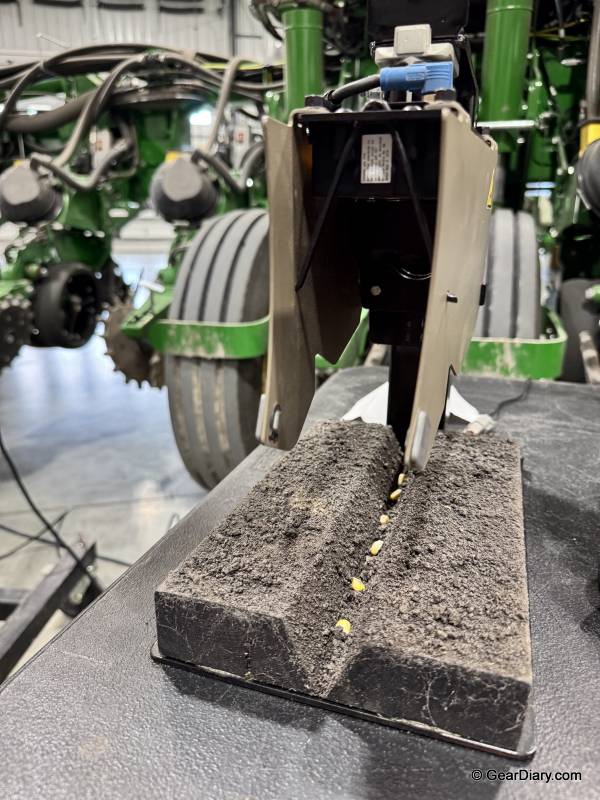
FurrowVision camera close-up
FurrowVision answers the question that high-speed planting immediately raises: how do you know it worked? The system puts 3D cameras and lasers in the seed trench itself, streaming real-time imagery to the cab so the operator can see seed placement, depth, seed-to-soil contact, and how much residue or debris is in the furrow — while planting, at speed, without stopping to dig.
The comparison offered at the event was to the invention of the X-ray for a suspected broken bone. Before, you inferred from symptoms and experience. After, you looked.
The practical consequence is that planter adjustment stops being a stop-and-check ritual and becomes a continuous, proactive process. If the trench looks wrong, you adjust row cleaners or downforce now, on this pass, rather than discovering the problem at emergence when the only remaining option is to feel bad about it.
There is also a longer game here, which Deere has been transparent about: once you can see the furrow, you can eventually automate the response to what you see, adjusting depth automatically for soil conditions and obstructions rather than surfacing it for a human to handle. At the lab, we saw FurrowVision in action, including it creating a furrow in test soil, and we could see the difference it makes.
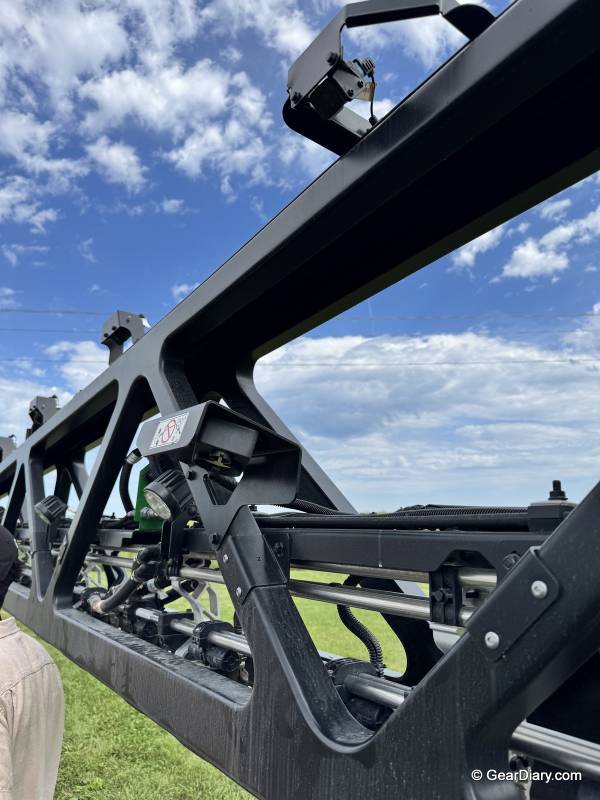
See & Spray was the most impressive demonstration of the day, and it is the easiest to explain to someone with no agricultural background. Cameras run the length of the Sprayer’s boom, scanning the ground continuously and distinguishing crop from weed in real time. Individual nozzles fire only where a weed actually is. Deere cites the system scanning more than 2,100 square feet of crop per second at speeds up to 15 mph, on booms up to 120 feet.
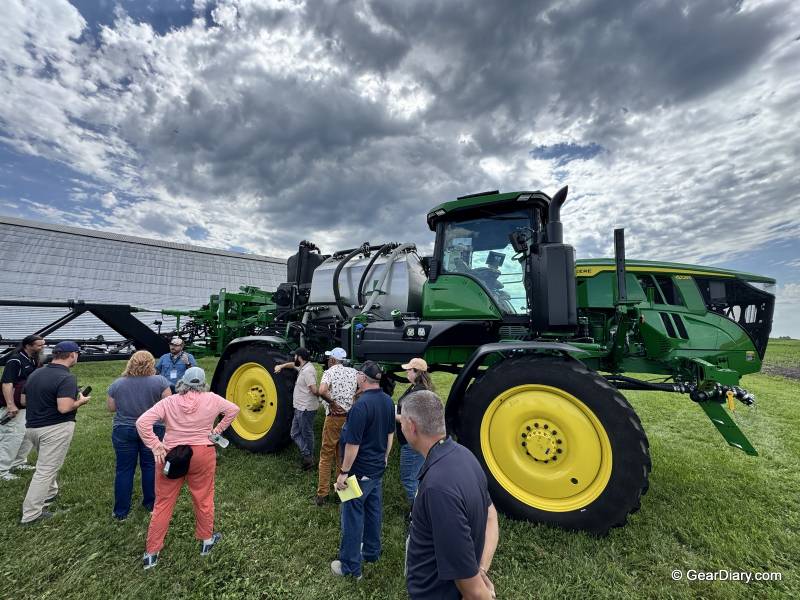
The savings are not marginal. Deere has reported average herbicide savings of 59 percent across corn, soybean, and cotton acres, amounting to roughly 8 million gallons conserved in a single season, and its customers ran the technology across about 5 million acres in 2025. Farmers at the event described machines paying for themselves in under a year purely on chemical savings, which is unusual to hear about a piece of agricultural equipment.
Then there is the visualization, which is the part that lands emotionally: after a pass, the operator can see a map of the area that wasn’t sprayed—the ground that would have been blanket-treated under the old approach and wasn’t. It makes the abstraction concrete. You are looking at money that stayed in the tank and chemistry that stayed out of the field. There’s also the environmental impact as well, of course. Less herbicide sprayed means less overspray on your neighbor’s field and less getting into the surrounding air.
It is also the cleanest illustration of what AI-powered decision-making is actually for in this context. Nobody is asking a neural network to be creative about weeds. They are asking it to make an extremely simple determination — plant or weed — several thousand times a second, with enough reliability that a farmer will trust it to withhold herbicide from ground the old system would have sprayed. Precision here means targeting only what needs treatment, improving yield outcomes and ROI at the same time.
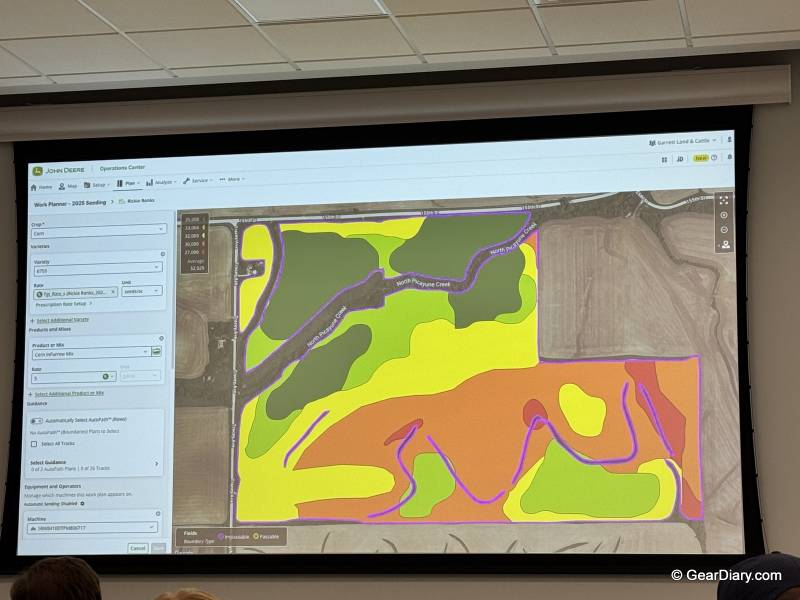
All of it flows into Operations Center, and this is where the day’s separate threads converged. Every pass by every machine generates data, and that data lands in one place. It is worth remembering what this replaced. Within living memory, and on plenty of operations far more recently than that, farm records were notes on legal pads, receipts in a shoebox, and folders in a filing cabinet in the farm office. The information existed. Retrieving it in time to change a decision generally did not happen.
The farmers we met in Iowa were not measured about this. “Revolutionized my life,” one said. Another framed it in terms of the resource that no equipment purchase can add to: “Can’t put a value on what my time is worth.” A third went further than I expected: “I’m not positive we’ll still be in business without it.” That is a striking thing to say about software, and it reflects how thin margins have become and how much of the remaining advantage lives in execution rather than in acreage.
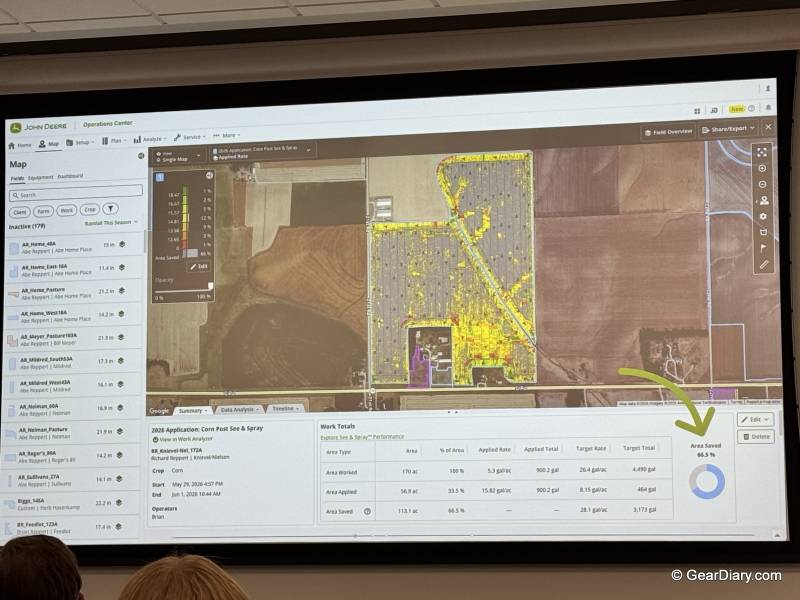
Operations Center is the digital hub of modern farming, and the machines above are its sensors. Ensuring you seed at the correct rate and fertilize at the correct rate is not glamorous, but it is where productivity and return on investment are actually determined, acre by acre, across a whole season.
Which brings me to my favorite word I learned in Iowa: agrolytics. Analytics applied to agronomy, and a fair one-word summary of what Deere spent the day describing. It is a slightly awkward coinage, and I expect it to stick anyway, because the industry now needs a word for this. The tractor and the farmer still matter enormously. But increasingly, the thing being sold is the decision the tractor and the data it collects enable — and technology has become the differentiator between operations that make those decisions well and operations that guess.
Disclosure: John Deere paid for my travel and accommodations but had zero editorial control over the content I wrote.