


Do you remember back in the early 2010s when Google released Google Glass? Were you like me and thought they were science fiction becoming science fact? Now, jump ahead to the present day and hold on to your socks! XREAL is launching its next-generation spatial computing glasses, the AURA. The XREAL AURA is a collaborative effort between XREAL, Google, and Qualcomm Technologies to deliver wired XR (extended reality) glasses with built-in Android XR and Gemini integration, powered by Qualcomm’s latest Snapdragon Reality Elite Platform chipset.
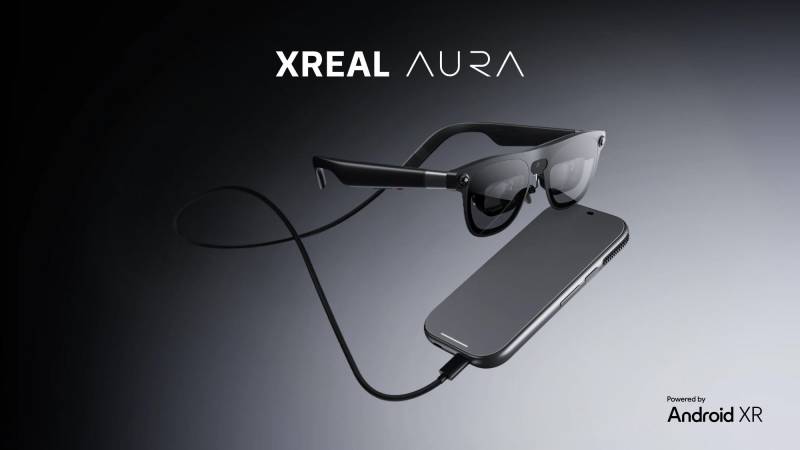
Some Quick Facts About the XREAL AURA
The XREAL AURA is packed with gadgety goodness. Take a gander at some of its features.
The glasses have a massive 70-degree field of view with a virtually borderless visual canvas, using XREAL’s X Prism optics and Sony Micro-OLED displays with a resolution of 1920 × 1200 pixels per eye and refresh rates up to 120Hz. That’s a lot of pixels sitting awfully close to your eyeballs.
The optical see-through frames weigh less than 95 grams and are designed for immersive mixed-reality experiences while still letting you see the real world around you. XREAL has also added electrochromic dimming with five levels of transparency that can be controlled automatically or manually, so you can dial things down when you want more immersion or brighten things up when remembering that walls, furniture, pets, and other humans still exist.
World-facing sensors on the frames support hand tracking, six-degrees-of-freedom, or 6DoF, tracking and multimodal AI experiences with user permission. The hardware includes two world-facing tracking cameras plus a high-resolution camera with a privacy LED indicator. That last part matters, especially for something designed to see the world with you.
Audio hasn’t been forgotten, either. The AURA includes Bose EQ tuning, Android XR-powered spatial audio, and a four-microphone array. It will also support insertable prescription lenses, which is excellent news for those of us who need a little optical assistance before adding futuristic computers in front of our eyes.
The XREAL AURA uses a dual-chip, split-compute architecture designed for portable spatial computing. Inside the frames, the XREAL X1S Spatial Coprocessor supports low-latency spatial display, sensor processing, and stable glasses-based XR experiences. A separate compute puck uses Qualcomm’s latest Snapdragon Reality Elite Platform for the heavy lifting.
That puck is essentially the AURA’s pocket-sized brain. XREAL plans configurations with 12GB of memory and 256GB of storage or 16GB of memory and 512GB of storage. It has a 4,455mAh battery, supports charging at up to 65 watts, and includes Wi-Fi 6/6E and Bluetooth 5.3.
You aren’t stuck waving your hands around like Tom Cruise in Minority Report, either. The AURA supports hands, voice, and a touchpad on the compute puck for input, and you can also connect Bluetooth keyboards, mice, and game controllers. The puck even has a fingerprint button to power the system on or off and lock it.
The AURA can also accept DisplayPort input from a PC, laptop, or handheld gaming console, which opens up some interesting possibilities if you’d rather bring a giant virtual display with you than an actual giant display.
The XREAL AURA isn’t just a headset or display glasses. The AURA can be your own private screen, a spatial workspace, and a digital canvas all in one. And with Android XR, XREAL says millions of apps will be available through Google Play on day one, including Google Maps, YouTube, Gemini, Chrome, and Photos. There will also be more than 100 apps specifically designed for XR.
You can watch movies, check your email, post on your social media accounts, play games, work with documents, extend your laptop into a private spatial workspace, and so much more while still being able to see the world around you. You could use the AURA as your own private movie theater on a flight, set up virtual screens in a hotel room without packing a monitor, or connect it to a handheld gaming system when its built-in screen suddenly feels a little puny.
You can even use Gemini AI to help you understand what you see, what’s on screen, and what’s around you if you choose to allow it and grant the required user permissions. Gemini can also respond to natural conversations, open apps, help navigate the AURA, and provide contextual information based on what you’re doing.
The important words there are “with user permission.” A wearable computer with cameras and an AI that can understand what you’re looking at is undeniably cool, but it’s also the sort of technology where privacy controls aren’t exactly an optional garnish.
The AURA’s dual-chip architecture is an interesting approach to making all this work without strapping a miniature furnace to your face. There’s one chipset in the glasses themselves, the XREAL X1S Spatial Coprocessor, and then the separate compute module housing the Qualcomm Snapdragon Reality Elite Platform chipset that connects to the glasses. Doing so helps balance performance, thermals, battery life, and wearability.
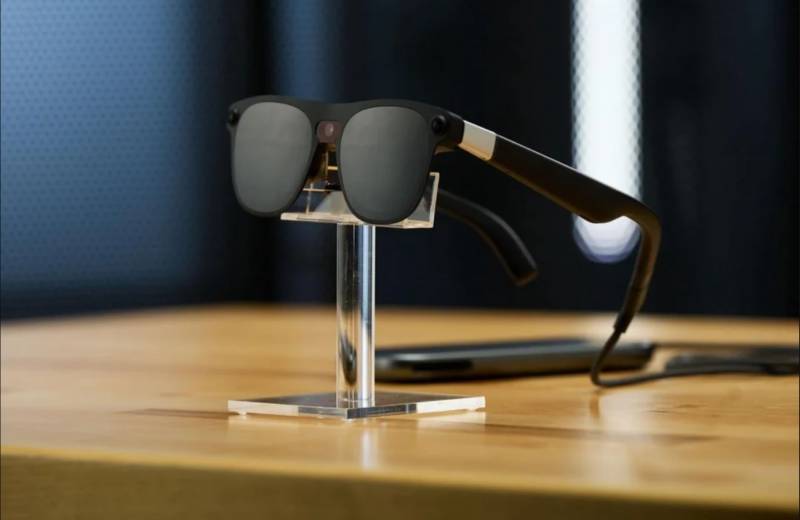
I’m truly excited to see if XREAL, Google, and Qualcomm can deliver on their promises. We still don’t know the exact final price, but XREAL has now said the base model will cost no more than $1,500 before tax. So, no, I don’t think anyone should expect these to land in stocking-stuffer territory.
If you’re already sold on the idea, XREAL is offering a $199 Priority Deposit that gets you in line and applies toward the purchase price when the AURA launches. The deposit is fully refundable before you complete the final purchase, and XREAL says earlier reservations will receive earlier access. It’s worth noting that this is a reservation, not an actual preorder; final pricing, configurations, and shipping details will be announced closer to launch.
The bigger question will be: does the XREAL AURA fill a void you’ve been trying to fill? Can one device replace dozens of others in your life and improve the experience? Or will spatial computing glasses remain something that sounds amazing until you remember you have to wear them on your face for hours at a time?
For a deeper dive into the AURA, check out this video with Norman Chan from Tested and XREAL CEO Chi Xu. I can’t wait to find out.
