


MediaTek is pushing deeper into laptops with the MediaTek Dimensity CX C10 Max, the first system-on-chip in its new Dimensity Compute Experiences family and the silicon destined for an upcoming premium, ultra-portable Googlebook. Built on TSMC’s 3nm process, the chip combines an eight-core CPU, an 11-core GPU, a 55 TOPS neural processor, Wi-Fi 7, and an image processor aimed at better video calls. The pitch is familiar: more speed, more on-device AI, and longer battery life in thinner machines. The more interesting question is how much of that promise survives once the first Googlebook reaches desks and backpacks.
A Laptop Chip Built Around Efficiency
The MediaTek Dimensity CX C10 Max is the flagship chip in MediaTek’s new Dimensity Compute Experiences, or CX, family. It’s a system-on-chip, commonly shortened to SoC, meaning the CPU, graphics processor, AI hardware, camera processing, and other important components are combined into a single package rather than scattered across separate chips.
MediaTek is manufacturing the CX C10 Max using TSMC’s 3nm process. Smaller manufacturing processes help chip designers balance performance, power consumption, and heat, and MediaTek is clearly leaning into that latter two. The company envisions the CX C10 Max inside thin, light, fanless computers that can run all day without turning into either a space heater or a permanent resident of the nearest electrical outlet.
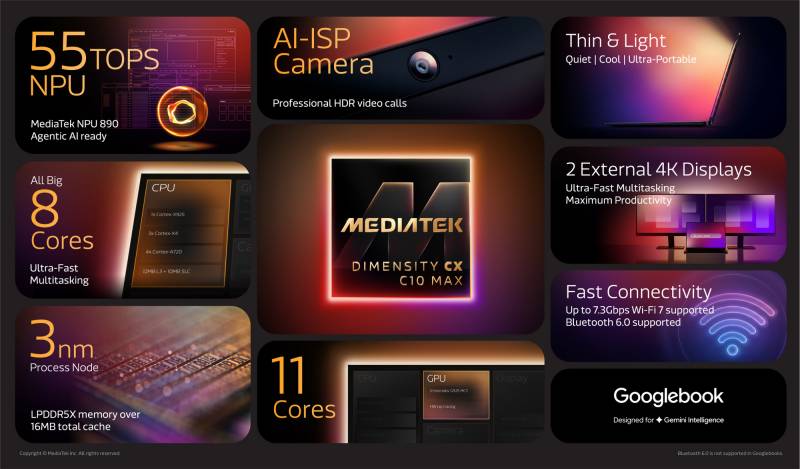
Its eight-core CPU uses what MediaTek calls an “All Big Core” design. The accompanying specifications break that down into one Cortex-X925 core, three Cortex-X4 cores, and four Cortex-A720 cores. MediaTek also lists LPDDR5X memory support, along with 12MB of L3 cache and 10MB of system-level cache. Cache is extremely fast memory located close to the processor, so it can retrieve frequently needed data without waiting on slower system memory.
An 11-core Immortalis-G925 MC11 GPU handles graphics with hardware ray tracing. That feature can produce more realistic lighting, shadows, and reflections in games and other supported 3D applications, although the experience will ultimately depend as much on software support as on the hardware.
For someone who spends the day bouncing among dozens of browser tabs, video meetings, cloud applications, and media, the important part isn’t the collection of component names. It’s whether the finished laptop can keep all of that moving without becoming noisy, hot, or surprisingly thirsty.
55 TOPS Puts On-Device AI Front and Center
The MediaTek Dimensity CX C10 Max includes the brand’s eighth-generation NPU 890, a neural processing unit dedicated to artificial intelligence workloads. It can deliver up to 55 TOPS, or 55 trillion operations per second.
TOPS describes how much AI-specific computational work a processor can theoretically handle, but it isn’t a stopwatch for how quickly every AI feature will respond. Software optimization, memory, the complexity of a particular task, and how much work stays on the laptop rather than traveling to a cloud server can all affect the experience.
MediaTek designed the NPU 890 for Gemini Intelligence features and describes the chip as ready for agentic AI. Broadly speaking, agentic AI refers to software that can work through multiple steps toward a goal rather than simply responding to a single prompt. The interesting part will be seeing what Google does with that processing headroom because MediaTek hasn’t detailed the specific Gemini experiences the first CX C10 Max-powered Googlebook will offer.
Doing more AI processing directly on a laptop can also have privacy and responsiveness benefits because some information doesn’t need to make a round trip to a remote server. Whether those benefits are noticeable will depend on how Google and individual applications use the NPU.
Video Calls Get Dedicated Camera Hardware
Anyone who has spent enough time on laptop video calls knows that a supposedly premium computer can still produce an image that looks as though it came from the security camera above a convenience-store cash register. MediaTek is giving manufacturers considerably more camera hardware to work with.
The MediaTek Dimensity CX C10 Max’s integrated Imagiq 1090 image signal processor, or ISP, supports camera sensors up to 32 megapixels. An ISP handles much of the processing that turns raw information from a camera sensor into a usable image. Here, MediaTek is adding AI-assisted processing for HDR video, smoother video zoom, sustained focus, and what it describes as cinematic video.
That could matter for more than meetings. A better built-in camera would also help with livestreaming, recording presentations, remote classes, telehealth appointments, or simply looking less like you’re calling from a dimly lit cave. Of course, a capable ISP can only do so much if a laptop manufacturer pairs it with a mediocre camera sensor or lens.
Two 4K Displays and Wi-Fi 7 Add Desktop Flexibility
The MediaTek Dimensity CX C10 Max can drive two external 4K displays, a useful feature for anyone who wants a lightweight travel computer that can become a multi-monitor workstation once they reach a desk. That setup could accommodate email and messaging on one display, a browser or document on another, and the laptop’s own screen for whatever demands attention next.
Wireless connectivity includes Wi-Fi 7 with supported speeds up to 7.3Gbps. That figure represents the platform’s maximum supported connection speed, not a promise that your home internet connection will suddenly run at 7.3Gbps, but Wi-Fi 7 can provide additional bandwidth for fast local networking, downloads, streaming, and busy wireless environments.
The silicon also supports dual-engine Bluetooth 6.0. There’s an important footnote, however: MediaTek’s accompanying infographic notes that Bluetooth 6.0 isn’t supported in Googlebooks. In other words, the capability exists in the chip, but you shouldn’t assume it will be available on the first Googlebook built around it.
The First Googlebook Will Tell the Rest of the Story
On paper, the MediaTek Dimensity CX C10 Max has many of the ingredients expected from a modern premium laptop platform: a 3nm design, eight CPU cores, an 11-core GPU, substantial dedicated AI processing, advanced camera hardware, two external 4K displays, and Wi-Fi 7.
What MediaTek hasn’t provided yet may prove just as important. The announcement doesn’t identify the first Googlebook model, its price, launch date, battery capacity, display specifications, or real-world benchmark results. “All-day” battery life also can’t be evaluated until there’s finished hardware to test.
That makes the CX C10 Max an interesting foundation, not a finished verdict. If manufacturers can turn its efficiency claims into genuinely thin, quiet machines with strong battery life, capable webcams, and enough performance to handle both everyday work and Google’s expanding AI ambitions, there could be plenty here worth watching. For now, the hardware specifications provide the outline, and the eventual Googlebook will have to fill in the details.