


I love e-ink displays. I love them. I think they’re one of the coolest pieces of modern tech ever invented. Over the decades, huge advancements in the basic invention’s features and capabilities have enabled a pretty interesting spread of consumer and commercial devices. The color e-ink revolution has been popular with consumers, and E Ink has been hard at work, iterating on the Kaleido 3 panel, and they’ve just announced the new Kaleido 4.

E Ink’s new Kaleido 4 color panel offers big improvements over the previous generation. (Image: E Ink)
There are some exciting improvements, and I’m looking forward to checking out the next generation of e-ink hardware in the future!
Kaleido 4 Announced Features
Color gamut volume doubled to more than 40k: This measures the total range of colors a display can reproduce. The Kaleido panel family uses an RGB light layer over the monochrome e-ink layer, which filters the colors reflected through the RGB layer by adjusting the monochrome layer. This limits the total number of colors the panel can display, so the Kaleido 4’s improved color gamut is a big jump.
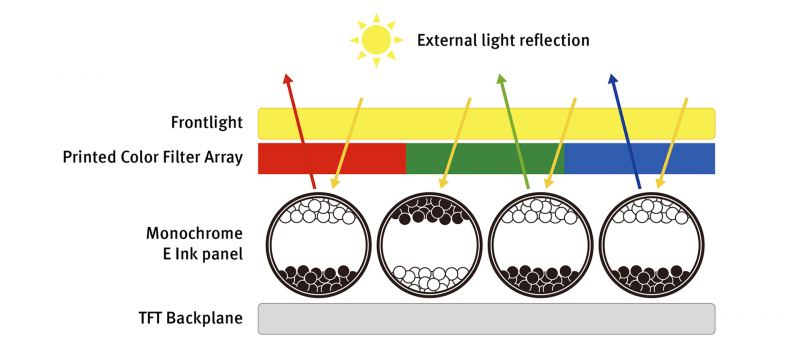
E Ink’s Kaleido technology uses an RGB filter layer to display a range of colors. (Image: E Ink)
White reflectance increased by 15%: This measures how white an e-ink display appears when all pixels are white (in other words, when the display is blank). This layer is called the TFT backplane. One of the biggest consumer complaints about color e-ink devices is the noticeably dimmer display, and many new device owners have ultimately exchanged for a monochrome model.
This issue stems from how the RGB layer filters light, which necessarily blocks some reflected light.
The current-generation Kaleido 3’s white reflectance measures at 22%; the Kaleido 4 will reportedly hit around 25%. By comparison, a monochrome e-ink display usually measures around 40-48%.
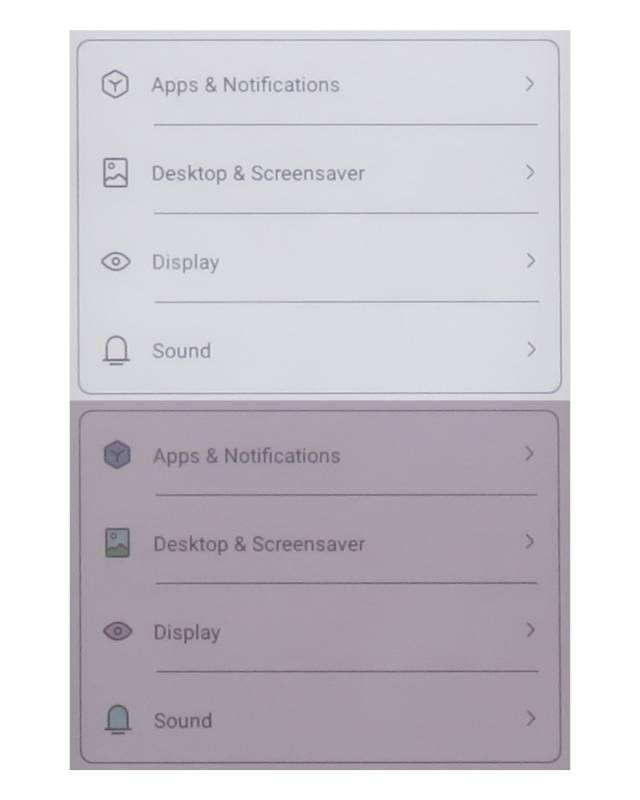
Kaleido 3 displays are noticeably dimmer than current-generation monochrome panels. (Top: BOOX Palma 2; Bottom: BOOX Palma 2 Pro)
Contrast improved by 50%: This measures how dark blacks are relative to whites (the panel’s background tone). This can mean making blacks blacker and improving the panel’s reflectance. The announced specs suggest E Ink has darkened the black granules in the monochrome e-ink layer while improving the TFT backplane’s white reflectance.
18 frames per second (FPS) video playback: This is double the Kaleido 3 and a huge improvement for users who want to view rich media (GIFs or videos) on an e-ink device, such as Android tablets and handsets from BOOX. It’s still nowhere near as good as a regular LCD, which can easily display 30 FPS video content without a hitch, but it’s still an improvement that will boost the real-world flexibility of e-ink devices as replacements for traditional tablets and handsets.
EMR pen support: This is a very exciting piece of information buried in the press release. To date, only one consumer device uses the new Kaleido 4 display: the Hanvon Technology M10C II, a tablet released only in China. This new tablet, which you can read about here, uses an EMR stylus!
Over the last year, E Ink has moved pretty aggressively away from offering new e-ink panels with EMR pen technology. Instead, they pushed both MPP (Microsoft Pen Protocol) 2.0 and USI (Universal Stylus Initiative) tech, but both have problems that require savvy engineering to mitigate, particularly around responsiveness and latency.
The fact that this Chinese OEM just announced a Kaleido 4 tablet with an EMR pen strongly implies E Ink has returned to manufacturing e-ink panels with integrated EMR, which is fantastic news for those of us who prefer this technology over anything active.