
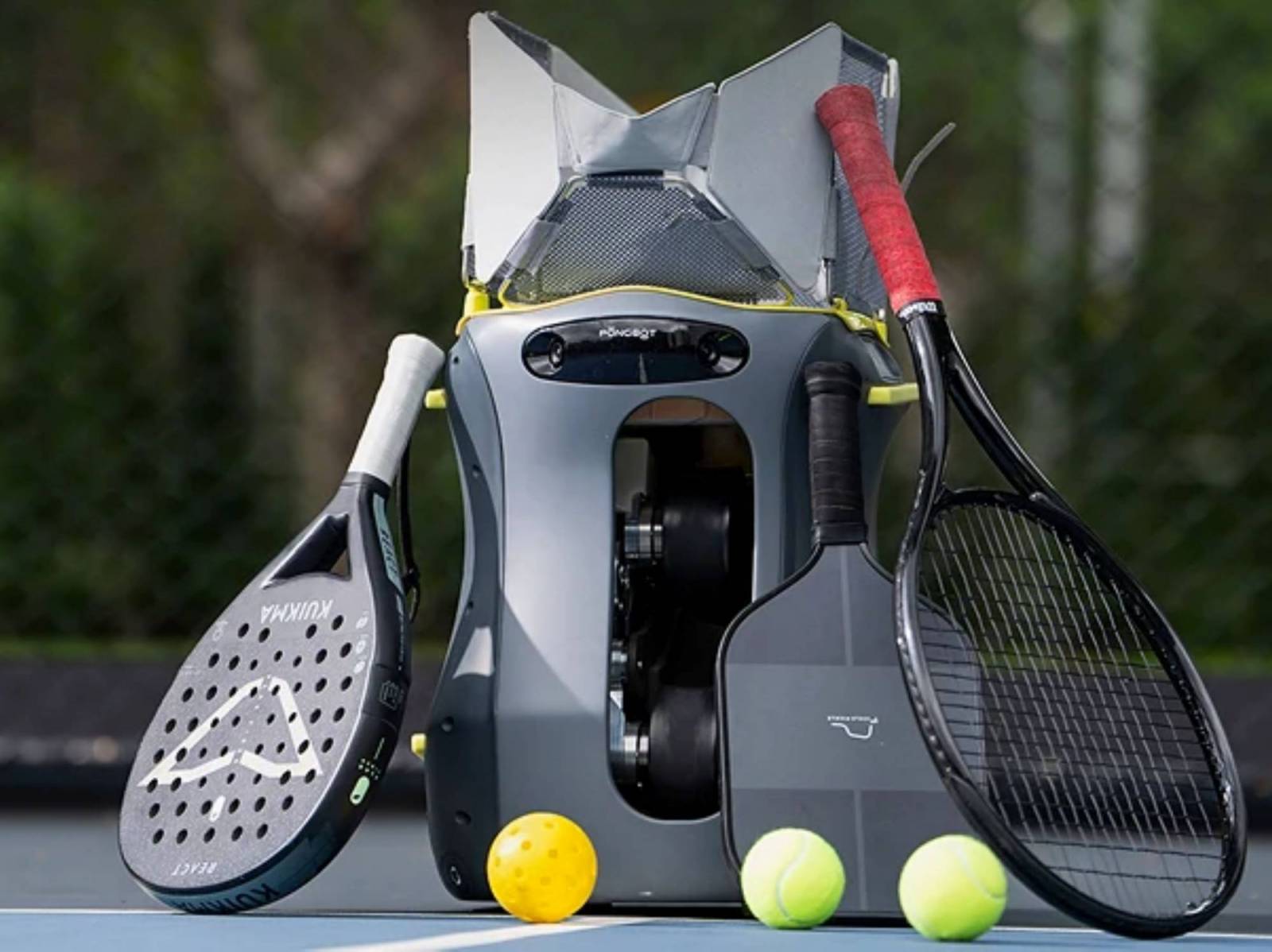


Finding someone to practice tennis, pickleball, or padel with isn’t always easy, especially when your schedule doesn’t cooperate with anyone else’s. Traditional ball machines can help, but they typically send balls across the court without paying much attention to how you’re playing. The Pongbot Aura takes a different approach, combining a portable ball-launching machine with customizable drills, voice controls, and optional AI-powered coaching that analyzes your movements. Designed to support three popular racket sports, Aura promises something closer to a personal training partner than a conventional ball feeder, although how much coaching you get depends on the version you choose.
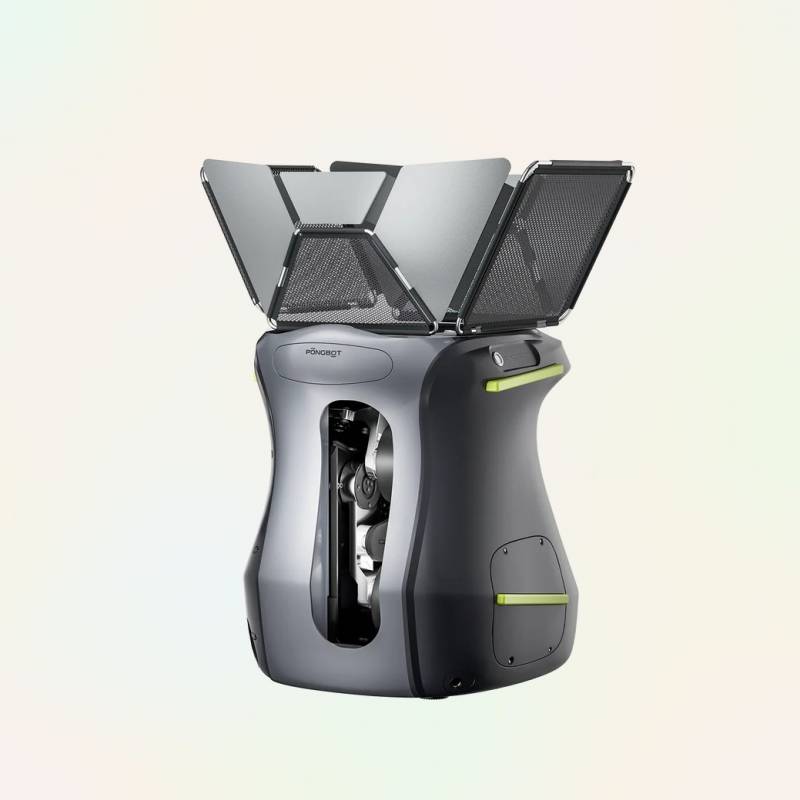
Pongbot Aura
There’s More to Practice Than Hitting Another Hundred Balls
Anyone who’s practiced with a conventional ball machine knows the routine. Set the speed, choose where you want the balls to land, and start swinging. It’s useful for repetition, but the machine doesn’t care whether you’re improving, developing bad habits, or barely getting back into position before the next ball arrives.
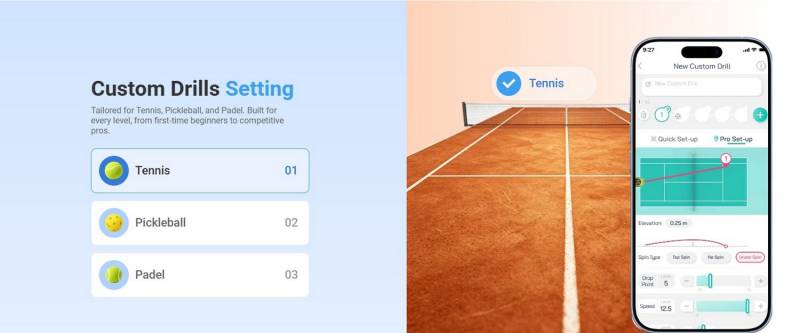
Pongbot wants Aura to offer a more thoughtful approach to independent practice, with training programs that can be adjusted for different skill levels and goals. You can work on shot consistency, placement, spin, footwork, and other aspects of your game without convincing a friend to spend an afternoon feeding you balls.
Pongbot Aura also handles tennis, pickleball, and padel. Its adjustable launching wheels accommodate different ball sizes, so you don’t need to buy a separate machine for each sport.
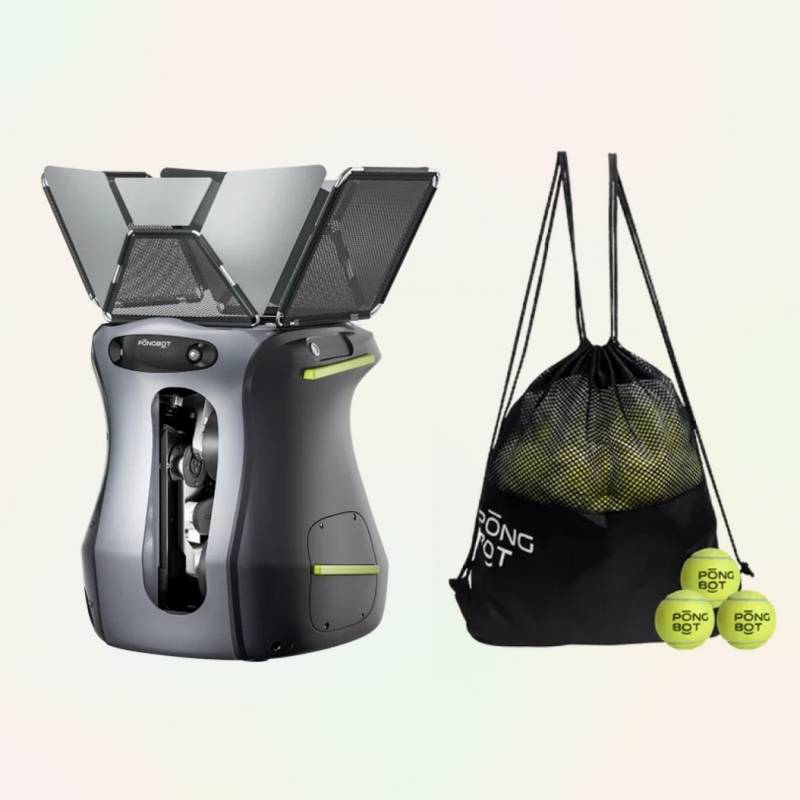
Pongbot Aura S
It accepts standard, red, orange, and green-dot tennis balls, 26-hole and 40-hole pickleballs, and standard padel balls. The folding hopper holds up to 120 tennis or padel balls or 100 pickleballs. You’ll want to stick with one ball type at a time, and Pongbot recommends avoiding combinations of balls with significantly different wear levels, since that can affect feeding consistency.
That multi-sport capability is particularly appealing for families or clubs where people don’t necessarily agree on which racket sport deserves their free time.
Aura or Aura S? The Difference Matters
Pongbot offers several Aura configurations, and the names make the lineup sound more complicated than it needs to be. You have two basic choices: whether you want camera-based coaching and whether you need access to more than one sport.
The standard Pongbot Aura, with a regular retail price of $1,199.99, is a customizable ball machine that supports app control, voice commands, and a large library of training exercises. It includes PONG.AI, a conversational training assistant that recommends drills based on what you’re trying to improve. You can adjust the speed, spin, placement, depth, and frequency of the balls to work on particular skills or practice different rally patterns.
The Pongbot Aura S, regularly priced at $1,699.99, adds the Spotter AI Vision Module. This dual-camera system watches your movements and tracks shots during training, giving the machine the information it needs to evaluate your technique and offer more personalized guidance.
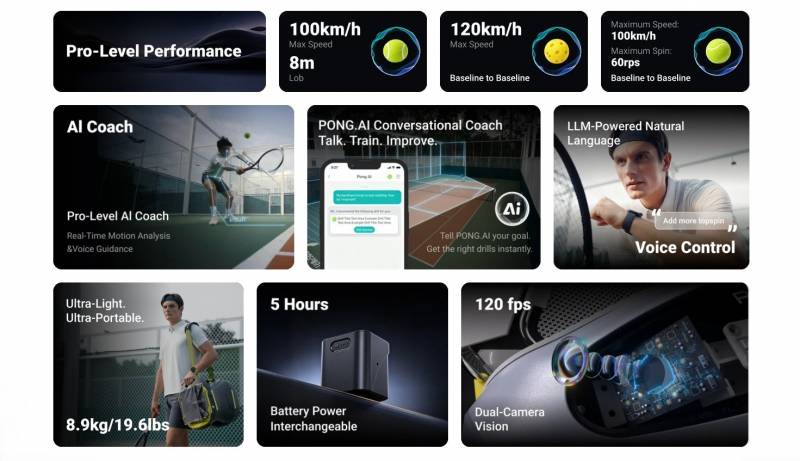
Its cameras capture footage at up to 120 frames per second, supported by a processor capable of 10 trillion operations per second, or 10 TOPS. That’s considerable computing power for something whose primary job is to send balls across a court, but analyzing movement and ball trajectories requires more processing than operating a conventional feeder.
With Spotter, Pongbot’s AI Coach can identify potential problems with your technique and provide targeted voice feedback during future sessions. If you’re consistently late preparing for a backhand, for example, the idea is that the system can recognize the pattern and help you work on correcting it.
Whether that feedback is as useful as having an experienced instructor watch you play remains to be seen. But there’s a meaningful difference between repeating a stroke and getting some indication of what might be going wrong.
For anyone who wants structured practice without the additional expense of camera-based coaching, the standard Aura may be sufficient. If you’d like the machine to analyze your movement rather than simply deliver customizable shots, Aura S is the version to consider.
What About the 3-in-1 Versions?
There’s one important detail to understand before choosing your Pongbot Aura: Just because the machine can handle three different sports doesn’t mean you automatically get access to all three.
Both the standard Aura and Aura S include software access to one sport of your choice, whether that’s tennis, pickleball, or padel. The machine has the hardware necessary to accommodate all three, but the training programs and operating modes for the other two sports remain locked until you purchase additional access.
If you start with tennis and later decide to take up pickleball, you won’t need another machine. Instead, you’ll need to purchase the appropriate Sport Unlock Card through Pongbot’s online store. Once you’ve purchased it, you activate the additional sport in the Aura app by scanning the card’s QR code or entering its activation credentials.
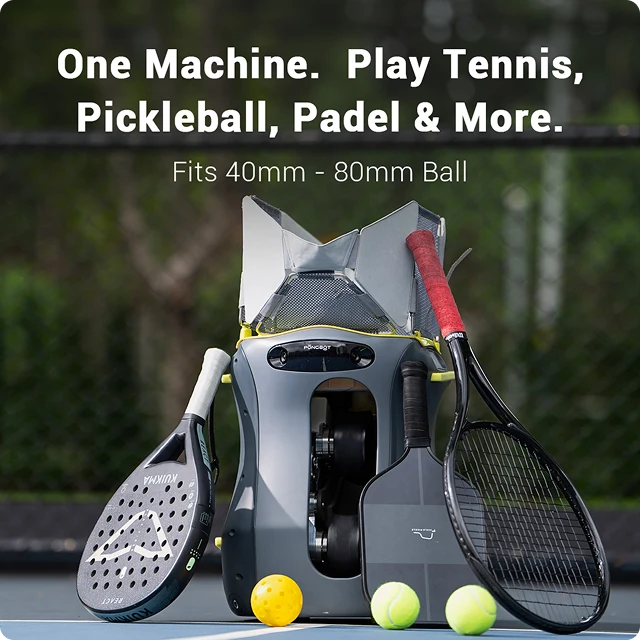
Pongbot Aura S 3-in-1
The Pongbot Aura 3-in-1, regularly priced at $1,359.99, eliminates that extra step by including software access to tennis, pickleball, and padel from the beginning. The Aura S 3-in-1, priced at $1,899.99, offers the same three-sport access along with the Spotter AI Vision Module for movement tracking, stroke analysis, and personalized coaching.
It’s also worth noting that purchasing a Sport Unlock Card doesn’t add any Spotter-powered coaching capabilities. Those require the additional camera hardware included with Pongbot Aura S. Likewise, choosing a 3-in-1 package doesn’t make the ball machine faster or more powerful. You’re paying for broader software access, not upgraded launching performance.
For someone who plays tennis exclusively, the single-sport Pongbot Aura or Aura S may be all that’s necessary. But if your household regularly switches between tennis and pickleball, or you’re interested in trying padel down the road, buying a 3-in-1 model could be more convenient than purchasing additional sport access later.
A Ball Machine That Knows When You’re Not Ready
One of the more interesting reasons to consider Pongbot Aura S is a feature called Recovery Trigger. Traditional ball machines generally deliver balls at predetermined intervals. If you’re still scrambling back into position after the previous shot, the next one might already be coming. That’s fine when you’re deliberately working on speed and endurance, but it isn’t always the best way to develop proper court positioning.
With Spotter tracking your movement, Recovery Trigger can wait until you’ve returned to the appropriate recovery area before feeding another ball.
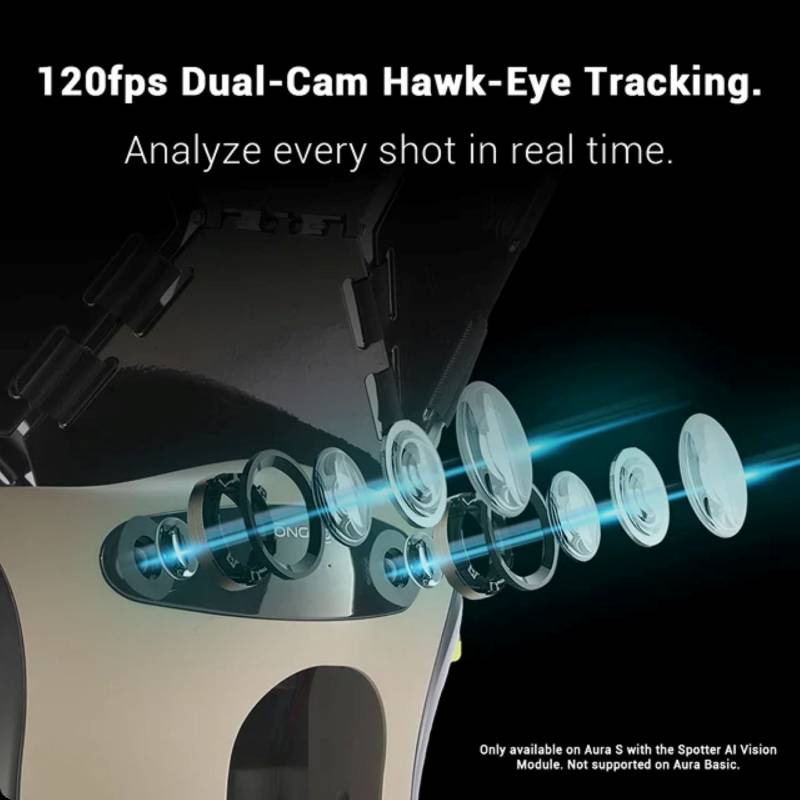
That could be particularly helpful for someone who’s developing the habit of admiring a good shot instead of immediately preparing for the next one. We’ve all seen that player, and occasionally we’ve been that player.
Pongbot Aura S also offers Match Challenge, which can recreate rally patterns and rhythms based on uploaded match footage. If you regularly struggle against an opponent who alternates deep shots with short, angled returns, practicing a similar sequence could help you prepare for the next match.
These features won’t reproduce everything that happens against a human opponent, but they could make solo practice feel a little less predictable.
Spotter isn’t limited to sitting on top of the ball machine, either. With the optional Spotter Base, you can mount it beside the net to analyze serves, shot landing points, and match activity. That arrangement also supports court-side livestreaming, although you’ll need the separate base accessory to power and position the module.
Plenty of Drills, but Do You Need to Search Through Them?
Aura includes a library of 10,000 drills, which should provide more than enough variety for most recreational players. Of course, having thousands of choices isn’t particularly helpful if you spend more time scrolling through them than practicing.
That’s where PONG.AI comes in.
Rather than manually searching through exercises, you can describe what you want to work on, whether that’s returning deep shots, improving forehand consistency, or developing better placement. The assistant then recommends suitable drills from the available library.
Importantly, PONG.AI is included with the standard Pongbot Aura. You don’t need to purchase Aura S to use it.
The system also supports voice commands, so you can change drills or pause a session without repeatedly retrieving your phone. Compatible Apple Watch controls provide another hands-free option.

If you have the Pongbot Aura S, coaching instructions can play through your smartphone, including connected Bluetooth headphones or speakers. That’s useful if you’d rather receive feedback privately than have your mechanical training partner announce your mistakes to everyone within earshot.
The Aura app records training sessions, including daily activity and monthly trends. Spotter adds more detailed shot-placement information, so you can review where balls landed and spot patterns in your performance.
How Does Aura Compare With the Pace S Pro?
Anyone familiar with Pongbot’s existing equipment might wonder whether Aura replaces the company’s Pace S Pro. It doesn’t. The two machines are intended for different kinds of training.
The Pace S Pro is Pongbot’s higher-performance tennis machine, aimed at advanced players and coaches who need demanding, tennis-focused practice. It offers 100Hz tracking (100 position updates per second), ball speeds up to about 80 mph, and more than eight hours of battery operation.
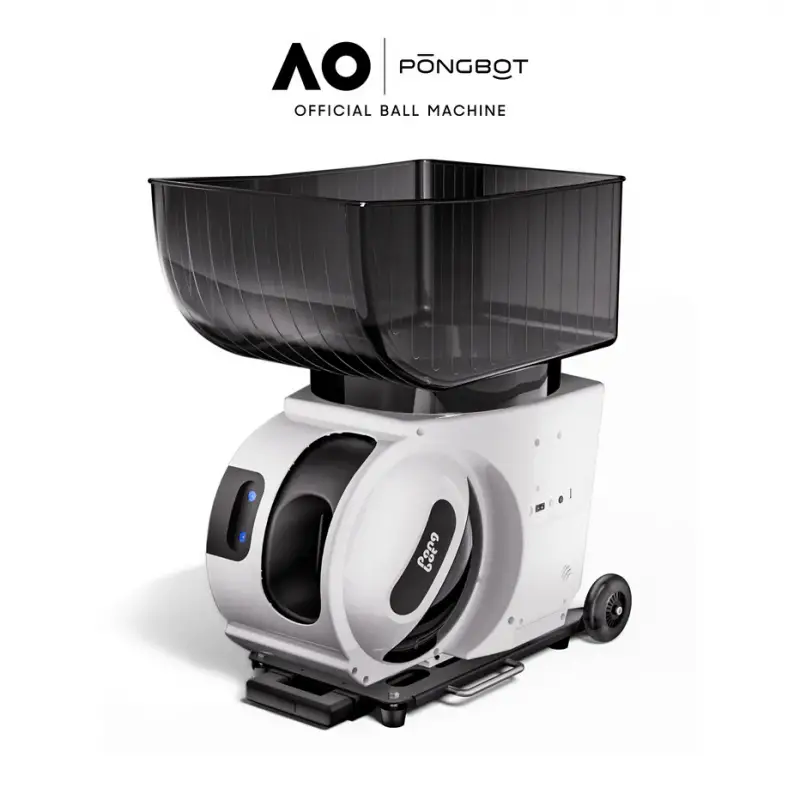
Pace S Pro
The Pongbot Aura uses 60Hz tracking, focuses on speeds appropriate for baseline rallies, and provides more than five hours of battery operation. Its appeal lies in portability, the ability to accommodate several racket sports, and the option to add camera-assisted coaching.
For someone training at a competitive level who wants fast, challenging tennis drills, Pace S Pro may be a better fit. But for a recreational or intermediate player who wants to develop skills, practice independently, and switch between different sports, Aura offers a different set of advantages.
More expensive equipment and higher specifications don’t automatically mean better training. The right machine depends on what you’re trying to improve.
Getting Aura to the Court Shouldn’t Be a Workout of Its Own
Ball machines aren’t much help if getting one out of the car feels like an event.
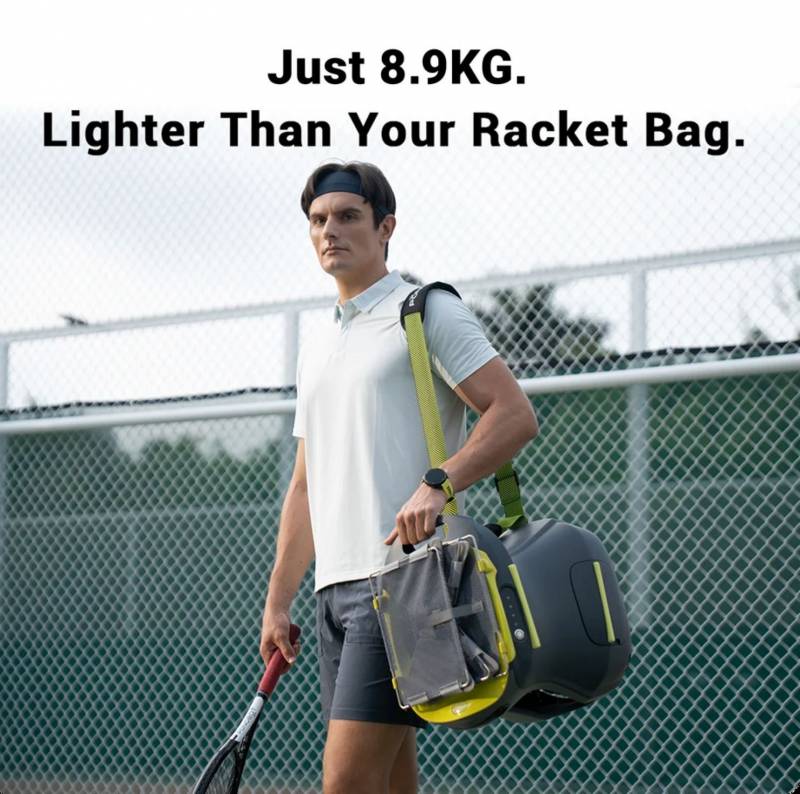
The Pongbot Aura has a folding ball hopper, a carrying handle, protective exterior panels, and a design intended to make moving it between courts relatively manageable. Pongbot’s current specifications list its weight at approximately 19.6 pounds (8.9 kg) before adding the optional Spotter equipment.
The removable 4,500 mAh battery provides more than five hours of standard operation. If you’ve got a charged spare, you can swap batteries rather than calling it a day when the first one runs out.
Charging is handled through USB-C. A charging cable is included, but you’ll need to provide the power adapter. Pongbot recommends a model rated at 60 watts or higher for faster charging, although lower-powered adapters can also work.
The Pongbot Aura can be used on flat, standard hard, acrylic, concrete, clay, and grass courts, with landing-point adjustments to account for differences in ball bounce.
A few limitations are worth remembering. Although some internal components have basic water resistance, don’t operate Aura in rain or with wet balls, as this can interfere with feeding accuracy. Its recommended operating temperature range is 41°F to 113°F.
If you need to stop a session immediately, pressing the machine’s power button will halt operation without requiring you to find your phone.
Is the Pongbot Aura Worth Considering?
The Pongbot Aura Kickstarter campaign raised more than $4 million from 4,836 backers, suggesting strong interest in a more intelligent, versatile ball machine. Crowdfunding success doesn’t guarantee long-term reliability or excellent coaching, but it does indicate that plenty of people see the appeal.
The regular retail price starts at $1,199.99 for Aura, increases to $1,359.99 for Aura 3-in-1, and reaches $1,699.99 for Aura S or $1,899.99 for Aura S 3-in-1. Pongbot currently advertises significant promotional pricing, but those are the manufacturer’s full retail prices.
None of these machines qualify as an impulse purchase for most people. If you play a few times each summer, borrowing a ball machine or scheduling occasional lessons might make more financial sense.
But if you’re practicing several times a week, trying to improve between lessons, or tired of arranging your schedule around whoever’s willing to hit with you, Aura could be worth a closer look.
The standard Pongbot Aura offers the convenience of customizable independent practice, while Pongbot Aura S adds the option of getting useful feedback without a coach standing nearby. The 3-in-1 versions make it easier to enjoy that flexibility across several sports, without purchasing additional software access.
Whether Spotter’s coaching can consistently identify meaningful problems and help correct them is something that will need to be established through real-world testing. Still, a ball machine that can help you practice specific situations, give you time to recover, and potentially recognize recurring mistakes is an interesting development.
And unlike your regular doubles partner, it probably won’t complain when you ask for just one more round of backhands.