
Many options exist to quantify your health. Apps and wearables can track your sleep, dissect your diet, count your steps, and generally read the tea leaves on whether you’re optimizing your fitness and health. The hard part is that fitness devices are often one-size-fits-all, and it can be tough to tell whether a running watch will help with weightlifting or whether your step counter is properly tracking your heart rate. Luna Band takes a different approach, with LifeOS customizing the experience to each person’s needs, body, and goals.
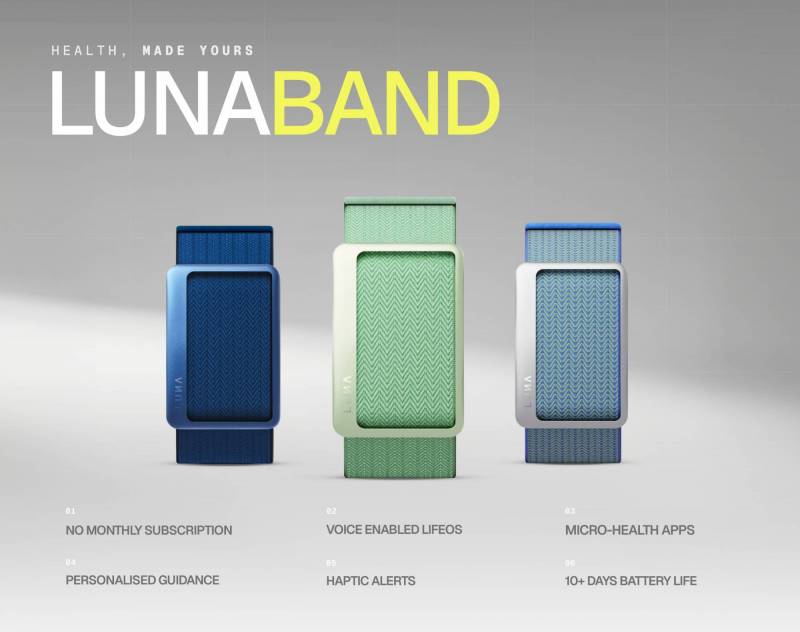
Luna Band tracks all the usual fitness markers: heart rate variability, blood oxygen, sleep, resting heart rate, steps, and daily activity. Its optical PPG heart-rate sensor uses four photodiodes along with green, red, and infrared LEDs, and the Band also has a skin-temperature sensor, accelerometer, gyroscope, and SpO? sensor. It supports more than 60 workout modes, with automatic detection for running, walking, cycling, elliptical workouts, and rowing, and it can track VO? max, training load and effort, and heart-rate zones. There’s also in-app GPS for outdoor activity tracking.
It’s waterproof to 5ATM, weighs just 24 grams, or about 0.85 ounce, and the frame measures approximately 1.57″ long by 1.06″ wide and 0.46″ thick. Battery life is rated for up to 10 days, with a full charge taking about an hour using Luna’s included charger. Every box includes the Band, charger, and USB cable, and two strap sizes.
In other words, the Luna Band offers what you’d expect from a modern fitness tracker, and with its screen-less design it looks on paper like a competitor to something like Whoop.
The real difference is in the associated software and Luna’s LifeOS health intelligence platform. Rather than working exactly the same way for everyone, Luna says the Band adapts itself according to the wearer’s individual goals.
When you add a goal, the Luna Band can reconfigure what it measures and how often it takes those readings, while LifeOS retrains its models around your body and that specific objective. The system learns your individual baselines rather than simply comparing you against averages, and Luna says its Micro apps, Peak Score, and even the Band’s firmware tune themselves to the individual wearer.
In other words, two Luna Bands may start with identical hardware and sensors, but Luna says that within days they can become significantly different experiences based on the people wearing them and what those people are trying to accomplish.
That personalization extends to how LifeOS uses all the information the Band collects. Luna tries to simplify fitness and health tracking by doing more of the interpretation for you rather than simply tossing a dashboard filled with numbers onto your phone and wishing you luck.
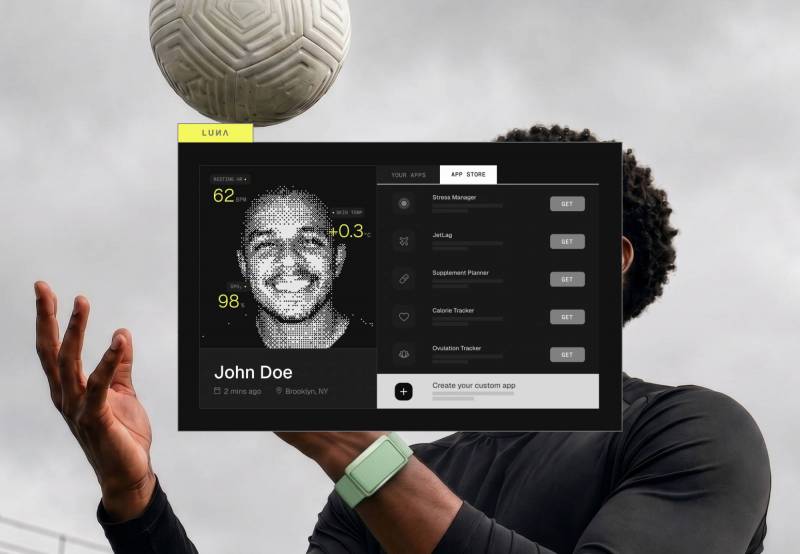
Instead, LifeOS uses your biometric signals and goals to build a personalized daily calendar with actionable guidance. Add or change a goal, and that calendar rebuilds itself around what you’re trying to accomplish. Luna’s product page also says AI-powered insights and coaching are included at no additional charge.
This holistic approach is a different way to tackle the fitness tracker experience, but it doesn’t mean Luna locks you entirely inside its own ecosystem. The Luna app is available for iOS and Android, and the Band can integrate with Apple Health, Google Fit, and Clue. Luna says Apple Health integration can give LifeOS a broader picture of your health information when building its personalized daily plan.
It’s an interesting spin on an increasingly crowded wearable market. Luna describes the Band as the first wearable that adapts itself to every individual user, and while that’s a fairly ambitious claim, the company’s approach is clearly about making personalization more than a collection of adjustable settings. The goal isn’t simply to let two people choose different workouts or dashboard widgets; it’s to have the underlying system pay attention to different things based on what each person is actually trying to accomplish.
There certainly seems to be interest in the concept. More than 100,000 people joined the Luna Band waitlist earlier this year, according to Luna, and the first drop sold out.
Most importantly, LifeOS isn’t tying all of that personalized guidance to another monthly subscription. The Luna app and LifeOS are free for Band users, with Luna saying its AI insights and coaching are included at no extra charge. That’s an especially notable distinction for a screen-less health tracker that will inevitably draw comparisons to Whoop.
Luna announced the Band’s worldwide availability at IFA 2026 in Berlin, where it is showing the Band alongside LifeOS. While the IFA announcement lists European pricing at €149, Luna’s U.S. store currently lists the Band for $149, including taxes and shipping.
So if you want the health and fitness tracking of a screen-less wearable but aren’t excited to add yet another subscription to your monthly bills, the Luna Band offers an intriguing alternative. The hardware covers the fitness and health basics you’d expect, but LifeOS and its ability to continually adapt the experience to your goals could make Luna far more interesting than another sensor strapped to your wrist.




Be the first to comment on "Luna Band Takes on Whoop with Adaptive LifeOS Health Tracking and No Subscription"