
Big-screen projectors have long asked homeowners to choose between cinematic scale and a living room that still feels like a living room. The XGIMI AURA 3 Series, debuting at IFA 2026, targets that compromise head-on. The new AURA 3 Max and AURA 3 Pro are ultra-short-throw 4K projectors that sit close to the wall, support native 120Hz playback, and use RGB triple-laser light engines. More interestingly, XGIMI is putting equal emphasis on contrast, gaming, built-in sound, and day-to-day usability, rather than treating projection as something reserved for dark rooms and dedicated home theaters.
A 120″ Picture Without a Projector Hanging Over Your Head
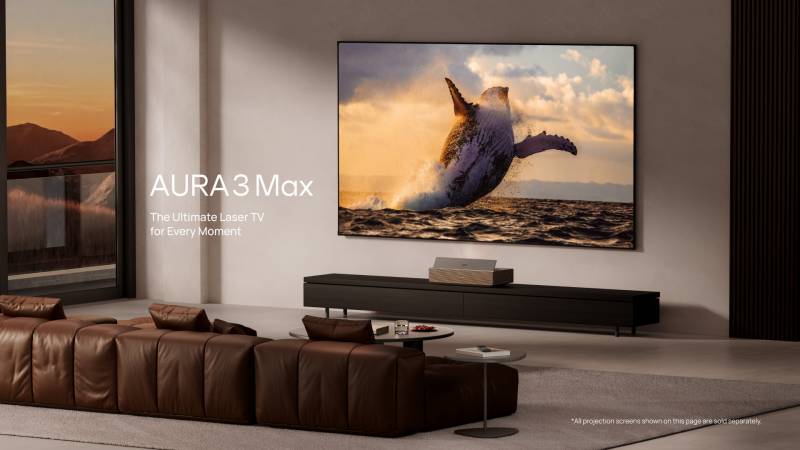
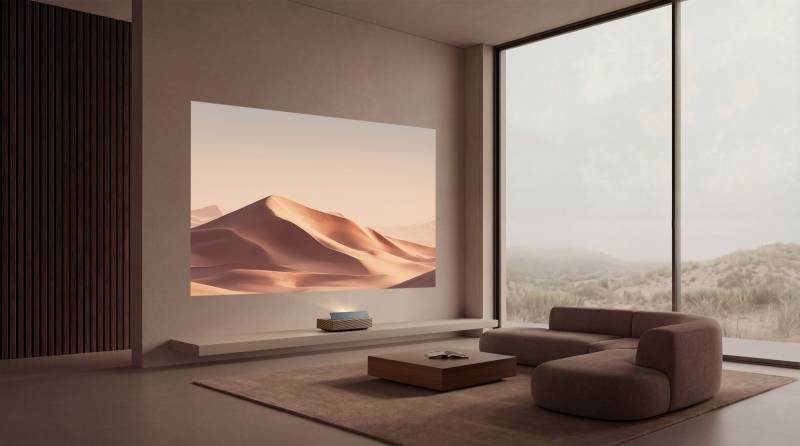
One of the strongest arguments for an ultra-short-throw projector has very little to do with picture quality. It’s simply easier to live with. The AURA 3 Series has a 0.163:1 throw ratio, so either model can produce a 120″ image while sitting about 8″ from the wall. Supported image sizes range from 80″ to 200″.
That changes the logistics considerably compared with a conventional projector. You don’t need to ceiling-mount anything behind the sofa, run a long HDMI cable across the room, or worry about somebody walking through the picture just as the murderer is being revealed. Instead, the projector can sit on a media console in roughly the same part of the room where you’d ordinarily put a television.
There is still a catch, because physics remains annoyingly unwilling to join the marketing department.
Ultra-short-throw projectors send light toward the screen at a very steep angle, so they’re unusually sensitive to the surface they’re projecting onto. A wall that looks perfectly flat from across the room may reveal waves, bumps, or other imperfections once a UST projector starts throwing a 100″ or 120″ image across it. A dedicated UST screen, particularly an ambient-light-rejecting model, is generally the better choice if picture quality is the priority.
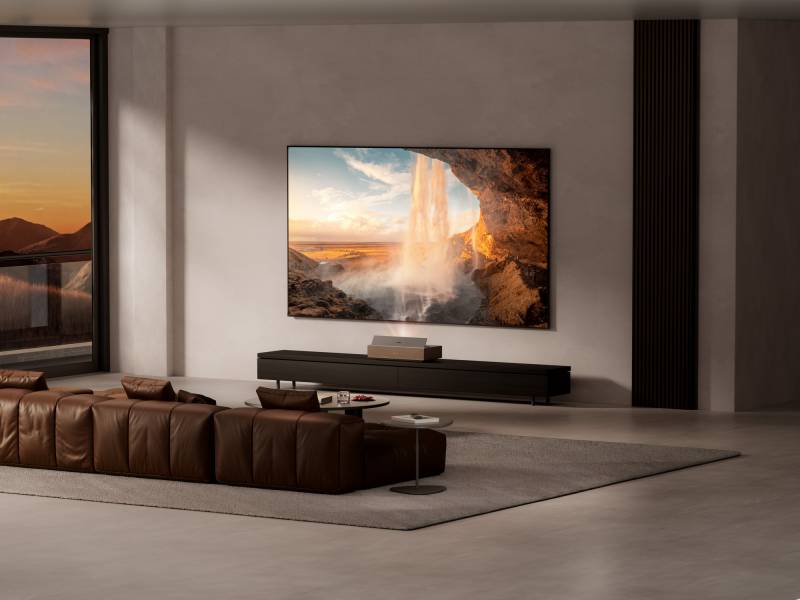
XGIMI includes automatic focus and uninterrupted automatic keystone correction to simplify setup, though careful physical placement is preferable to relying on digital correction to rescue a badly positioned projector.
At IFA, XGIMI will demonstrate the AURA 3 Max with its Ascend floor-rising screen. That combination makes particular sense for a multipurpose living room because the screen can disappear when you aren’t watching anything, rather than leaving a permanent 120″ rectangle dominating the wall.
The projector itself measures approximately 23.1″ wide, 11.6″ deep, and 5.4″ high. It isn’t tiny, but it doesn’t look like a piece of commercial AV equipment that wandered into the house by mistake. There’s also an automatic lens cover, a modest feature that makes considerably more sense when the projector is expected to spend years sitting in the open on a media console.
When it isn’t being used to watch something, the built-in XGIMI WALL app can display digital artwork on the wall. Whether that becomes a beloved feature or something you try twice and forget about will probably depend on how much enthusiasm you currently have for turning another surface in your home into a display.
The Dual-Iris System May Be the Bigger Story
Brightness gets plenty of attention in projector specifications, but throwing more light at the screen doesn’t automatically produce a better picture. Black levels and contrast remain difficult for projectors, especially outside a dedicated dark theater.
That’s where the AURA 3 Series gets more interesting.
XGIMI is introducing what it describes as the first Dynamic Dual Iris system in an ultra-short-throw projector lineup. Rather than relying entirely on electronic image processing to manipulate perceived contrast, the projector uses two physical apertures to regulate light as it moves through the optical system.
One controls the broader amount of light entering the imaging path, while the other makes finer adjustments that affect contrast and black levels. The system can change dynamically depending on the scene. The goal is to let bright scenes remain bright while keeping dark portions of the picture from drifting toward the grayish blacks that projectors can struggle with.
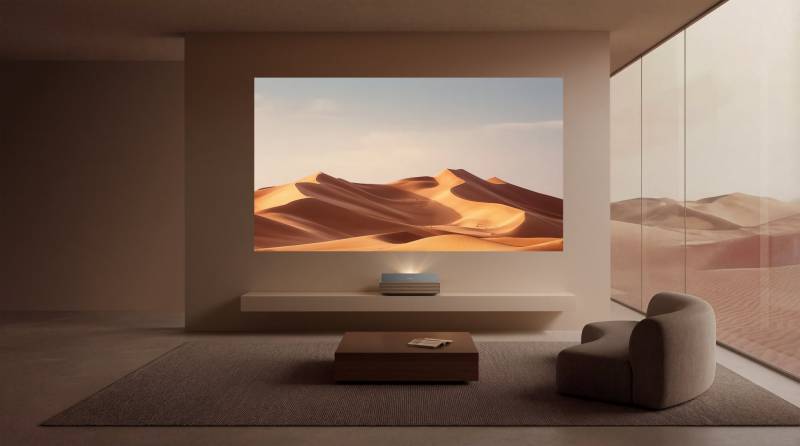
The AURA 3 Max is rated for up to an 8,000:1 native contrast ratio. XGIMI also uses Dynamic Black Enhancement, or DBLE, to increase dynamic contrast by up to 10 times while trying to preserve shadow detail and color.
Native contrast is still the more revealing number because it reflects what the projector can produce without relying on dynamic intervention. Even so, a well-behaved dynamic system can improve the experience with difficult material, particularly movies that jump repeatedly between bright exteriors and dark interiors.
The key phrase there is “well-behaved.” Dynamic iris systems can become distracting if adjustments are visible from scene to scene, so this is one of those features that will need to be judged with finished hardware rather than a specification sheet.
XGIMI’s X-VISION AI Image Processor handles additional picture adjustments, including texture enhancement, edge definition, and contrast optimization. Filmmaker Mode, IMAX Enhanced, and ISF Day and Night modes also give viewers more predictable picture settings if they’d rather not let the processor make every decision.
That’s an encouraging mix. Automated enhancement can help with compressed streaming video, sports, and casual viewing, but a movie doesn’t necessarily improve just because the processor has six more things to process.
Triple Lasers Bring More Brightness to the Living Room
The AURA 3 Series uses an RGB triple-laser light source, with independent red, green, and blue lasers producing the image. The AURA 3 Max is rated at up to 5,700 ISO lumens, while the AURA 3 Pro reaches up to 4,100 ISO lumens. The light source is expected to last 20,000 hours.
Those are substantial brightness claims for a home projector and should make the AURA 3 models more practical in spaces that aren’t completely dark. That could be especially useful for weekend sports, afternoon gaming, or households where lowering blackout shades before watching television would draw puzzled looks from everyone else in the room.
Still, projector brightness figures deserve some restraint. Laboratory ratings don’t tell you exactly how bright the picture will look at home. Picture mode, screen type, image size, ambient light, color settings, and other factors all change the result. The supplied product materials also note that brightness measurements come from XGIMI laboratory testing and may vary according to testing conditions, software, optical versions, room conditions, and firmware.
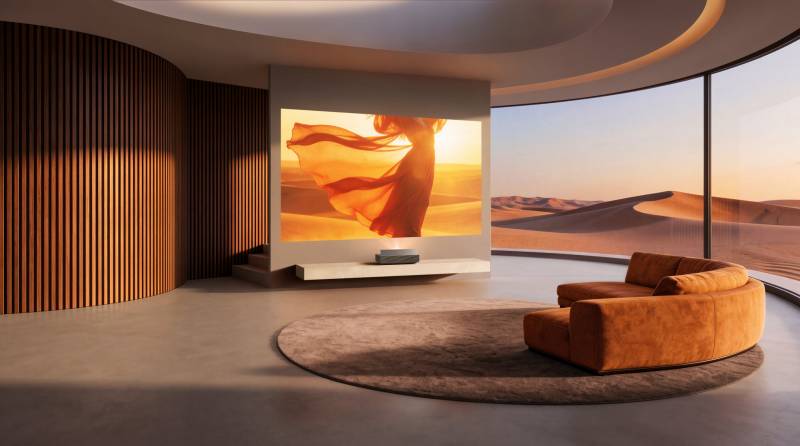
In other words, 5,700 ISO lumens is useful information, but it isn’t a promise that sunlight streaming through a wall of windows has suddenly ceased to exist.
The AURA 3 Series supports Dolby Vision, HDR10+, and HLG high dynamic range formats, along with dynamic tone mapping. HDR content can be mastered for displays capable of much higher brightness than a projector can reproduce, so tone mapping adapts that content to the projector’s available range. Done properly, it keeps bright details from blowing out while preventing darker parts of the image from collapsing into murk.
It also supports native 24-frame-per-second playback. Since most movies are shot and mastered at 24 fps, the projector can preserve the intended film cadence without forcing the content into a different frame rate.
The AURA 3 Series also supports 3D, and it includes two pairs of 3D glasses. That’s become an increasingly uncommon feature, but anyone with a collection of 3D Blu-rays that has been waiting patiently for society to come to its senses again may appreciate its survival.
XGIMI Is Taking the DLP Rainbow Effect Seriously
Both AURA 3 models use DLP projection, and XGIMI has incorporated anti-RBE processing intended to reduce rainbow artifacts in both 2D and 3D content. RBE stands for rainbow effect. Some people viewing single-chip DLP projectors can see brief flashes of red, green, and blue around bright objects against dark backgrounds, particularly when moving their eyes quickly across the picture. Plenty of people never notice it. Others see it immediately and then have the unfortunate experience of being unable to stop seeing it.
That makes anti-RBE technology worth mentioning, although it’s impossible to evaluate from the feature list alone. How effective XGIMI’s implementation is, particularly during dark, high-contrast scenes, is something that will require hands-on viewing.
Native 4K 120Hz Makes the AURA 3 Series More Interesting for Gaming
This is also the first AURA generation making a particularly serious pitch to gamers. The projectors use two dedicated DLP controllers that process image information in parallel, enabling native 4K output at up to 120Hz. That means the projector can display a 3840-by-2160 image while refreshing it as many as 120 times per second. For movies, 120Hz isn’t terribly exciting by itself. For a PlayStation 5, Xbox Series X, or gaming PC, it can be.
Games that can run above 60 frames per second can look considerably smoother at higher refresh rates, especially during quick camera movements. The projector also supports variable refresh rate, commonly shortened to VRR. Rather than forcing the display to refresh at a fixed interval while the game’s frame rate changes, VRR lets the projector synchronize more closely with the source, reducing visible tearing.
It also supports Auto Low Latency Mode, or ALLM. With compatible equipment, ALLM tells the projector that a game is being played so it can switch into a lower-latency mode without making you dig through picture menus first. There’s Dolby Vision Gaming support, too.
The advertised 1ms input-lag figure needs some context, however. According to XGIMI’s specifications, that number applies at 1080p and 240Hz in Game Mode with automatic keystone correction disabled. It shouldn’t be interpreted as 1ms latency while playing at 4K and 120Hz.
That doesn’t make the specification unimpressive, but it’s an important distinction. Gaming-display latency claims have a funny habit of arriving with their most favorable resolution and refresh-rate combination tucked somewhere nearby in smaller type.
Connectivity looks appropriate for the job. There are three HDMI ports, with HDMI 2 and HDMI 3 supporting 4K at 120Hz. HDMI 2 also supports eARC, or Enhanced Audio Return Channel, for sending higher-quality sound to a compatible soundbar or AV receiver.
There’s also Gigabit Ethernet, which may be preferable to Wi-Fi for online gaming, high-bitrate local streaming, or anyone who has learned that “the router is only one room away” can still become an unexpectedly complicated sentence.
Google TV Means You Won’t Need Another Streaming Box
The AURA 3 Series runs Google TV, giving it direct access to major streaming apps including Netflix, YouTube, and Prime Video. Google Cast and DLNA let you send compatible media to the projector, and connectivity includes Wi-Fi 6 and Bluetooth 5.2. Internally, there’s 3GB of RAM and 64GB of storage.
That integrated setup matters for an ultra-short-throw projector pitched as a television replacement. If every streaming session required switching to another box and another remote, some of the convenience would disappear quickly.
The AURA 3 Series also boots in 16 seconds or less, according to the supplied specifications, including the time required for the automatic lens cover to open. For a device you’ll likely use every day, startup time is one of those decidedly unglamorous specs that can matter more to your day-to-day experience than several of the numbers printed in large type on the box.
The Built-In Audio Is More Substantial Than Expected
Projector speakers often feel like an afterthought because somebody noticed an empty checkbox on the spec sheet. XGIMI is taking a more serious approach here. The AURA 3 Series has four 20-watt Harman Kardon speakers, producing 80W of total built-in audio. It supports Dolby Atmos and DTS Virtual:X.
A dedicated surround system should still outperform speakers inside a projector chassis, but 80W gives the AURA 3 Series a reasonable chance of working as a self-contained entertainment system without immediately requiring a soundbar.
That matters if the attraction of an ultra-short-throw projector is simplifying the room. Buying the projector and then surrounding it with a soundbar, subwoofer, AV receiver, rear speakers, streaming device, and another forest of cables undermines the elegance of the idea.
Anyone who wants external audio still has plenty of options. The connection panel includes HDMI eARC, optical audio, and an analog audio output. There’s also one USB 3.0 port and two USB 2.0 ports.
AURA 3 Max or AURA 3 Pro?
The AURA 3 Max and AURA 3 Pro share most of the technology that defines the series, including RGB triple-laser projection, native 4K 120Hz support, the Dynamic Dual Iris system, the 0.163:1 throw ratio, Google TV, Harman Kardon audio, HDR support, and 3D playback.
The most obvious distinction is brightness.
The AURA 3 Max is rated for up to 5,700 ISO lumens, compared with up to 4,100 ISO lumens for the AURA 3 Pro. XGIMI is positioning the Max for more demanding large-screen installations and brighter environments.
That could make the Max worthwhile if you plan to run a particularly large screen or watch frequently in daylight. In a controlled room at night, the difference may matter less than contrast, black level, color accuracy, fan noise, and the dual-iris system’s behavior.
There are also a few details in the supplied materials that deserve verification once final retail specification sheets are available. Some entries in XGIMI’s broader product deck remain marked TBD even though the launch materials provide brightness and contrast figures elsewhere.
That isn’t necessarily alarming this early in a launch cycle, but it’s a good reason not to treat every number in a presentation deck as carved into granite.
The Kickstarter Launch Deserves the Usual Preorder Caution
XGIMI has opened preorders through its website ahead of an October 20 Kickstarter campaign. A $50 deposit is intended to unlock an additional $200 discount, and customers who place the deposit are expected to receive a link by email on October 20 to complete their Kickstarter pledge.
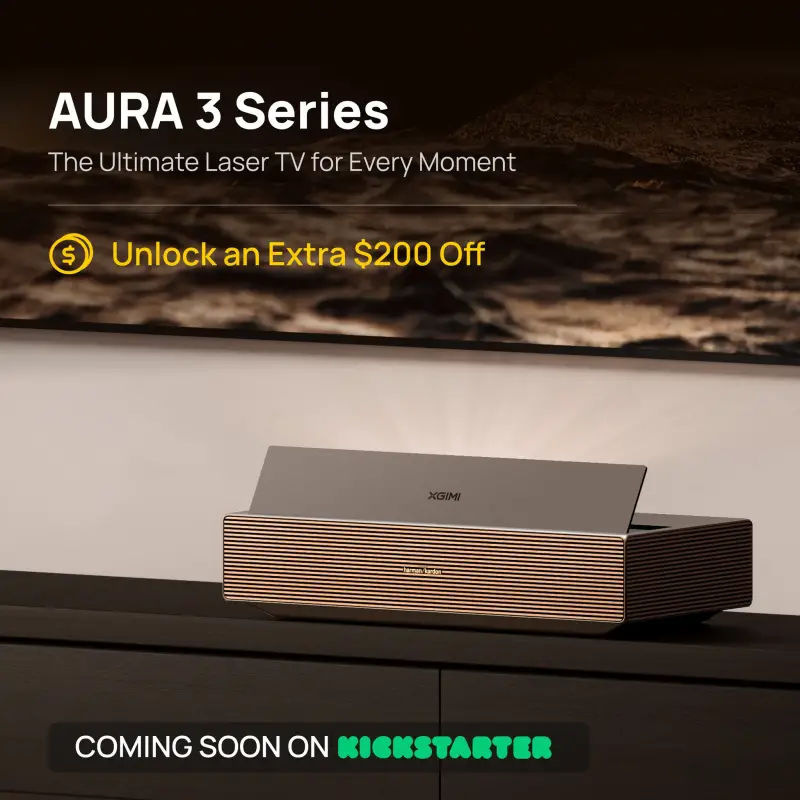
The Kickstarter-exclusive pricing is $2,399 for the AURA 3 Max and $2,199 for the AURA 3 Pro.
Anyone considering the early offer should check the final Kickstarter terms carefully once the campaign goes live, particularly the delivery timetable, warranty details, cancellation policies, and exactly how that preorder discount is applied.
A crowdfunding pledge is still different from buying a projector that’s sitting in a retailer’s warehouse, even when the company behind it is an established projector manufacturer with a solid Kickstarter reputation.
IFA Will Show Whether the Specifications Add Up to a Better Projector
XGIMI is building living-room and dining-room environments around the projectors rather than displaying them solely as pieces of AV hardware, and that’s probably the right approach. An ultra-short-throw projector succeeds or fails partly on picture quality, but also on whether it can coexist comfortably with the rest of the room.
The AURA 3 Series has plenty going for it before anyone brings a meter to the screen. It has an unusually short throw distance, substantial claimed brightness, physical dual-iris light control, native 4K 120Hz gaming, Google TV, serious built-in audio, 3D support, and a useful selection of inputs.
What remains unknown is just as important. Real-world black levels, visible iris behavior, fan noise, anti-RBE performance, color accuracy, 4K 120Hz gaming latency, and daytime performance will ultimately say more about these projectors than the feature list.
That’s particularly true at $2,199 and $2,399, where buyers have every right to be fussy.
If the production hardware delivers on the more interesting parts of the specification sheet, especially the dual-iris contrast system and native 4K 120Hz performance, the AURA 3 Series could make a persuasive case for replacing a very large television with something even larger.




Be the first to comment on "XGIMI AURA 3 Series Brings Native 4K 120Hz Gaming and Dual-Iris Contrast"