
MediaTek is pushing its flagship smartphone platform into the 2nm era with the Dimensity 9600 Pro, a system-on-a-chip aimed at phones that need more speed without turning battery life into collateral damage. The chip combines an eight-core CPU, a new graphics processor, expanded on-device AI hardware, faster memory and storage support, upgraded camera processing, and 5G-Advanced connectivity. MediaTek is also introducing the related Dimensity 9600M, designed to bring many of the same ideas to a broader range of phones. The first handsets using either platform are expected during the third quarter of 2026, so they’ll be here fairly soon.
Smaller Silicon, Bigger Performance Claims
The headline change is the move to a 2nm manufacturing process, a milestone MediaTek is positioning as first-to-announce. Smaller process technology can improve performance and power efficiency, although the node number alone doesn’t tell you how a finished phone will behave. MediaTek pairs it with an “All Big Core” 2+3+3 CPU layout: two C2-Ultra cores running at up to 4.55GHz, three C2-Pro cores at 4.35GHz, and three more C2-Pro cores at 3.1GHz.
Compared with MediaTek’s previous-generation Dimensity flagship processor, the company reports up to 17% faster single-core performance and 15% faster multi-core performance. The accompanying infographic also lists 37% more efficient single-core power use and 61% more efficient multi-core power use. That last figure may matter more than another benchmark win if it translates into a phone that stays fast during long gaming sessions, navigation, video editing, or a day of bouncing among work apps without chewing through the battery.
The Dimensity 9600 Pro also gets a 34.5MB cache, including 21% more L2 cache, plus support for LPDDR6 memory with 33% higher effective bandwidth and UFS 5.0 storage with up to twice the read/write speed of two-channel UFS 4. That should help phones open large apps quickly, juggle background tasks, and move big photo or video files with fewer pauses.
On-Device AI Is Moving from Answers to Actions
MediaTek is leaning heavily into “agentic AI,” meaning software designed to do more than answer a prompt. The idea is that a phone can understand what’s happening on the device, anticipate what you may need, and take appropriate actions while keeping more processing local instead of sending everything to the cloud.
The Dimensity 9600 Pro uses a dual neural processing unit, or NPU, with MediaTek’s NPU 1090 handling heavier workloads and a second-generation Super Efficient NPU intended for always-on tasks. MediaTek reports 51% faster large language model prefill performance, referring to the stage when the model digests your prompt and context before responding, along with 55% more generated text tokens per watt, twice the INT4 compute capability, and 40% lower power use for always-on AI. The platform can run certain on-device models with up to 30 billion parameters, a rough measure of model size, and it supports Mixture of Experts models, model compression, proactive suggestions, and scene detection.
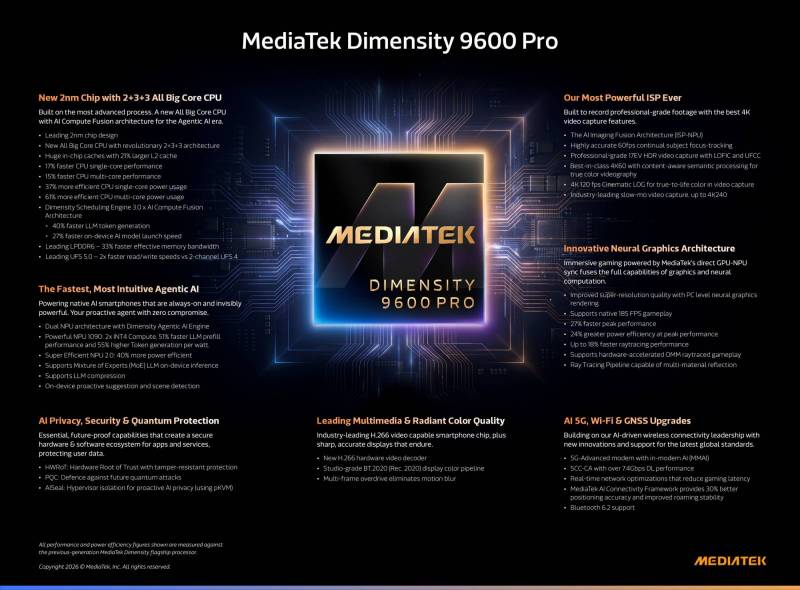
A new AI Compute Fusion Architecture lets the CPU and NPU share work, while the Dimensity Scheduling Engine 3.0 manages computing, memory, and power resources. MediaTek also claims this combination can improve large language model token generation by 40% and reduce on-device AI model launch time by 27%. Those numbers are interesting, but usefulness will depend heavily on what each phone maker builds on the silicon. A capable NPU can’t rescue an assistant that’s nosy, clumsy, or determined to “help” at exactly the wrong moment.
Gaming Gets More Frames and More Neural Graphics
For gaming, the Dimensity 9600 Pro adds the G2-Ultra NX graphics processor and a Neural Graphics Architecture that links GPU rendering with AI processing. MediaTek lists up to 27% higher peak graphics performance, 24% better power efficiency at peak performance, and up to 18% faster ray tracing than its previous flagship chip.
The platform supports native gameplay at up to 185 frames per second, PC-style neural super-resolution, hardware-accelerated ray tracing features, and multi-material reflections. HyperEngine also manages network and system resources to help keep games smooth. A 185 fps ceiling isn’t a promise that every game, display, or phone will hit it, but the extra headroom could matter on high-refresh-rate flagships, particularly when you’re gaming long enough for heat and battery drain to become the real opponents.
Cameras Push into 4K240 Slow Motion
The camera side may be easier to appreciate without a benchmark chart. The Imagiq 1290 image signal processor, or ISP, works with the NPU for computational photography and video. The platform supports continuous AI-assisted subject tracking at 60 fps, 4K video at 240 fps for ultra-slow-motion capture, 4K120 Cinematic LOG recording for greater flexibility when color grading, and 4K60 processing designed to preserve more natural color.
MediaTek also lists 17EV HDR video capture using its LOFIC and UFCC imaging technologies, intended to retain detail across very bright and very dark parts of a scene. That could help when you’re recording a concert with harsh stage lighting, a kid running from shade into sun, or a nighttime street scene where phone cameras tend to either blow out the lights or bury everything else in darkness. The chip also includes hardware decoding for H.266 video, a newer compression format, a BT.2020 wide-color pipeline, and multi-frame overdrive to reduce motion blur on display.
Connectivity and Security Get Quieter Upgrades
The wireless package includes a 5G-Advanced modem with AI-assisted modem management, five-component carrier aggregation that combines multiple slices of cellular spectrum, and claimed download performance above 7.4Gbps under suitable network conditions. MediaTek’s connectivity framework is also rated for 30% better positioning accuracy and improved roaming stability, while real-time network optimization is intended to reduce gaming latency. It also supports Bluetooth 6.2.
Security features include a hardware root of trust for tamper resistance, post-quantum cryptography intended to guard against future quantum-computing attacks, and AISeal, which uses pKVM hypervisor isolation to separate sensitive proactive-AI functions from other parts of the system. Those aren’t the specs most people will compare at a carrier store, but they’re increasingly relevant when a phone is being asked to understand more of your personal data and act on it.
The Dimensity 9600M Broadens the Lineup
Alongside the Pro chip, the Dimensity 9600M is intended to bring much of the same flagship approach to a wider range of phones. It uses MediaTek’s latest Agentic AI Engine and Dimensity Scheduling Engine, supports always-on on-device AI and real-time AI-enhanced imaging, includes an ISP with real-time tracking, offers HyperEngine gaming at up to 185 fps, and carries over the company’s newer connectivity features.
MediaTek hasn’t identified the first phone models that will use either chip, so the more revealing part comes next. The first Dimensity 9600 Pro and 9600M phones are expected this quarter, and that’s when battery life, sustained performance, camera quality, AI behavior, and thermal management can be judged outside a lab. MediaTek notes that its performance and efficiency figures were measured on demo devices in its own labs, while the infographic compares those figures with its previous-generation Dimensity flagship processor.




Be the first to comment on "MediaTek Dimensity 9600 Pro Takes Flagship Phones to 2nm With Faster AI, 4K240 Video, and Serious Gaming Muscle"