
Lenovo Innovation World 2026 is shaping up less like a single product launch and more like a sprawling argument that your next computer, tablet, or monitor should be doing more of its thinking locally. Concurrent with IFA 2026 in Berlin, Lenovo is unveiling new Yoga creator laptops and tablets, colorful IdeaPad Vibe notebooks, redesigned IdeaCentre all-in-ones, ThinkBook laptops, compact ThinkCentre desktops, ThinkVision monitors, security tools, and a pair of laptop concepts. Some are conventional upgrades, some are genuinely unusual, and nearly all arrive carrying some version of Lenovo’s expanding AI strategy for home, creative, and business work.
Lenovo IdeaCentre AIO i
Lenovo Innovation World 2026’s Strategy Is Less About One Device and More About the Hand-Off
The common thread is Lenovo Qira, the company’s contextual AI layer, along with a broader push toward running more AI work on the device instead of sending every request to the cloud. On supported consumer hardware, Qira is meant to follow context across PCs, tablets, phones, and wearables. Workato-powered connections can tie into email, calendars, and collaboration services so a natural-language request can pull together information without requiring quite as much app hopping. Whether that becomes genuinely useful or just another assistant competing for attention will depend heavily on execution, app support, and how much control people get over what Qira can see.
On the business side, Lenovo is using the phrase Hybrid AI for a similar idea at a larger scale: some jobs run locally, some at the edge, some on company infrastructure, and some in the cloud. That distinction matters because local processing can reduce latency, keep sensitive material closer to the device, and work without a constant internet connection. It can also demand serious hardware. Lenovo’s new machines range from mainstream Copilot+ PCs to compact desktops built to run much larger models, and prices rise accordingly.
Yoga Pro 9n and Yoga 9n 2-in-1 Bring RTX Spark to Creators
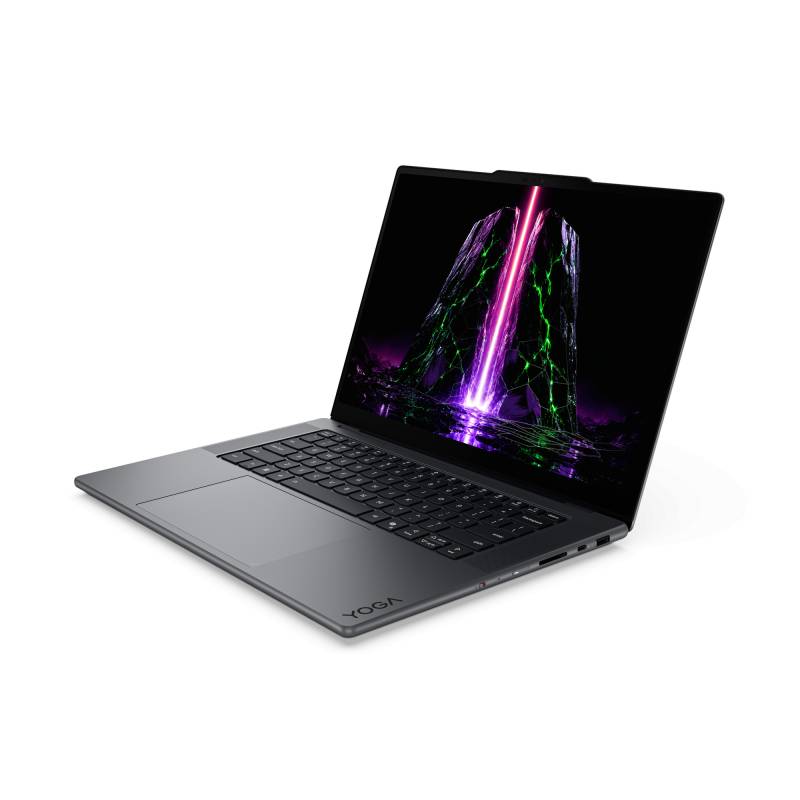
The 15″ Lenovo Yoga Pro 9n is the straight-ahead performance model in the new Yoga lineup. It pairs NVIDIA RTX Spark with a Grace CPU offering up to 20 cores and a Blackwell RTX GPU with up to 6,144 cores. Lenovo is offering up to 128GB of 9,400MHz LPDDR5X unified memory, meaning the processor and graphics hardware can draw from a shared high-speed memory pool rather than treating system memory and graphics memory as entirely separate territories. Storage can reach 4TB across two SSD slots.
Lenovo Yoga Pro 9n
That hardware targets people editing high-resolution video, rendering 3D scenes, compiling software, developing AI applications, or running local models that would overwhelm a typical ultraportable. The CUDA software stack, NVIDIA’s well-established collection of tools for GPU-accelerated computing, is part of the appeal for developers and creative apps that already know how to use it. The same RTX hardware can handle gaming, too, so this isn’t a machine that expects you to pretend a powerful GPU is only for work.
The 15.3″ PureSight Pro OLED display has a 2560 by 1600 resolution, a 16:10 aspect ratio, a variable 48Hz to 165Hz refresh rate, and peak HDR brightness rated at 1,100 nits. It covers 100% of the sRGB and P3 color spaces, with touch offered on some configurations. There’s also a 9.2-megapixel infrared camera, a haptic Force Pad that can accept pen input, four speakers with Dolby Atmos, Wi-Fi 7, Bluetooth 5.4, a 92.5Wh battery, and 140W charging. Lenovo lists the aluminum laptop at a starting weight of 3.64 pounds and as thin as 0.66″.
Lenovo Yoga 9n 2-in-1
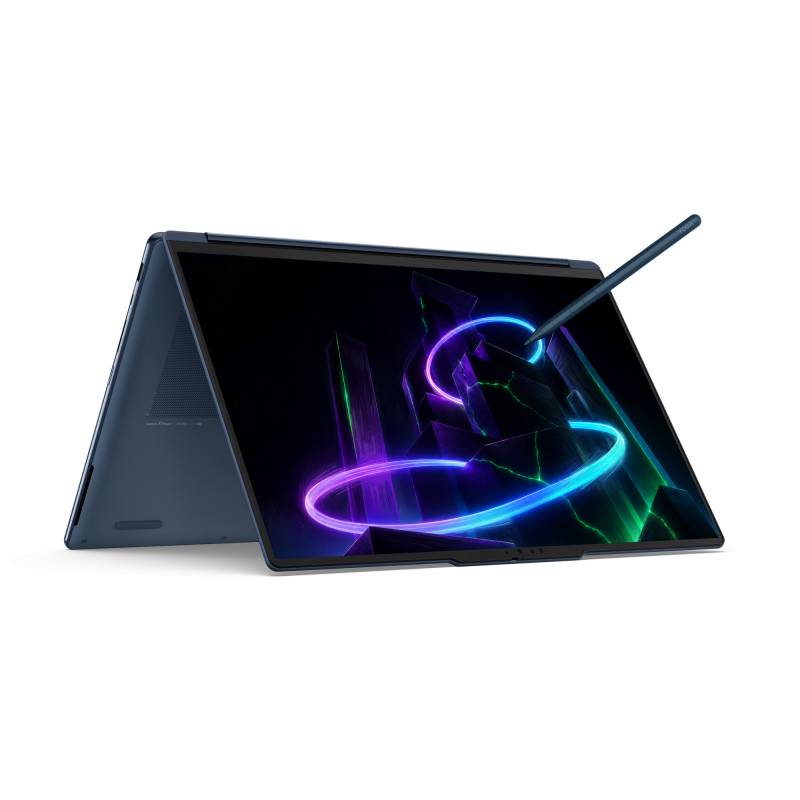
The 16″ Yoga 9n 2-in-1 takes much of that performance idea and wraps it in a 360-degree convertible. It tops out at 64GB of unified memory and 2TB of PCIe Gen 4 SSD storage, while keeping the same general RTX Spark pairing of a Grace CPU and Blackwell RTX graphics. The 16″ 2880 by 1800 OLED panel runs from 30Hz to 120Hz, reaches a claimed 1,100 nits in HDR, supports touch, and is designed for the Yoga Pen Gen 2.
The clever part is that the pen can work on both the screen and the haptic Force Pad. That gives you a second drawing or navigation surface when you don’t want your hand covering the display. The laptop can move among laptop, tablet, tent, stand, and canvas positions, and its six-speaker Dolby Atmos system puts two tweeters in the rotating soundbar so they keep firing toward you as the hinge moves. A 99.9Wh battery is paired with 140W charging, and Lenovo rates a 15-minute Rapid Charge Express session for up to three hours of use under its test conditions. At 4.28 pounds, though, this is a convertible in the “portable workstation” sense, not the “forget it’s in your bag” sense.
Both new Yoga laptops include USB4, USB-A, HDMI 2.1, an audio jack, and an SD card reader, with the Pro model getting the faster UHS-II reader while the convertible uses UHS-I. Lenovo hasn’t announced estimated pricing or an on-sale date for either laptop yet. That missing number matters. Specs this ambitious tend to stop feeling whimsical the moment the configuration page opens.
Two Yoga Tablets Make the Pen the Starting Point
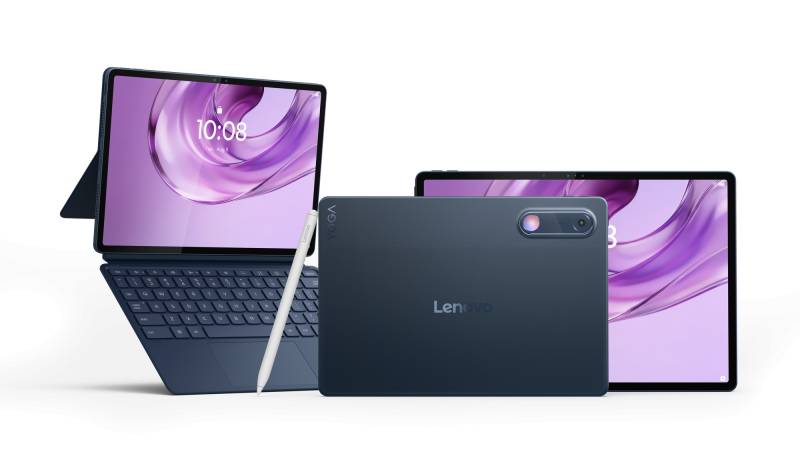
The Yoga Tab Plus Gen 2 and Yoga Tab Gen 2 are more approachable, at least in the sense that Lenovo has provided prices. Both ship with Android 17 and are built around pen, touch, voice, and camera input, with native features including Lenovo AI Vision, Smart AI Input, AI Creation Tools, AI Note, Live Transcript, and Qira. The Tab Pen Pro 2 supports 8,192 pressure levels, tilt detection, palm rejection, squeeze-to-select, click-to-draw, flip-to-erase, and other gestures intended to make it feel less like a plastic accessory that lives forgotten in a drawer.
Lenovo Yoga Tab Gen 2 Family
The $999.99 Yoga Tab Plus Gen 2 is the larger model, with a 13″ 3840 by 2560 display in a roomy 3:2 aspect ratio. It can refresh at up to 144Hz, covers 100% of the DCI-P3 color gamut, and reaches a claimed 1,100 nits at peak brightness. A Snapdragon 8 Elite Mobile Platform handles processing, with configurations up to 16GB of RAM and 512GB of internal storage. A microSD slot can add up to 2TB more, which is still worth applauding in a world where expandable storage is still treated like an eccentric hobby.
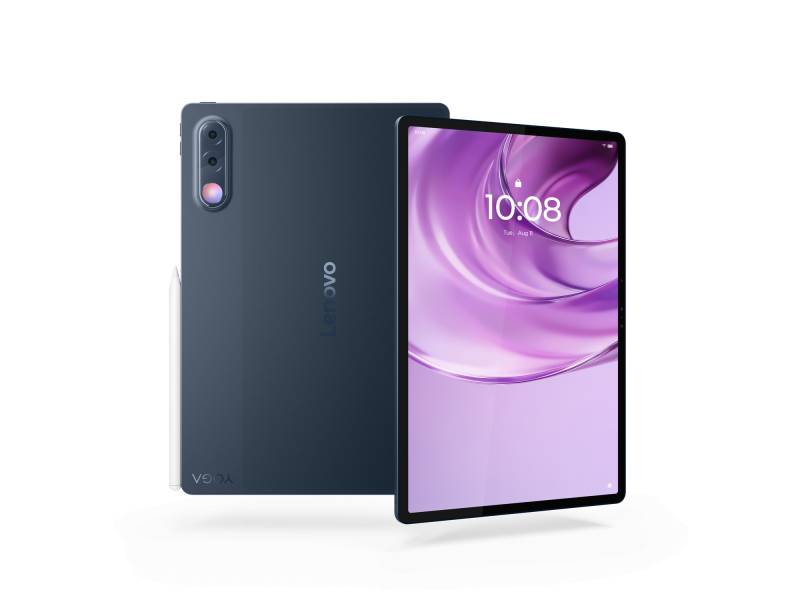
Lenovo Yoga Tab Plus Gen 2
Its 12,700mAh battery supports 68W charging, and the tablet has six Harman Kardon speakers, Wi-Fi 7, Bluetooth 6.0, a 13-megapixel rear camera with a 2-megapixel macro camera, and a front camera arrangement designed to support video and AI features. The tablet alone starts at 1.33 pounds. A one-step magnetic clamshell keyboard can turn it into a more conventional work setup when a screen keyboard won’t cut it.
The $729.99 Yoga Tab Gen 2 shrinks the idea to an 11.1″ 4K display with the same 3:2 shape and up to 144Hz refresh rate. It uses MediaTek’s Dimensity 9500s processor, offers up to 12GB of RAM and 256GB of internal storage, and also accepts microSD cards up to 2TB. The 11,000mAh battery supports 68W charging, and the tablet weighs about 1.06 pounds before accessories. An available detachable 2-in-1 keyboard pack includes a stand and keyboard, making it easier to picture carrying between classes, meetings, a couch, and a coffee shop without feeling like you packed a second laptop.
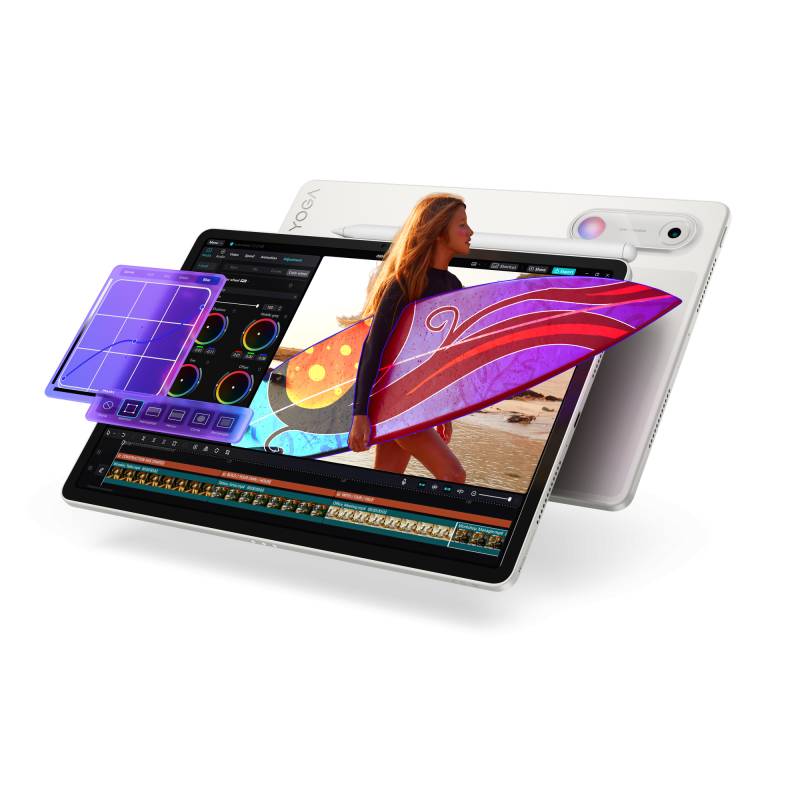
Lenovo Yoga Tab Gen 2
Lenovo is promising seven Android operating system upgrades for both tablets, taking them through Android 24, plus security updates through 2033. That’s an unusually long runway for an Android tablet, although the company notes that upgrade timing, market availability, carrier involvement, and specific features can vary. Both tablets are expected in September 2026.
Smart Canvas and Qira Try to Connect the Messy Middle
Lenovo Smart Canvas Concept is not a product you can buy. It’s a demonstration of how the company wants compatible devices to hand work back and forth using pen, voice, camera, and touch. Lenovo is showing the concept with a Yoga AIO i Aura Edition (32″, 11) and Yoga Tab Gen 2, with the idea that a sketch or note started on one device could continue on another without the usual ritual of exporting, emailing, syncing, and wondering which version is the current one.
That’s also where Qira starts to make more sense as a strategy rather than another isolated AI feature. A contextual assistant is more valuable if it can remember what you were doing across devices and less valuable if every machine behaves like it just met you. The obvious questions are privacy, interoperability, and whether the experience remains useful outside Lenovo’s own hardware. For now, Smart Canvas remains a concept, and several Qira features depend on compatible hardware, software updates, internet access, supported apps, and regional availability. That’s enough fine print to keep expectations properly seated.
IdeaPad Vibe Trades Laptop Gray for Something More Personal
The IdeaPad Vibe series aims at a different problem: most affordable laptops look as if color was removed during a budget meeting. The 14″ and 15″ models will come in Dreamy Violet, Spicy Gold, Zen Green, Chill Blue, Radiant Coral, Moody Blue, and Lowkey Grey, with the palette developed in consultation with Pantone. Optional swappable keycaps add another layer of customization. It’s a cosmetic idea, certainly, but there’s no law requiring a practical computer to resemble office carpeting. OLED configurations are specifically tied to Lowkey Grey and Moody Blue where supported.
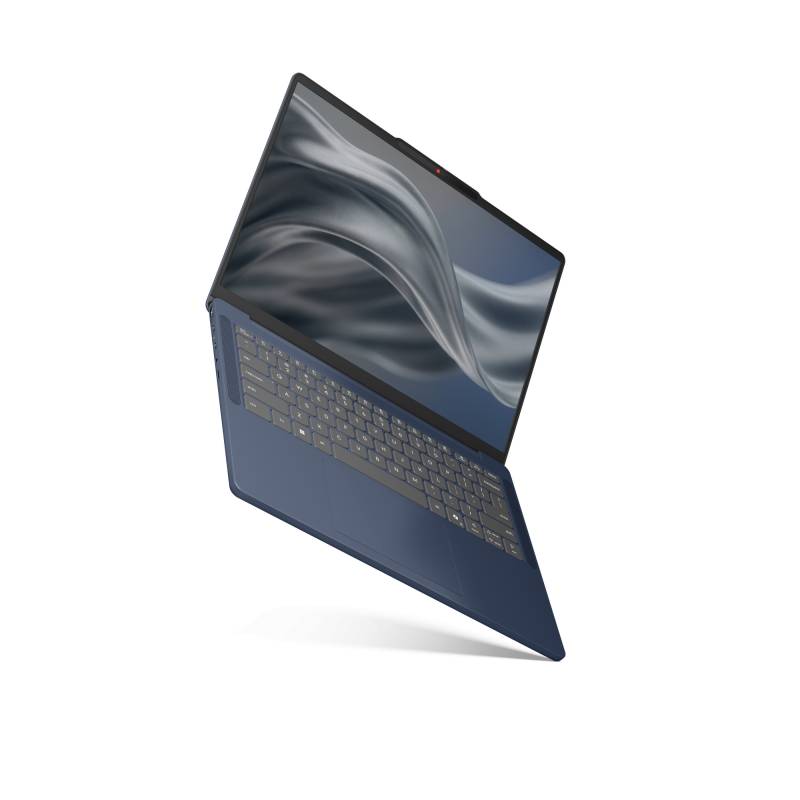
Lenovo IdeaPad Vibe
The first IdeaPad Vibe configurations will use either Snapdragon X processors or AMD Ryzen AI 400 Series chips. Snapdragon versions qualify as Copilot+ PCs on supported configurations and can be equipped with up to 24GB of memory, while AMD models can reach 32GB with upgradeable dual-channel memory. Storage goes up to 1TB with two SSD slots. The 14″ model can be ordered with a WUXGA OLED display covering 100% of DCI-P3, while the 15″ version steps up to a 2.1K OLED panel with the same wide color coverage and optional touch. IPS choices with up to 120Hz refresh rates are also part of the mix.
Connectivity is refreshingly ordinary in the best sense. The machines include USB-A, USB-C with power delivery and DisplayPort output, HDMI, a microSD card reader, and a headset jack. Wi-Fi 7 and Bluetooth are available, and a 5-megapixel infrared camera includes a privacy shutter. The AMD versions offer 50Wh or 65Wh battery choices, while the Snapdragon spec lists a 50Wh battery. The 14″ models start around 2.87 pounds, with the 15″ versions around 3.31 pounds.
AMD IdeaPad Vibe models are expected in October 2026 starting at $699.99. Snapdragon versions are expected in November at the same $699.99 starting price, with additional Intel-powered offerings planned later. As always, the interesting configuration is unlikely to be the one represented by the smallest number in the press material, particularly once OLED, more memory, and larger storage enter the picture.
IdeaCentre AIO i Brings Color and a Cleaner Desk
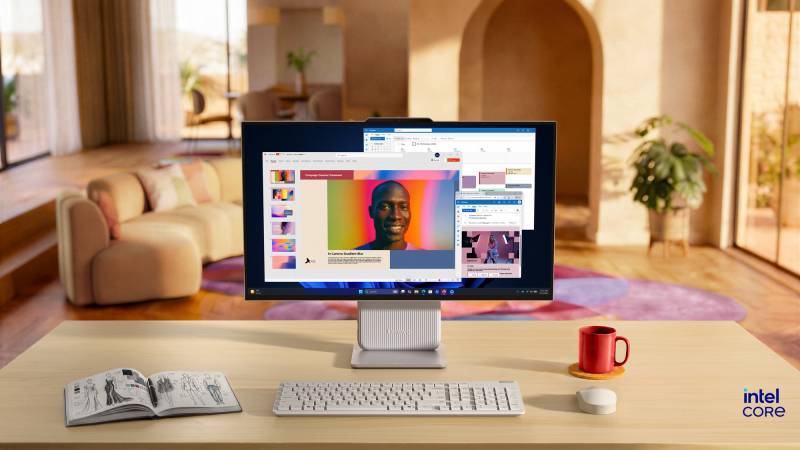
The IdeaCentre AIO i is Lenovo’s attempt to make the family desktop feel less like equipment. It comes in 23.8″ and 27″ sizes, with Cloud Grey and Luna Grey joined by Zen Green, Chill Blue, Dreamy Violet, and Radiant Coral. Both versions use full HD IPS displays with up to a 120Hz refresh rate, 350 nits of brightness, low-blue-light hardware, and optional touch. The 24″ model supports 8GB or 16GB of LPDDR5X memory, while the 27″ can be configured with 16GB or 32GB.
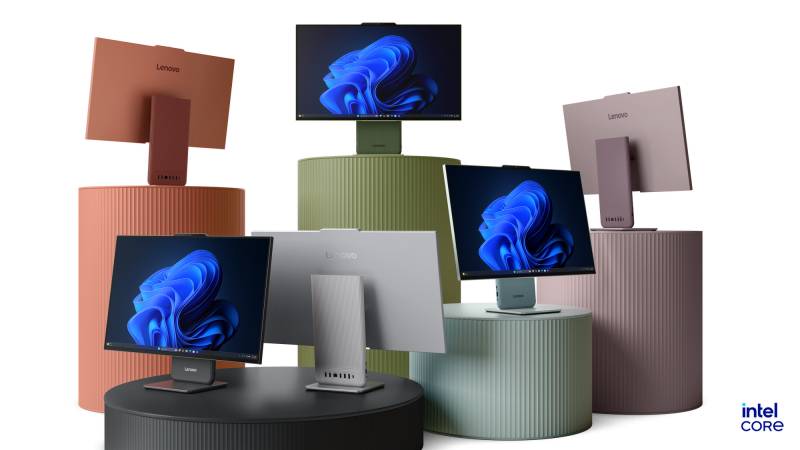
Lenovo IdeaCentre AIO i
Processing goes up to an Intel Core i7 350, and storage options include 512GB or 1TB PCIe SSDs. Lenovo has also removed the bulky center box often found behind an all-in-one display, giving the machine a cleaner profile. The stand provides 30mm of vertical adjustment and tilts from -5 degrees to 15 degrees. It offers a 5-megapixel or infrared camera, plus stereo Harman-tuned speakers.
It has six USB ports split between USB-A and USB-C, plus Ethernet, a headset jack, and an HDMI connection that works for both input and output. HDMI-in is the sleeper feature here because it lets the AIO serve as a display for another device instead of becoming a large, attractive paperweight when the internal computer eventually feels old. Some configurations include optional 15W wireless charging, and Wi-Fi 7 is available.

Lenovo IdeaCentre AIO i
Adaptive Lighting adds configurable lighting effects for startup, everyday use, and music, but those controls are expected to arrive through a future over-the-air software update rather than being ready on day one. The matching Lenovo Essential Wireless Combo Gen 3 keyboard and mouse may also be sold separately depending on the market. The 23.8″ IdeaCentre AIO i is expected in November starting at $939.99, while the 27″ version is expected to start at $1,149.99.
ThinkCentre X Ultra Packs AI into 1.6 Liters
Lenovo’s business announcements get more interesting with the ThinkCentre X Ultra, a 1.6-liter desktop measuring about 7.2″ square and 2″ tall. It can be configured with an AMD Ryzen AI Max+ PRO 495 processor, an NPU rated for up to 55 TOPS, and up to 128GB of high-speed unified memory. TOPS means trillions of operations per second, a rough measure of AI acceleration. It isn’t a universal performance score, but it helps show how much dedicated AI compute a chip is designed to provide.
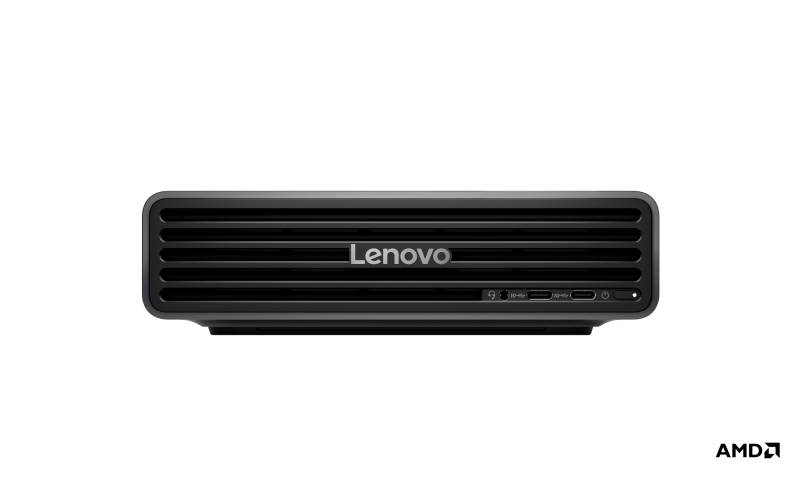
Lenovo ThinkCentre X Ultra
The X Ultra can use integrated Radeon 8065S graphics with up to 96GB of graphics memory, and storage can reach 8TB across two M.2 SSDs. Two Thunderbolt 4 ports, two front USB-C ports, USB-A, DisplayPort 2.1, HDMI 2.1, 10-gigabit Ethernet, Wi-Fi 7, and Bluetooth 5.4 make it unusually well connected for something this small. Lenovo’s thermal design is intended to keep sustained workloads from turning the tiny chassis into a desktop hair dryer.
The more unusual feature is clustering. Up to four ThinkCentre X Ultra systems can connect as a unified platform, so larger AI models and multi-agent workloads can draw on more compute and memory. That won’t matter to someone whose most demanding task is a spreadsheet with emotional baggage, but it could appeal to developers or organizations that want substantial local AI capability without a rack-mounted server. The ThinkCentre X Ultra is expected in November starting at $3,699.

Lenovo ThinkCentre M75q
The ThinkCentre M75 family covers more conventional business needs. The tiny M75q Gen 6 can be configured with up to an AMD Ryzen AI 7 PRO 450GE processor, a 50 TOPS NPU, 64GB of DDR5 memory, and two 2TB SSDs. It can sit behind a monitor, hide in a desk, and drive up to four displays. It’s expected in September and starts at $1,379.
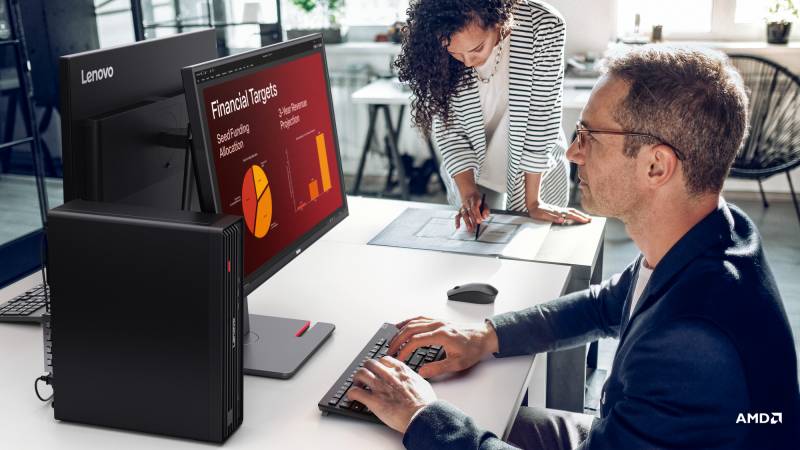
Lenovo ThinkCentre M75s
The small-form-factor M75s Gen 6 moves up to an AMD Ryzen AI 7 PRO 450G, supports 64GB of memory, offers integrated Radeon 860M or discrete Radeon RX 6400 graphics, and can combine SSD and hard-drive storage with internal expansion slots. It’s expected in October starting at $1,489.
ThinkBook 14 Gen 9 and 14x Gen 2 Take Two Routes to Mobility
The ThinkBook 14 Gen 9 is Lenovo’s more AI-focused new business notebook. It uses Qualcomm’s Snapdragon X2 Plus platform and delivers 80 TOPS of AI performance. The 14″ WUXGA display reaches 400 nits and can be ordered with touch; memory tops out at 32GB, storage reaches 1TB with room for a second SSD, and the laptop weighs about 2.87 pounds.
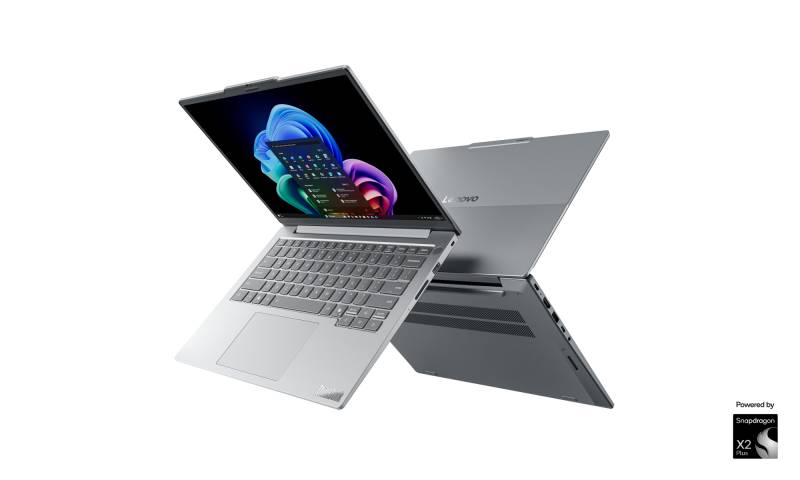
Lenovo ThinkBook 14 Gen 9
Lenovo is also emphasizing battery life, claiming up to 26 hours of local video playback under its internal test conditions. That number shouldn’t be mistaken for 26 hours of Zoom, browser tabs, spreadsheets, and whatever else a real workday can inflict on a battery, but it suggests efficiency is a priority. The 50Wh battery charges over USB-C, while Wi-Fi 7, HDMI 2.1, two USB-C ports, two USB-A ports, an SD card reader, an audio jack, and a Kensington lock keep the machine office-friendly. It’s expected in October starting at $1,299.
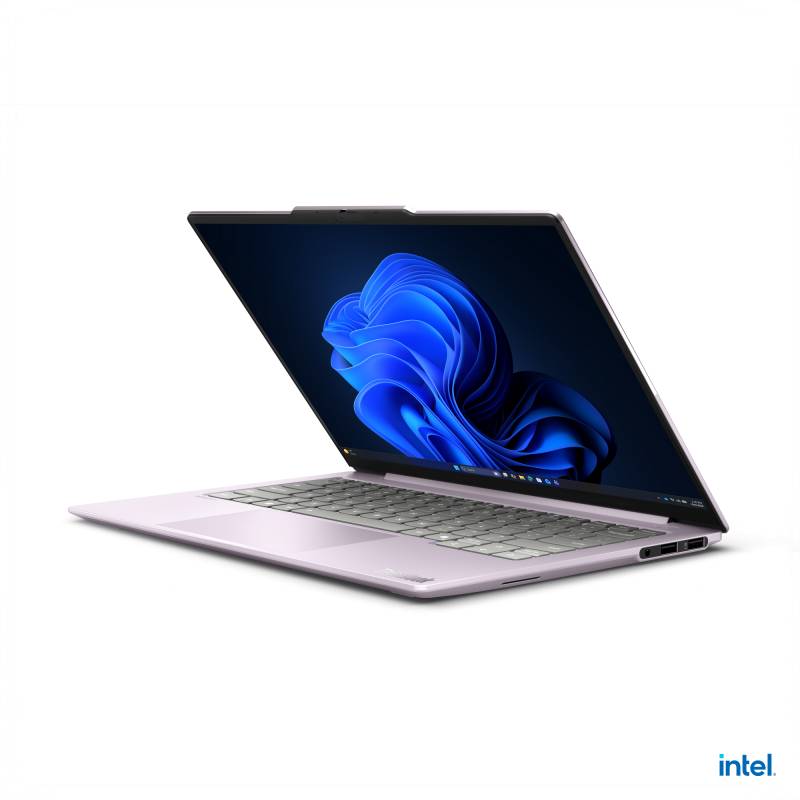
Lenovo ThinkBook 14x Gen 2
The ThinkBook 14x Gen 2 goes after portability instead. Lenovo lists it at just 2.18 pounds and as thin as 0.5″, with Intel Core 7 Series 3 processors, up to 32GB of LPDDR5X memory, and up to 2TB of storage. Display choices include a 14″ 2.8K OLED panel running at 120Hz with 100% DCI-P3 coverage and 500 nits of brightness, or a WUXGA 120Hz LCD with 100% sRGB coverage and optional touch.
Battery options are 54.7Wh or 65Wh, and ports include two USB-C, two USB-A, HDMI 2.1, and an audio jack. Wi-Fi 6E or Wi-Fi 7 will be available depending on configuration. Celestial White, Luna Grey, Veil Blue, and Mystic Violet finishes add some welcome variation to business-laptop aesthetics. The ThinkBook 14x Gen 2 is expected in the first quarter of 2027 starting at $999.99.
Lenovo’s Concepts Are the Most Interesting Things You Can’t Buy Yet
Project AeroBlade is the sort of concept that makes ordinary laptop spec sheets look sleepy. The 14″ prototype is under 10mm thick and under 830 grams, or about 1.83 pounds, yet it uses a fanless cooling system designed to sustain performance. Lenovo developed its Active Flow thermal solution with Frore Systems, using AirJet solid-state cooling technology instead of conventional spinning fans.
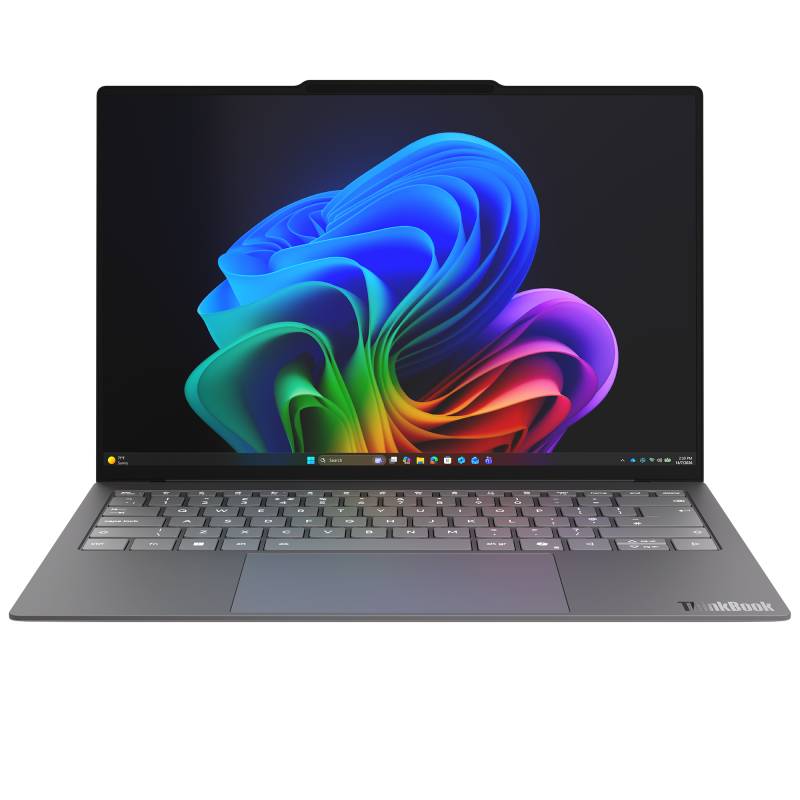
Lenovo ThinkBook Project AeroBlade
The point isn’t merely silence. Removing a fan can reduce dust intake and mechanical complexity, but thin computers usually pay for that simplicity by throttling performance when heat builds. AeroBlade is Lenovo’s attempt to see whether solid-state airflow can keep a slim machine fast for longer. The concept also uses magnesium-aluminum construction, an OLED display with a high screen-to-body ratio, Thunderbolt 4, and Wi-Fi 7. There’s no announced price or release date because, for now, it’s a proof of concept.
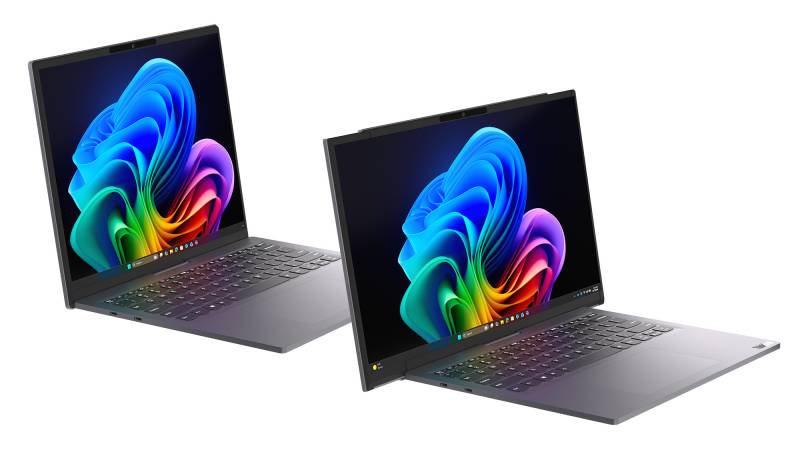
Lenovo ThinkBook Project Swan
Project Swan takes the opposite approach to screen size. It begins as a portable 14″ notebook, then rolls out into a 17″ 16:9 display when you need more room for side-by-side documents, dashboards, editing tools, or presentations. Lenovo lists the concept at 17.9mm thick and 1.6 kilograms, or about 3.53 pounds. A rollable laptop still has to answer plenty of questions about durability, long-term panel wear, and whether the mechanical complexity is worth it, but the problem it’s trying to solve is real: large screens are useful, and large laptops are annoying to carry.
ThinkVision Monitors Put More of the Meeting into the Screen
Lenovo’s new ThinkVision displays lean heavily into docking and video collaboration. The 34″ ThinkVision P34WD-4v uses a 3440 by 1440 IPS ultrawide panel with a 24Hz to 120Hz adaptive refresh range, HDR10, 98% DCI-P3 coverage, and 99% coverage of both sRGB and BT.709. It includes Thunderbolt 4 input and output, HDMI 2.1, DisplayPort 1.4, and DisplayPort output for daisy-chaining another screen.
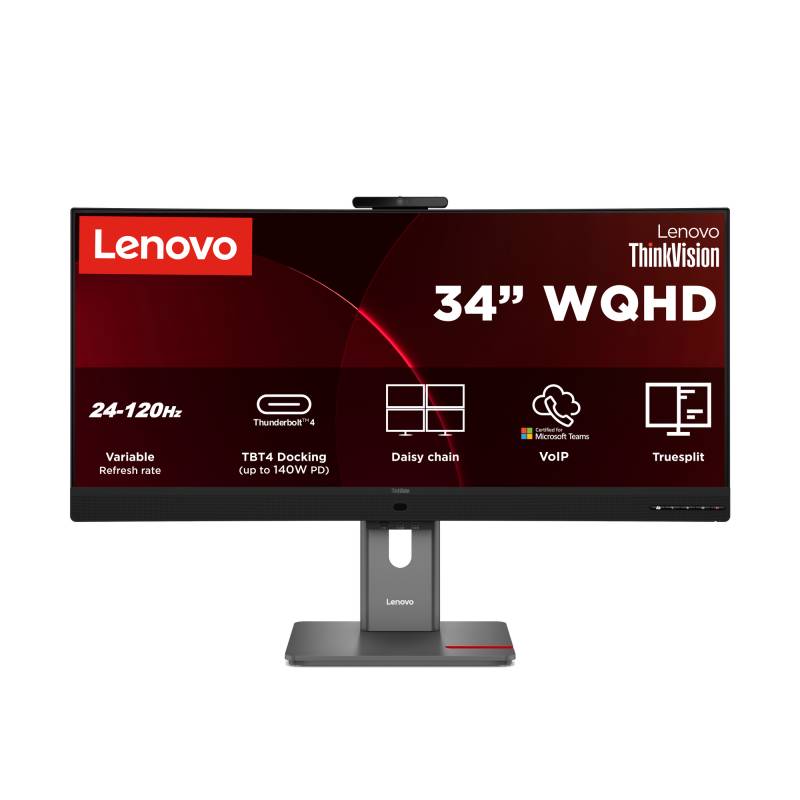
Lenovo 34″ ThinkVision P34WD-4v
More unusually, the P34WD-4v integrates a 5-megapixel camera and sensor-based meeting features that can keep a face centered, detect multiple participants, adjust speaker volume based on distance, and support Windows Hello sign-in. Other sensors can adjust brightness, dim the display when you leave, encourage healthier viewing distance, and detect someone looking over your shoulder. It’s expected in December 2027 starting at $699, an unusually long gap between announcement and planned availability.
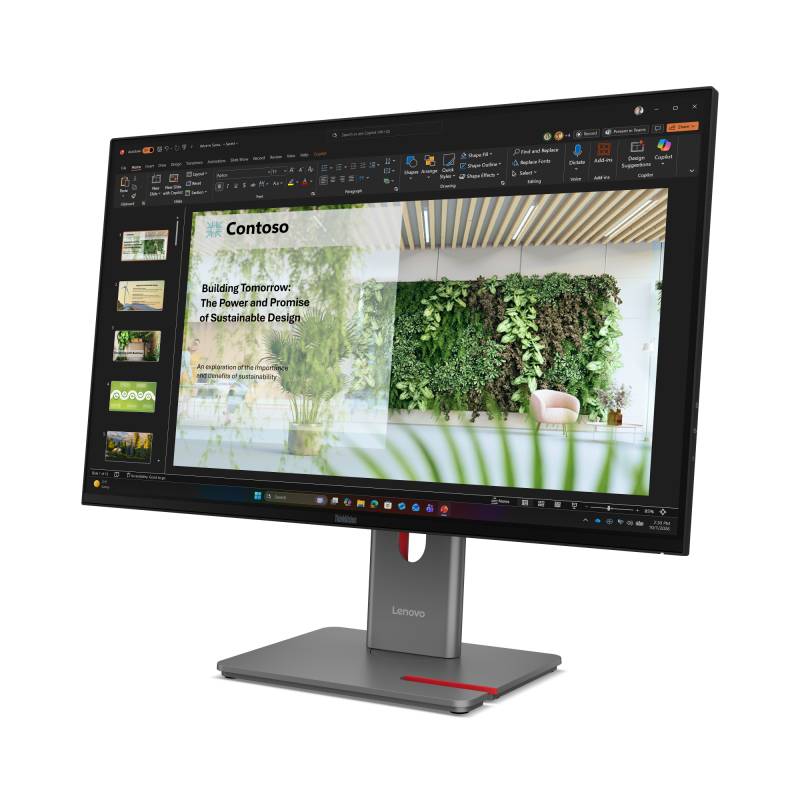
Lenovo ThinkVision P27UL-40
The ThinkVision P27UL-40 is aimed more squarely at visual work. Its 27″ 4K OLED panel uses an inkjet-printing manufacturing process, with 3840 by 2160 resolution, up to a 120Hz refresh rate, 99% DCI-P3 coverage, 100% sRGB coverage, and VESA DisplayHDR True Black 500 certification. Lenovo is also touting the RGB pixel layout for sharper text and reduced color fringing, a legitimate concern with some OLED subpixel arrangements when the display is used for documents instead of movies.
Thunderbolt 4 docking, Thunderbolt 4 output, HDMI 2.1, DisplayPort input and output, automatic OLED panel maintenance, synchronized brightness with compatible Lenovo laptops, and remote management through Lenovo Display Fleet Manager round out the package. The P27UL-40 is expected in March 2027 starting at $1,299.
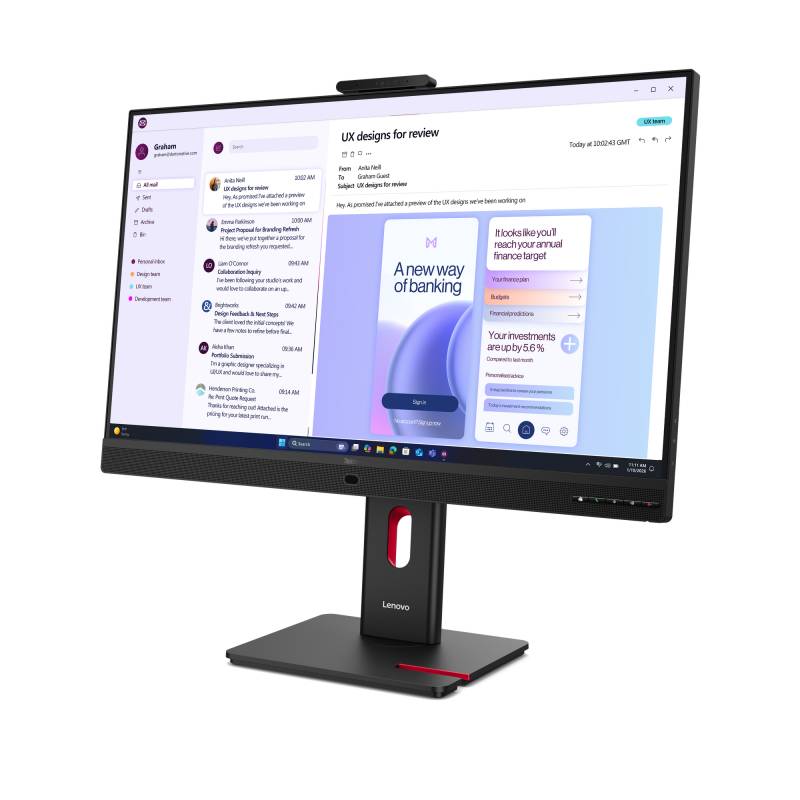
Lenovo 31.5″ ThinkVision T32UD-4v
The new T-series models cover more mainstream office setups. The 31.5″ ThinkVision T32UD-4v uses a 4K IPS panel with up to a 120Hz refresh rate, while the 34″ ThinkVision T34WD-4v uses a 3440 by 1440 ultrawide VA panel, also topping out at 120Hz.
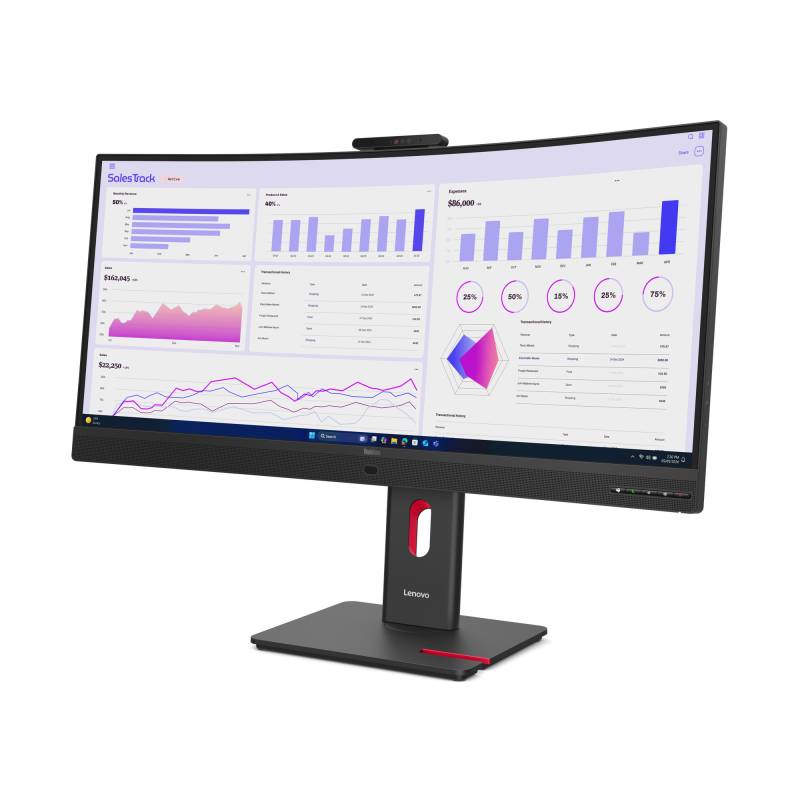
Lenovo ThinkVision T34WD-4v
Both combine Microsoft Teams certification, Windows Hello, USB-C docking with up to 100W power delivery, and AI-assisted comfort and privacy tools. The T34WD-4v is expected in January 2027 starting at $999, with the T32UD-4v following in February at $899.
ThinkShield Extends the AI Story into Security
The least glamorous part of Lenovo’s announcement may be one of the more consequential for businesses. ThinkShield TraceLock, powered by Absolute Security, is designed for select ThinkPad X1, X, and T-series machines with always-on cellular connectivity. Firmware-level persistence can let IT teams locate, wake, lock, or wipe a supported laptop even when it’s powered off or disconnected from normal Wi-Fi. For a company with sensitive data scattered across traveling laptops, that’s easier to justify than another animated assistant.
Prompt Security, a SentinelOne company, is also being offered through ThinkShield to help organizations watch how generative AI tools are being used, enforce policies, and reduce the chances of sensitive information wandering into an unapproved service. The challenge here is the familiar one: companies want employees to benefit from AI tools while also wanting to know where proprietary data is going. Governance software won’t resolve that tension by itself, but it gives IT departments more visibility than hoping everyone reads the policy document.
Pricing, Availability, and the Fine Print
Lenovo Innovation World 2026’s lineup spans an unusually wide range, from a $699.99 IdeaPad Vibe to a $3,699 ThinkCentre X Ultra, with tablets, all-in-ones, business notebooks, monitors, and concepts filling the space in between. The Yoga Tab Gen 2 and Yoga Tab Plus Gen 2 arrive first in September, along with the ThinkCentre M75q Gen 6. October brings the AMD IdeaPad Vibe, ThinkCentre M75s Gen 6, and ThinkBook 14 Gen 9. Snapdragon IdeaPad Vibe models, the IdeaCentre AIO i, and ThinkCentre X Ultra are expected in November, while the new ThinkVision displays and ThinkBook 14x Gen 2 extend the rollout well into 2027.
Estimated prices don’t include every configuration, tax, shipping, or optional accessories, and availability can vary by market. Battery-life and charging claims come from controlled testing, display features can differ by configuration, and several AI functions may require later software updates, compatible apps, an internet connection, or supported hardware. Adaptive Lighting on the IdeaCentre AIO i is specifically slated for a future software update, and Smart Canvas remains a concept rather than a shipping feature.
Taken together, the announcements show Lenovo trying to make AI less of a single button and more of an architectural decision running through hardware, software, and connected devices. The strongest ideas are the ones that solve recognizable annoyances even if you mentally delete the letters “AI” from the pitch: a convertible with a second pen surface, an affordable laptop that isn’t gray, an all-in-one with HDMI input, a tiny workstation with serious memory, a rollable screen that expands when you need it, and monitors that can replace a docking station. Whether Qira and the broader AI layer become equally useful will take longer to judge.

Be the first to comment on "Lenovo Goes Wide at Lenovo Innovation World 2026 with Yoga Powerhouses, Colorful IdeaPads, Tiny ThinkCentres, and a Whole Lot of AI"