
The Lowdown
The Sony RX10V is pretty darn good at everything it does. It can take terrific photos in most situations with its full automatic setting. For accomplished photographers, the RX10V lets you control everything about the camera. Not just exposure and focus points, but everything about how the camera operates. You can tailor this camera to the way you approach photography.
Overall
Pros
- Outstanding lens and zoom range
- Amazing autofocus and AI object detection
- Incredible shooting mode customizations are possible
- Camset files let you protect your customizations and share them with other RX10V users
- Excellent image quality
- It is lightweight
- Weather sealing
Cons
- The learning curve is steep
- No built-in flash
- The rear screen only flips out and is horizontal, but it would be nice to fold out to the side and flip over
- There is only one SD card slot
2017. Nearly a decade ago. That’s when Sony dropped the incredible RX10 IV superzoom bridge camera. Its 20.1MP 1-inch stacked CMOS sensor and Zeiss 24-600mm-equivalent lens struck a chord with photographers. Lightweight and versatile, it became a “wonder” camera for travel, wildlife, birding, landscapes, and more. An RX10 V seemed perpetually promised until Sony killed the program in 2025, crushing those of us still waiting. Photographers, rejoice! Nine years later, they’ve finally dropped the Sony RX10 V 25X High Zoom Digital Camera. We’re diving into what changed—and whether it was worth the wait.
Not Your Typical Review
Most camera reviews seem to obsess over specs. It has this many megapixels, the color accuracy is this or that, and the list is endless. I will leave that to the dedicated photography review sites. I’m going to approach this review more practically and try to answer the question that really matters for cameras: does it produce pleasing images? Isn’t that what really matters in a camera?
You can have the most advanced camera in the world, but if it can’t produce images that you’ll be proud to display, either on your wall or on your socials, then who cares? That ability depends on the camera itself and how easy it is to use. The best camera in the world still sucks if nobody but PhD-trained photographers can use it.
Having said all that, let’s start with the specs, because they are important to see.
Key Specs
| Effective Sensor Resolution | |
| Image Sensor | |
| Image Stabilization | |
| ISO Sensitivity | |
| Max Recording Modes | |
| Memory Card Slot | |
| Wireless | |
| Display Type | |
| Built-In Flash/Light | |
| Battery | |
| Dimensions (W x H x D) | |
| Weight | |
| Focal Length | |
| Optical Zoom | |
| Aperture |
| Sensor Resolution | |
| Image Sensor | |
| Image Stabilization |
| Shutter Speed | |
| Bulb/Time Mode | |
| ISO Sensitivity | |
| Metering Method | |
| Exposure Modes | |
| Exposure Compensation | |
| Metering Range | |
| Continuous Shooting |
| Aspect Ratio | |
| Image File Format |
| Internal Recording | |
| Video Output | |
| Recording Limit | |
| Broadcast Output | |
| IP Streaming | |
| Built-In Microphone | |
| Audio Recording |
| Memory Card Slot | |
| Internal Storage | |
| Video I/O | |
| Audio I/O | |
| Power I/O | |
| Other I/O | |
| Wireless | |
| Mobile App Compatible | |
| Global Positioning (GPS, GLONASS, etc.) |
| Display Type | |
| Resolution |
| Type | |
| Resolution | |
| Magnification | |
| Diopter Adjustment |
| Built-In Flash/Light | |
| Shoe Mount |
| Battery | |
| Environmental Resistance | |
| Operating Conditions | |
| Dimensions (W x H x D) | |
| Weight |
| Focal Length | |
| Optical Zoom | |
| Aperture | |
| Focus Range | |
| Filter Size |
| Package Weight | |
| Box Dimensions (LxWxH) |
Now that we’ve got the tech specs out of the way, let’s answer the question: Can an avid travel photographer take the Sony RX10V and, with some basic training, produce high-quality images with it?
So, What’s New and What’s Not?
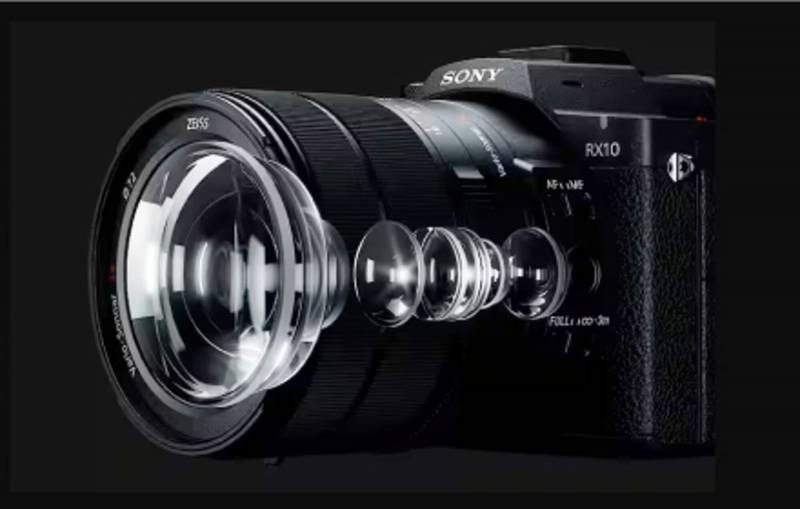
Sony decided to retain the outstanding Zeiss zoom lens from the RX10IV. With its 35mm-equivalent optical zoom range of 24mm to 600mm, it works just as well for broad landscape shots, and it does for tight zooms on distant targets. The beauty of this type of camera is that it does all that without ever having to carry and swap lenses. As a travel photographer, that’s huge.
Sony also didn’t change their 20.1MP 1″ CMOS sensor. While the 1″ sensor, at 13.2 × 8.8 mm, is considerably smaller than a full-sized sensor (36 × 24 mm) or Micro 4/3 (MFT) sensor (18 mm × 13.5 mm), it is much larger than competing superzoom cameras and small point-and-shoot cameras. They have a 1/2.3″ sensor that measures 6.3 × 4.7 mm.
What this means is that if you’re shooting for National Geographic or want to produce wall-sized enlargements, then you should be looking at an MFT sensor, a full-sized sensor, or a large-format digital camera. But if you want to produce images that can easily be printed at poster sizes, a 1″ sensor will give you vastly superior images over a 1/2.3″ sensor. Most of us fall into that last category.
The other bonus to the 1″ sensor is that it makes the camera body smaller, saving space. In addition, the smaller sensor creates an automatic crop factor versus a full-frame sensor. What this means is that the camera can actually have a smaller zoom lens while still achieving a longer optical zoom. The crop factor on a 1″ sensor is 2.7x.
The physical lens is actually a 9.1mm to 210mm zoom, but it achieves the equivalent of a 24mm to 600mm zoom on a full-frame camera. An actual 24mm to 600mm zoom would be huge and heavy, and nearly impossible to build.
OK, the zoom is the same as the last model, and so is the sensor. So what did they actually change? The smarts! The RX10V gets the same BIONZ XR processor and dedicated AI processor from the outstanding Sony Alpha series cameras. This adds much faster image processing.
That allows the camera to capture images at 30 frames per second for roughly 8.8 seconds (265 images) before the buffer needs a break to write the images to the SD card. It also brings incredible AI object recognition.
The camera can recognize and quickly focus on Human, Animal, Bird, Insect, Car, Train, and Airplane targets. Its 575 phase-detect points cover 70.6% of the still-image area.
They also ditched the old NP-FW50 lithium-ion rechargeable battery and its 1020mAh capacity, delivering about 400 still images per charge. Instead, they opted for the Alpha’s excellent NP-FZ100 rechargeable lithium-ion battery pack with 2280mAh and up to 630 images per charge.
The menu system changed from the relatively simple RX10IV menu to the Sony Alpha menu system. As you can see, this is page #4 of 58 pages of settings!
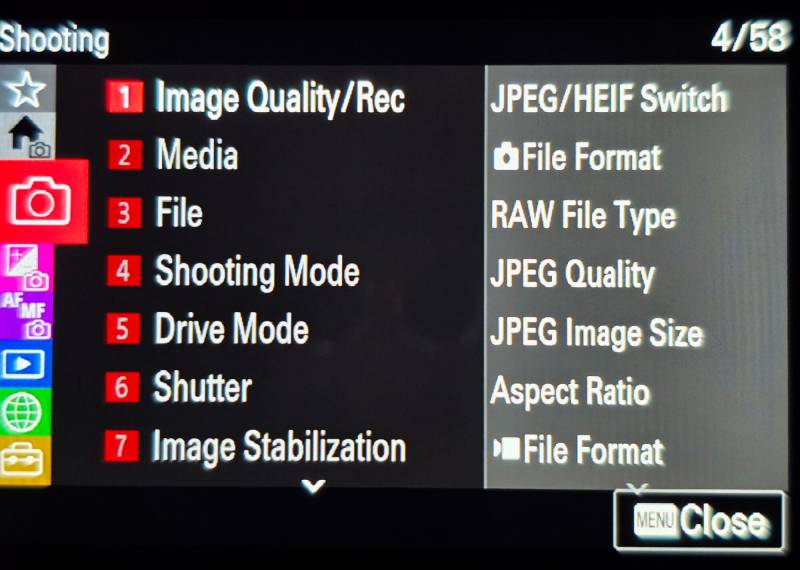
It is a much more robust menu that gives you access to every aspect of the camera and the camera controls. You can set so many shooting parameters that it is mind-boggling. Beyond that, you can reconfigure all the controls to do whatever suits your fancy. Don’t like the shutter speed dial? Change it to modify the ISO. Don’t like the Function button? Change it to modify the focus style. Seriously, you can change nearly everything. That can be a little intimidating.
Because you can set custom shooting modes, Sony added a new feature called Camsets. You can save off your custom shooting modes in a custom Camset file. Then, if you need to reset the camera to factory settings, you can reload all your customizations by restoring them from the Camset file.
The real beauty of this is that you don’t have to necessarily come up with all your own custom settings. The internet is a wonderful thing, and plenty of experts are more than willing to share their customizations.
This is actually how I got my camera initially set up. I downloaded another photographer’s Camset file, put it on an SD card, and then loaded it into my camera. Instantly, I had custom modes set up for macro shooting, landscapes, wildlife, and birds in flight. Since then, I have tweaked those modes to my liking and saved my own Camset file for safekeeping.
There are also significant improvements in video capture and processing. I personally don’t do much video work as I am primarily a travel and nature photographer. But I want to acknowledge these improvements.
It added 10-bit 4:2:2 recording with an S-Log3 workflow for professional results. You can now capture high-resolution 4x slow motion in 4K at 120P. It has a 1.38x sensor crop at 120p, but at 4K 60p, it uses the full sensor. The same AI autofocus and focus tracking from the still side are fully used when shooting video.
The other big change is the control layout. We’ll take a look at the controls in the next section.
Let’s Look At The Camera
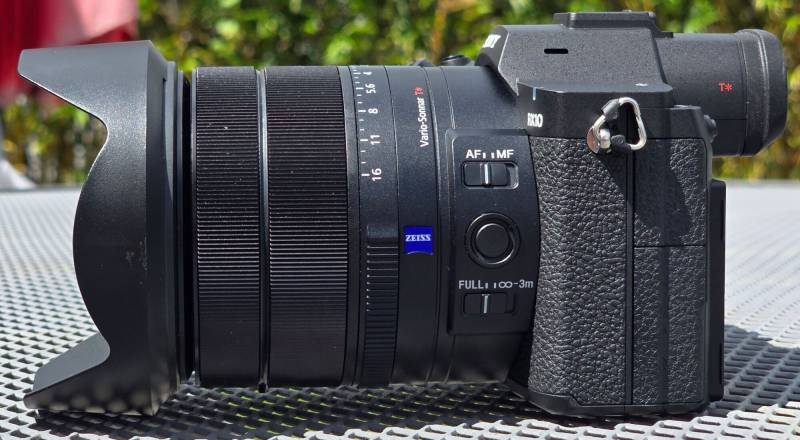
The camera retains the basic design from the RX10IV. The deep hand grip offers excellent grip and stability. Because the lens is the same, it retains the tulip lens shade that reverses for storage. You can see the shutter release button on the grip, and the Wide/Tele switch around the shutter button. You can also see one of the two shoulder strap mounts on the right side of the body.
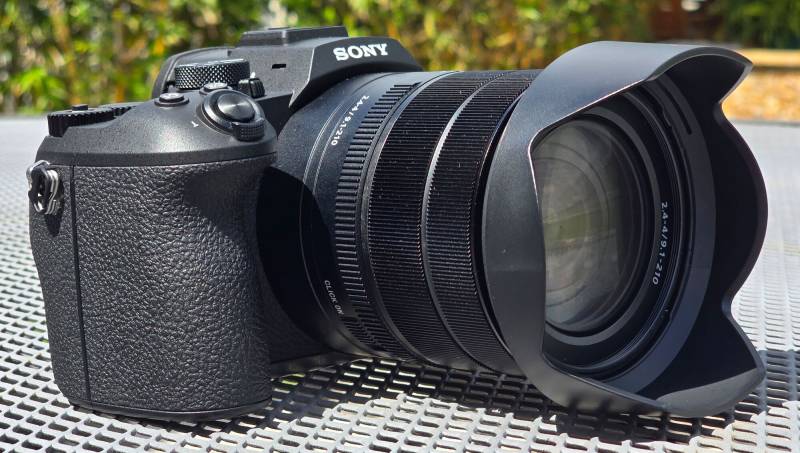
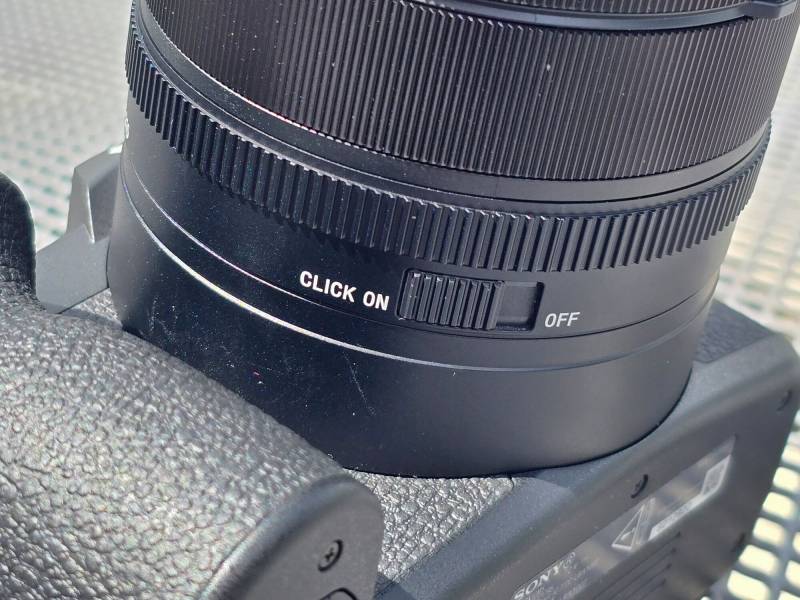
Tucked down on the right side of the lens is a click-on/off switch. This lets the aperture ring turn smoothly, or with small detents, or clicks, along the way.
The left side of the body has the auto/manual focus switch, aperture preview button, and focus distance limit switch. That switch lets you set the focus range to full or limit it to three meters to infinity to help with focus hunting.
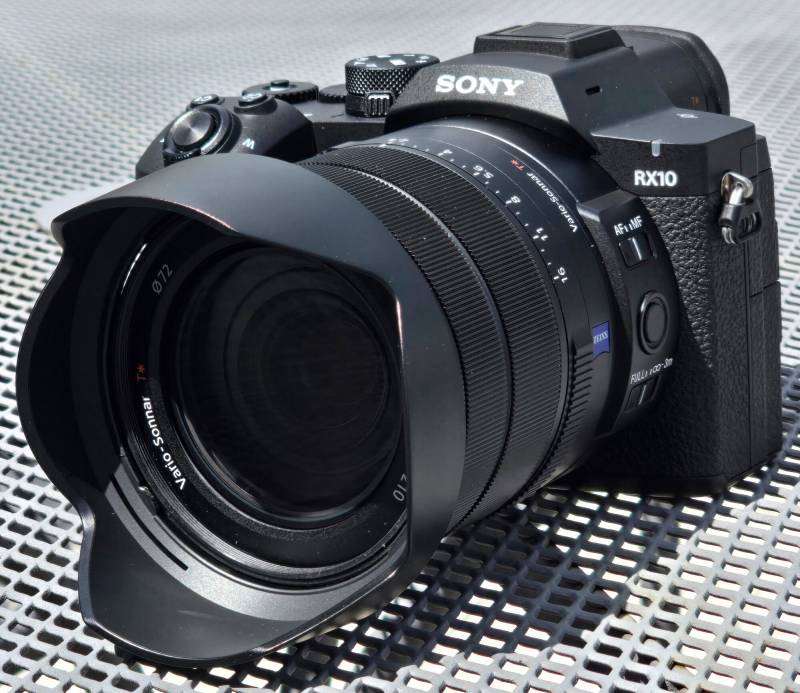
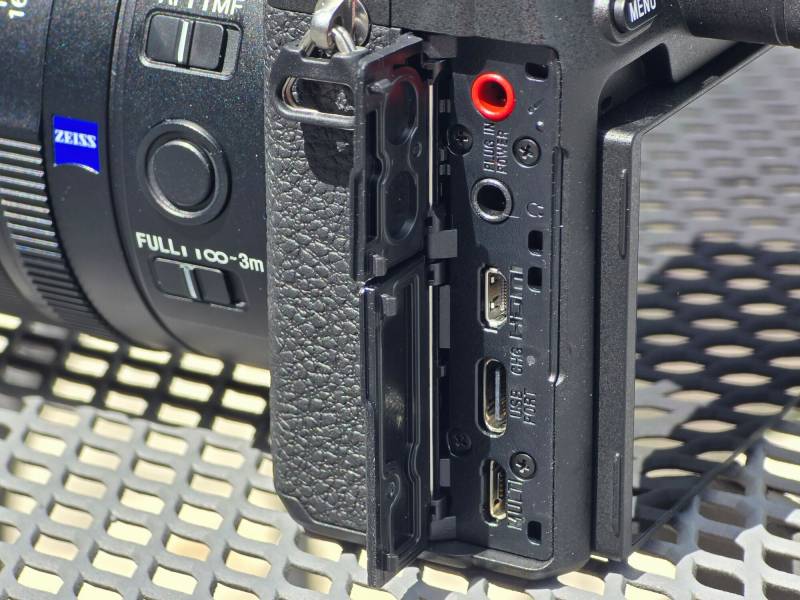
You can also see the second strap mounting point on the right side of the body. Toward the back of the body, Sony included flip-open doors that cover the accessory ports.
Under the top door, we find the 3.5mm microphone jack and the 3.5mm headphone jacks. Under the bottom door, we see the Micro HDMI port, USB-C port that is used for high-speed 10Gbps data transfer, 4K livestreaming, and charging the camera, and the Multi/Micro USB Port legacy accessory terminal primarily used for cabled remote controls. Both doors are weather-sealed.
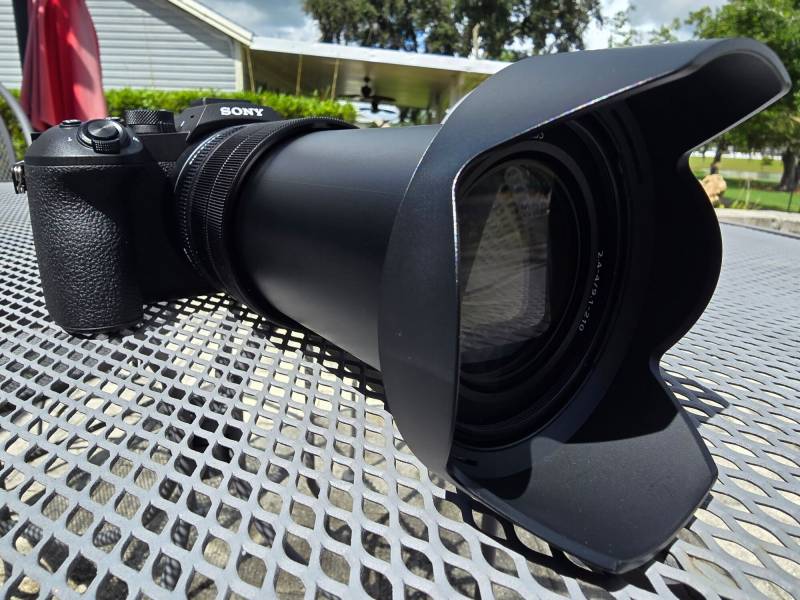
With the Zeiss zoom lens fully extended to its 600mm focal length, it makes for a pretty imposing, yet still light and well-balanced package.
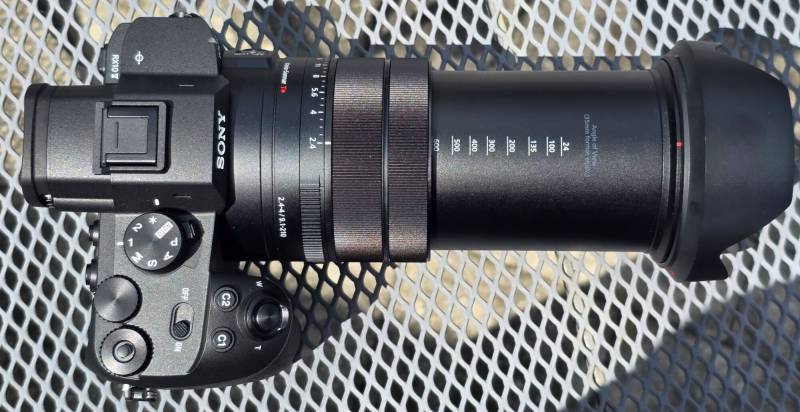
Across the top, we see the mode dial featuring full auto, programmed auto, aperture priority, shutter priority, manual, quick-access mode 1, quick-access mode 2, and * – access to up to ten custom modes. Surrounding the mode dial is a three-position switch that sets the camera to photos, movies, or S&Q – slow and quick- for time-lapse or slow-motion shooting. Just behind that are the C1 and C2 custom buttons that can be programmed to set just about any camera function.
The power switch is just to the right of the mode dial. Behind that, we see two programmable dials that can be used to control shutter speed, focus mode, or nearly anything else you want to access by a control dial. The right one has a center button that locks the dial to prevent accidental changes.
At the base of the lens is the aperture ring. Two other rings sit in front of that and can be programmed to control focus and zoom. Right on top of the body is the protective cover over the hot shoe.
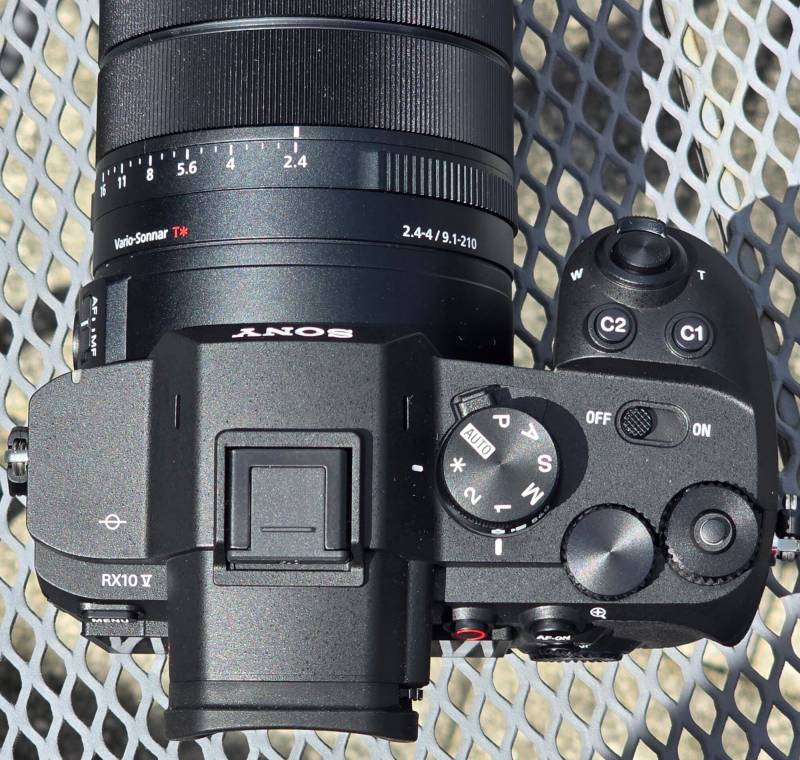
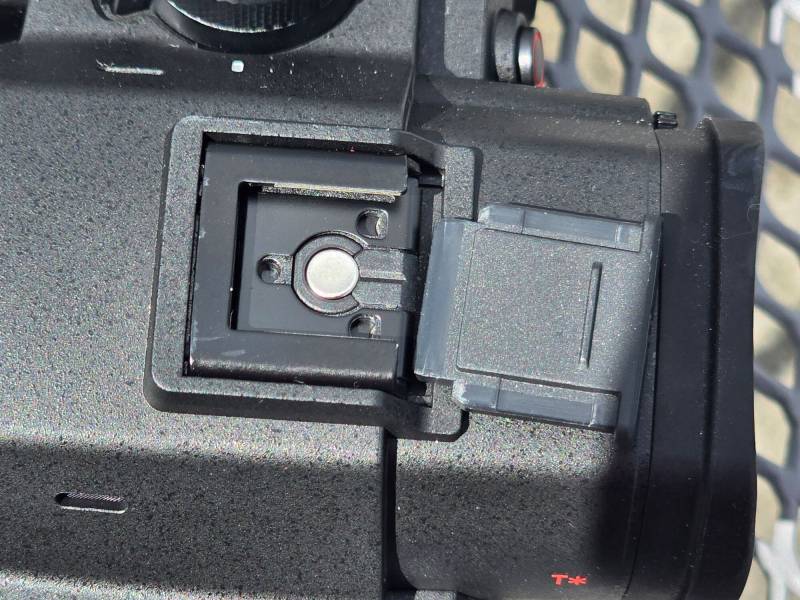
Slipping the cover off, we see the contacts for an external flash. This also highlights a negative change from the RX10IV to the RX10V: the removal of the pop-up flash.
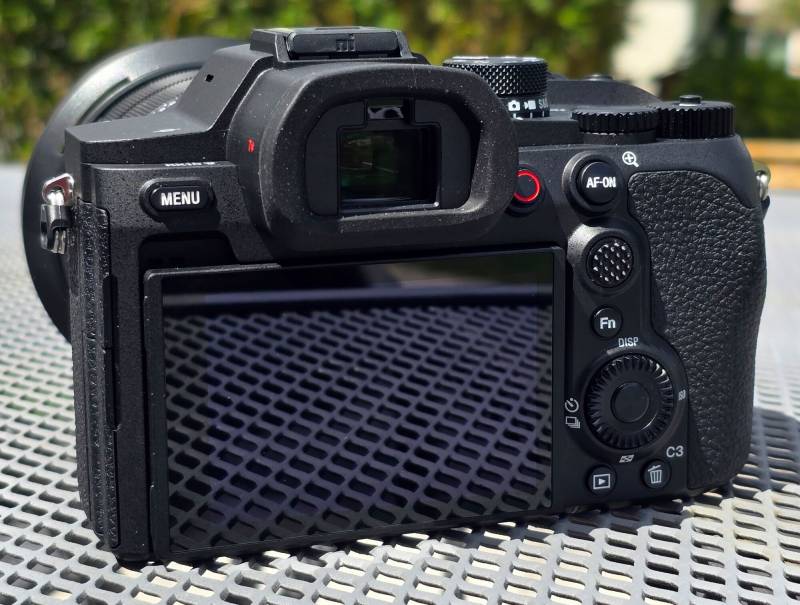
The back features an electronic viewfinder with a nice rubber pad that seals well around your eye or eyeglasses. The MENU button brings up Sony’s extensive settings menu. It is carried over from the Sony Alpha line. You can see the movie record button, autofocus-on button, joystick button, function button, multi-button, playback button, and trash button. All of these can be preprogrammed to do anything that you want them to do.
The main feature on the back is the large LCD screen. It is a touchscreen, but that can be disabled. The screen can show common settings as well as a live view. You can change the settings easily by touch or via the menu.
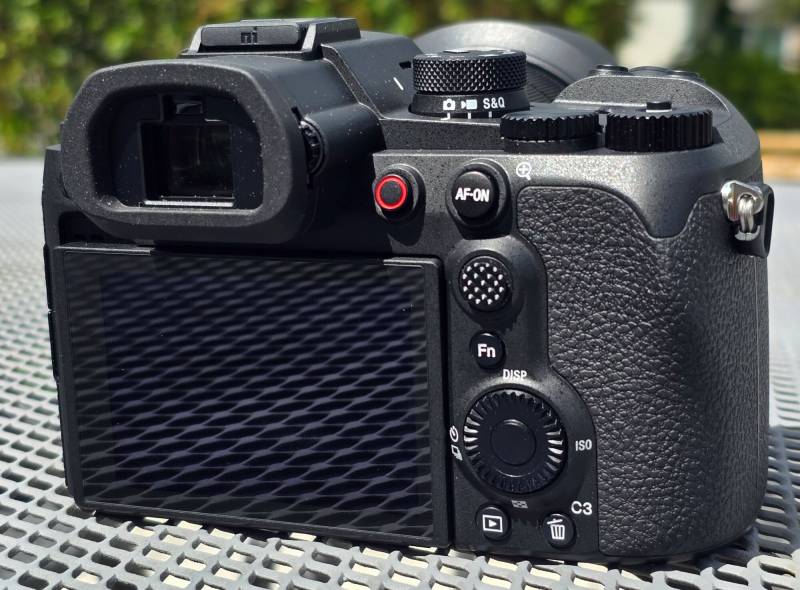
To the right of the viewfinder is the diopter dial. This lets you dial in a -4.0 to +3.0 diopter adjustment, letting you shoot without glasses. You can also get a better view of the still/movie/S&Q dial below the mode dial.
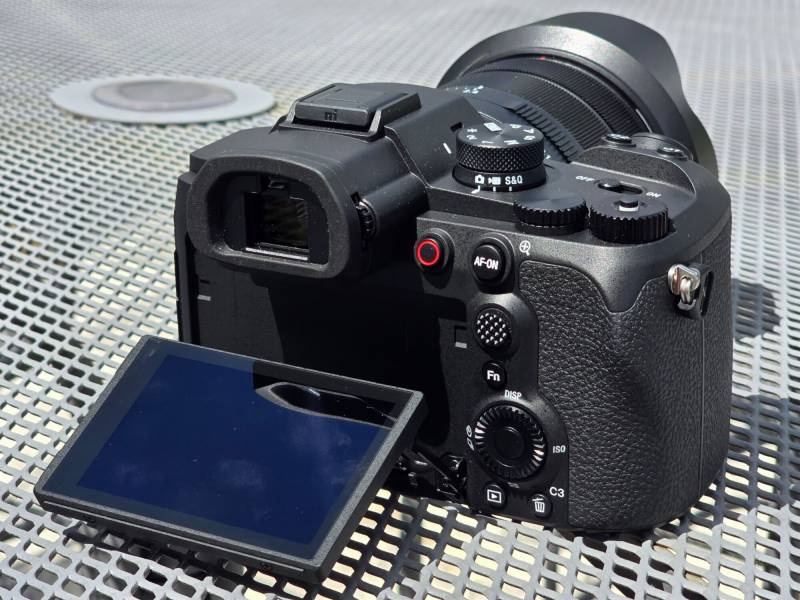
The screen flips out and can be flipped to about 45° down or 90° up. I’m surprised that they don’t allow it to flip out to the left 180° and flip around. This would let you use the RX10V effectively as a vlogging camera. That seems like a miss from Sony.
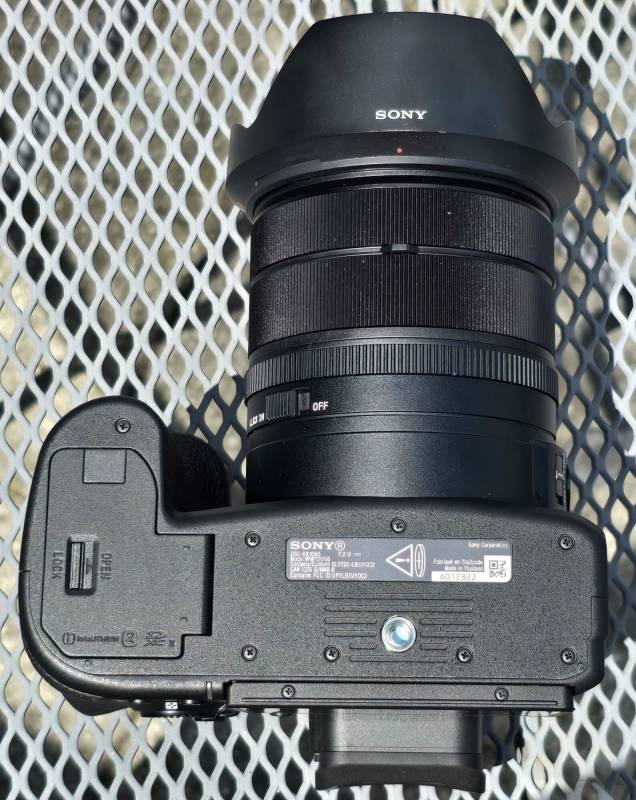
Flipping the camera over, we see the standard, threaded tripod socket and the battery/SD card door.
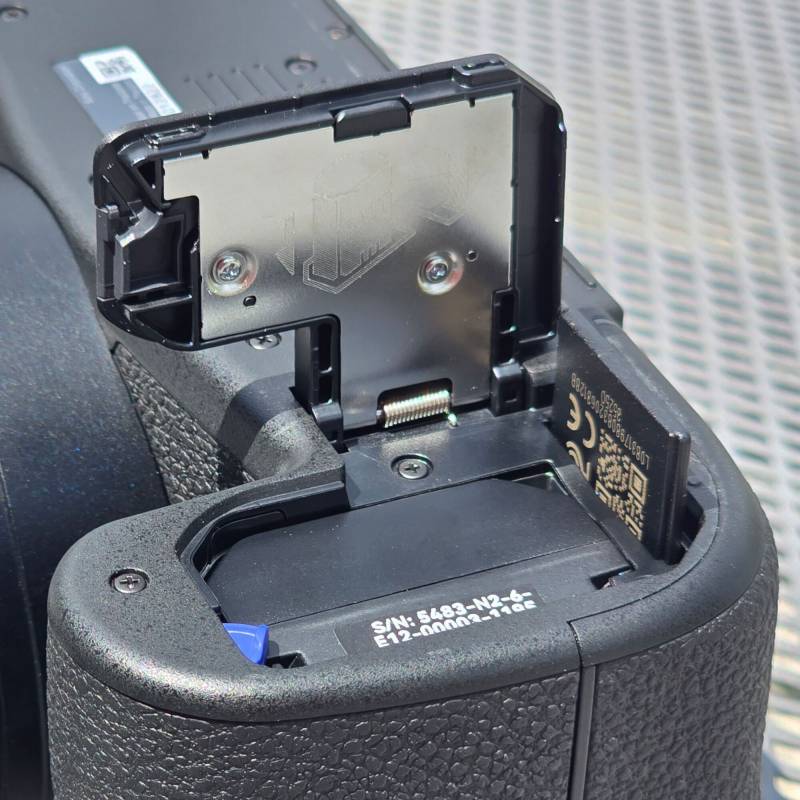
The battery and SD card are installed inside that compartment. A small, spring-loaded tab holds the battery in place. The SD card, shown uninstalled, uses a push-to-lock/push-to-unlock, spring-loaded slot. There is only a single SD card slot. Most pro cameras have dual SD card slots so you can write redundant files, or double your capacity. A single slot feels like a missed opportunity. Like everything else on the camera, this door is weather-sealed.
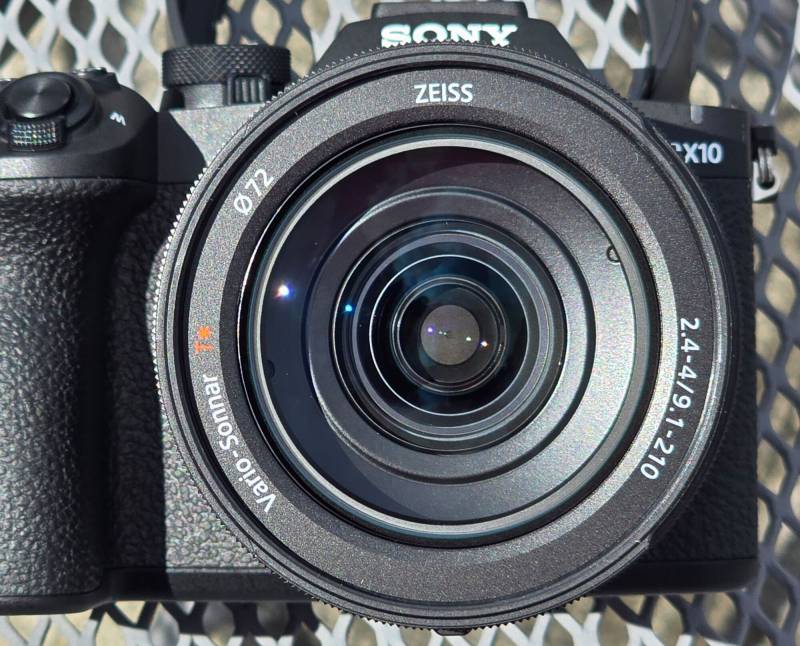
Staring down the business end of the imposing Zeiss lens, we see the internal mechanisms that are all in close at 24mm. The maximum aperture is a fast f/2.4, but it is variable and quickly stops down to f/4. In reality, it’s best to view this as an f/4 lens. Here is a look at the maximum aperture across the zoom range.
- 24mm equivalent: f/2.4
- 28mm equivalent: f/2.8
- 35mm equivalent: f/3.2
- 60mm equivalent: f/3.5
- 100mm to 600mm equivalent: f/4
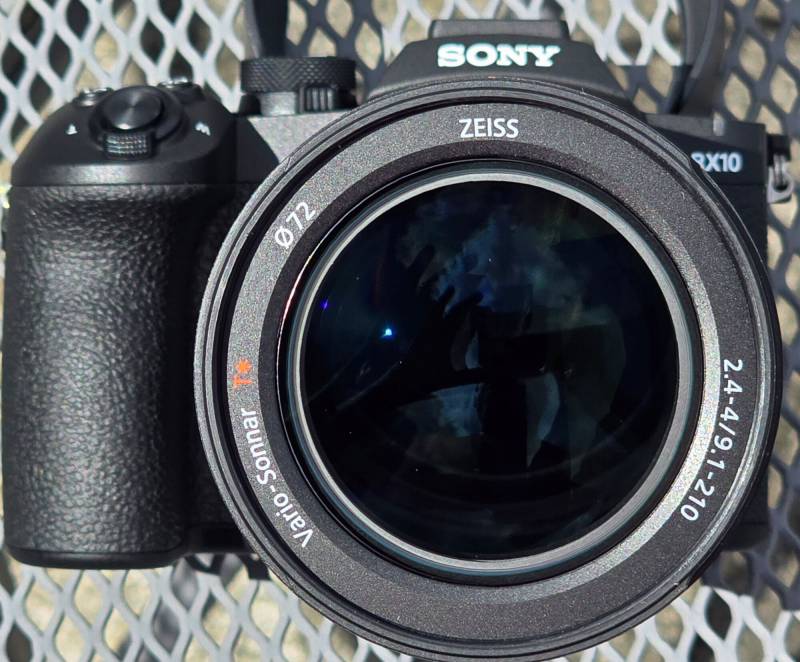
Zooming out to 600mm, we see the inside of that cavernous lens.
What’s in the Box?
The camera comes with the rechargeable battery NP-FZ100, a lens cap, the accessory shoe cap, the lens hood, and a shoulder strap. Sony makes an external battery charger, but you can just use a USB-C cable and charge the battery directly in the camera. The only thing you need to start using the camera is an SC card. The specs call for a UHS-I/UHS-II SDXC/SDHC card. V30/U3 is required for standard 4K recording in XAVC S. A V60 or V90 UHS-II card is a better choice for high-bitrate shooting and fast action, with lots of continuous images being written to the card.
How Do I Control the Camera?
If you’re a relatively simple shooter looking for great images with minimal fuss, the RX10V has full auto and programmed auto modes. In full auto mode, the camera makes every decision, locking out some menu settings. It is the one-touch shooting option for quick shots. The risk is that, since you have no control, it may choose a very slow shutter speed in low light or a very high ISO. If you’re hand-holding, you’ll likely wind up with blurry or grainy images. Still, in full auto, the RX10V produces excellent images in most conditions, making it a great point-and-shoot solution that comes bundled with a monster 25X zoom range. Sweet!
In Program Auto, or “P” mode, the camera makes most of the decisions while still letting you control ISO, exposure, and other settings. You can also shift the program, changing the aperture/shutter combo and letting the camera adjust the other to keep a balanced exposure. Think of it as automatic shooting with options.
Aperture priority, “A”, and shutter priority, “S”, modes let you pick the aperture or shutter speed that you want, and the camera picks the other to produce a well-exposed image. You can also control other exposure settings like ISO, exposure compensation, and more.
Sony provides custom modes “1” & “2” right on the dial. You can create a fully custom mode set for the specific type of shooting you want and save it in these mode memory locations. You can actually set up to 10 of these, but only modes 1 & 2 are selectable from the dial.
In manual mode, “M”, nothing is set for you. You have to pick every aspect of the shot. This gives you 100% creative control, so you can tailor the camera to the exact shot you are trying to capture.
Finally, in custom mode, “*”, you can choose from any of the ten custom modes you set up. Think of it as fast access to modes for birds in flight, auto racing, portraits, landscapes, macro shooting, wildlife, and so on. What you set them for depends on your style of shooting.
But Does It Produce Good Images?
All the specs and features in the world don’t mean a thing if the camera doesn’t produce quality images. Lucky for me, there is plenty of wildlife where I live that I could use as subjects for some test images. I included the original image straight out of the camera, with no post-processing beyond resizing to 2,000 pixels on the long side so it would load in Gear Diary. The second image in each pair is an edited version, cropped, sometimes considerably, and processed to improve contrast and sharpness. I’ll talk about each pair as we go.
I deliberately lowered the exposure by 1/3 stop to preserve highlights, since I was planning to process each image. That’s why the original images tend to be a little darker than the processed image. I shot all these images in custom modes I set up for wildlife and/or birds, or in a custom landscape mode.
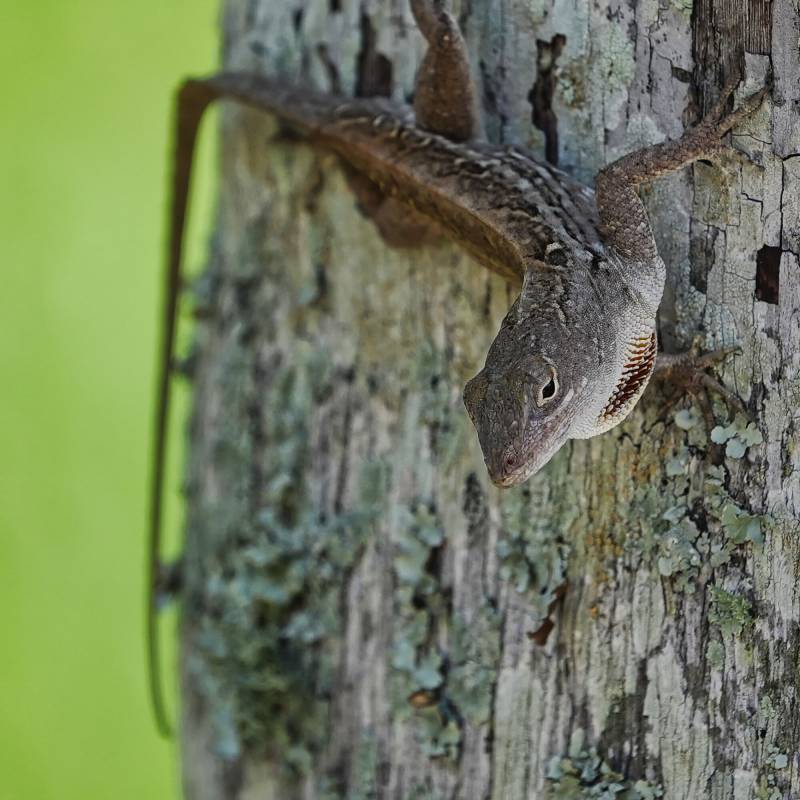
First, we have an anole on a queen palm tree in my yard.

Here is the same image, cropped in close. Check out the detail and sharpness of the eye. The RX10V locked focus on the eye using its AI animal eye tracking.
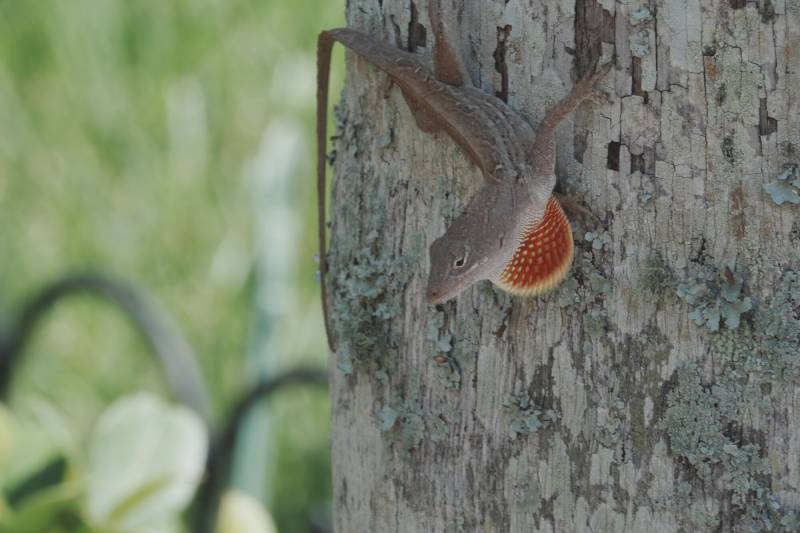
Here is the same anole with his dewlap extended.
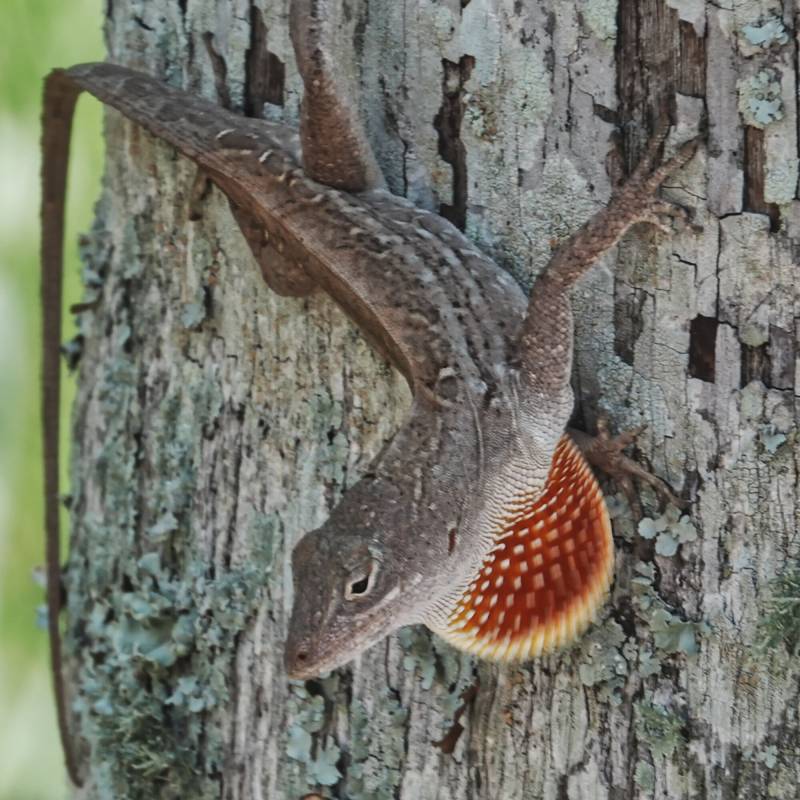
Check out the detail in the dewlap. I shot this with the aperture wide open, creating a narrow depth of field and pushing the tail out of focus.
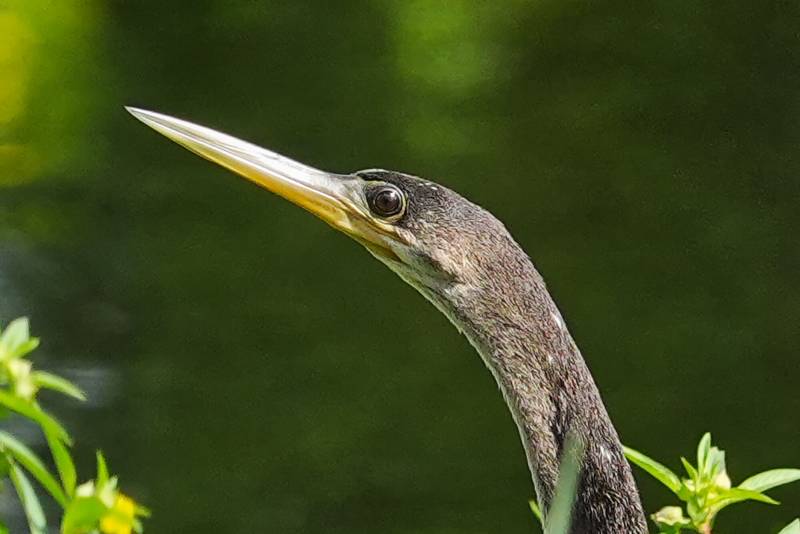
Here is a shy anihinga, hiding in the plants.
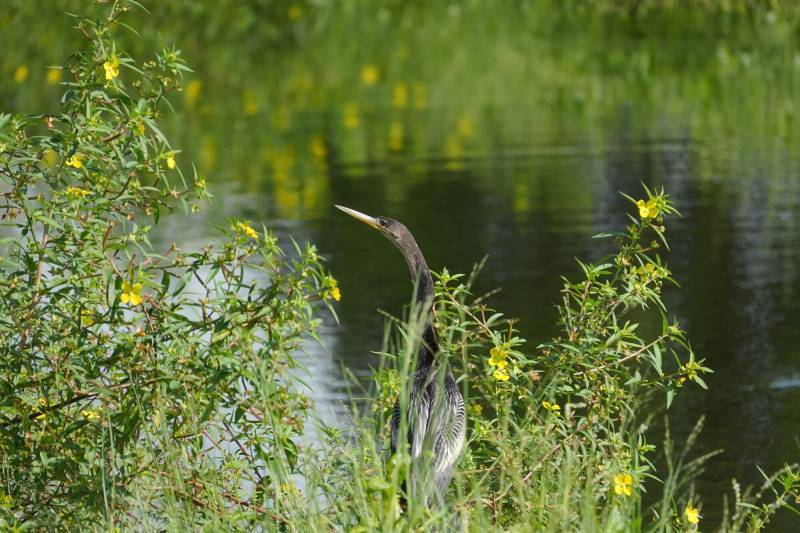
Once again, Sony’s eye tracking absolutely nailed the focus.
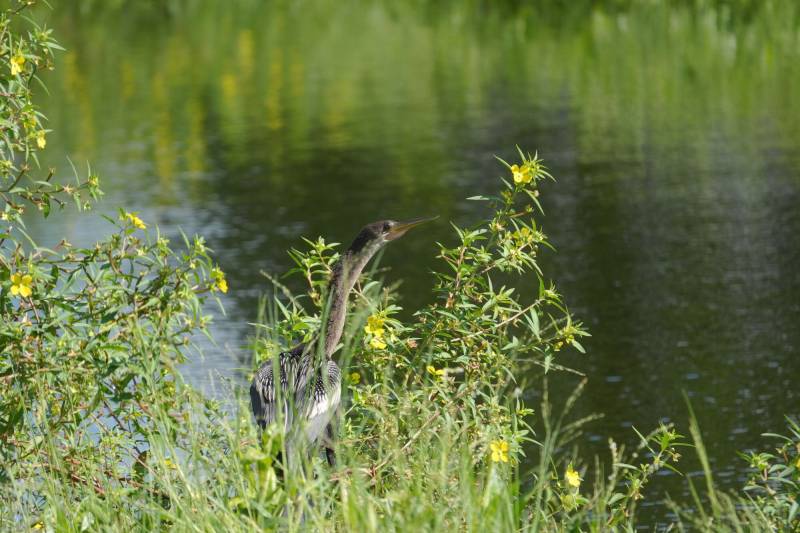
It moved more into the weeds, making focus a challenge.
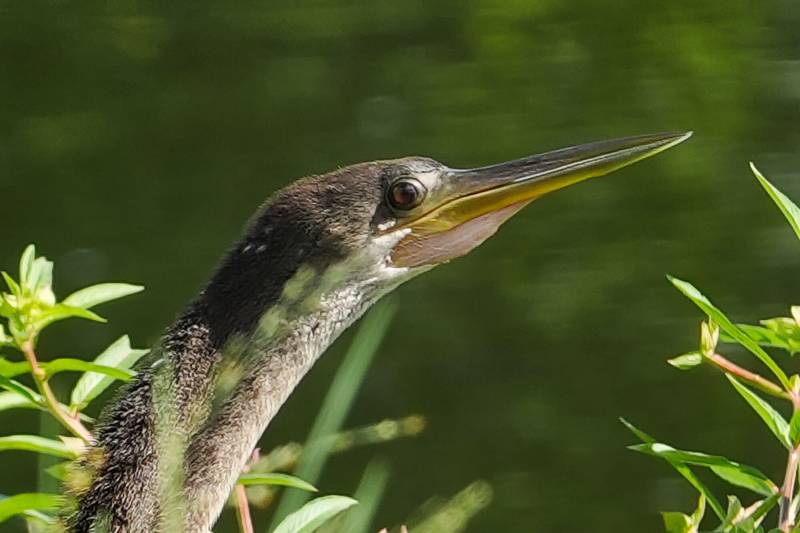
Even with the weed directly in front of its face, the focus was spot-on.
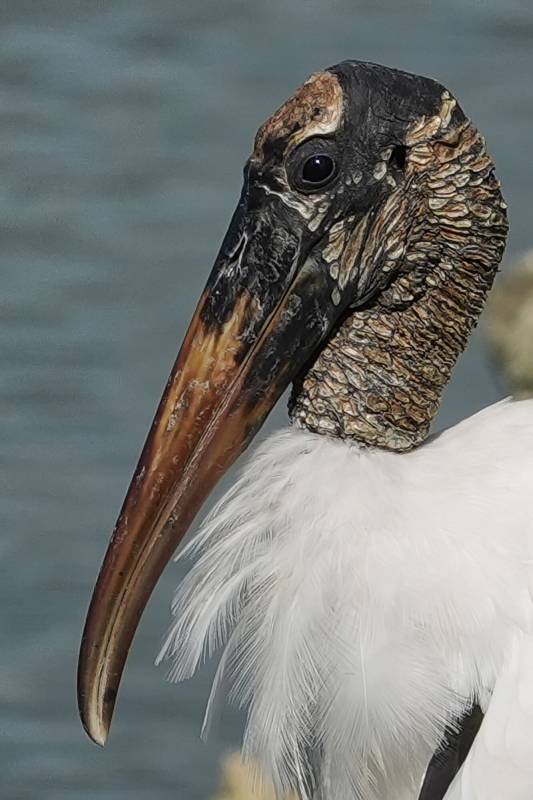
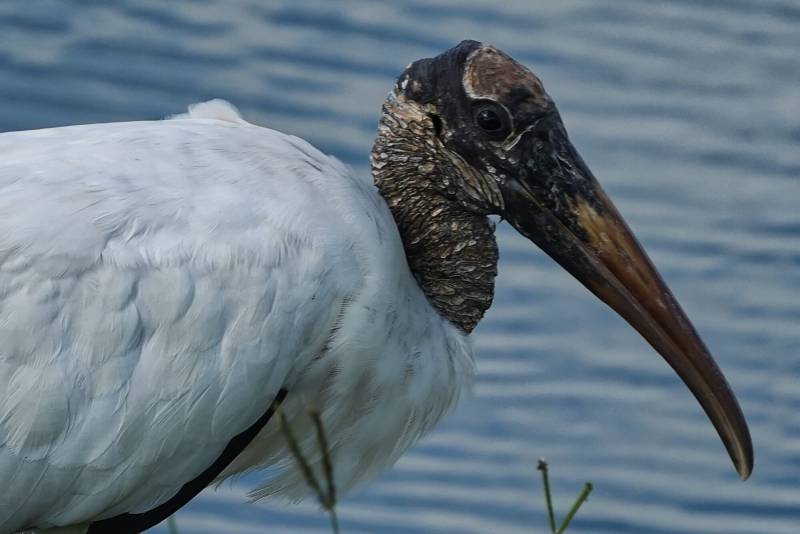
This wood stork was posing nicely for me.
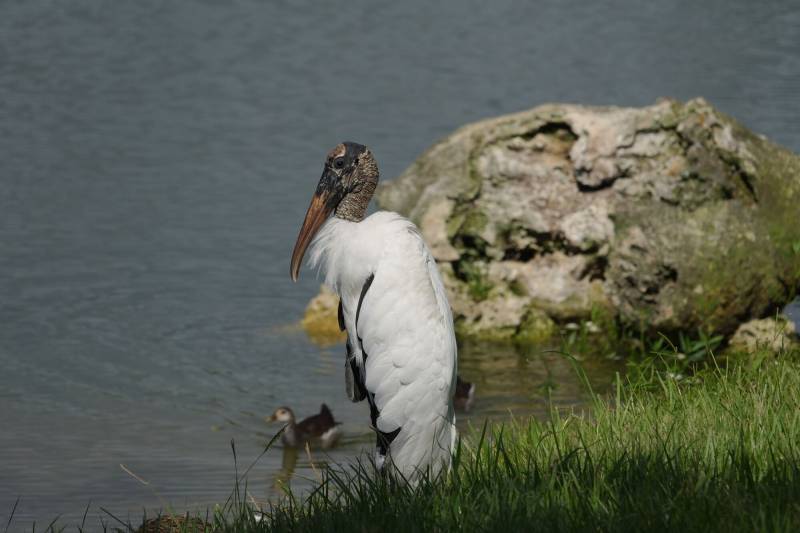
Check out the tack-sharp eye and the incredible texture on the head and neck. This is especially impressive when you realize how small a part of the original image this crop is.
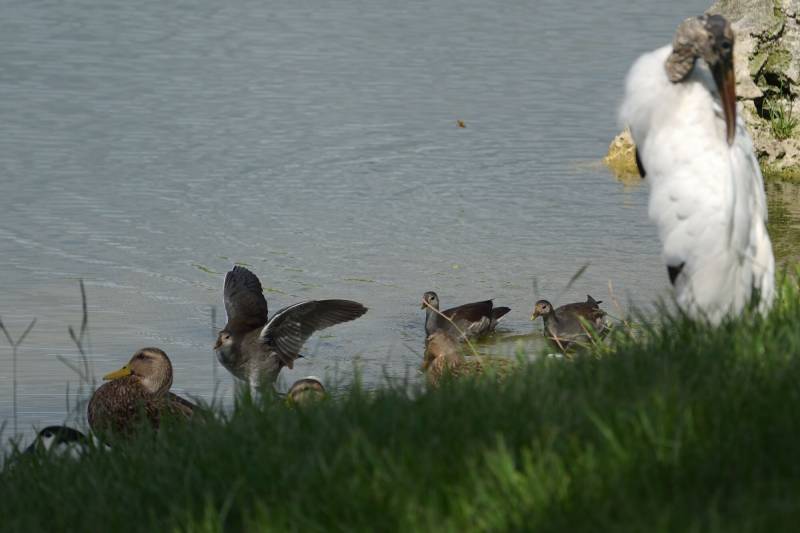
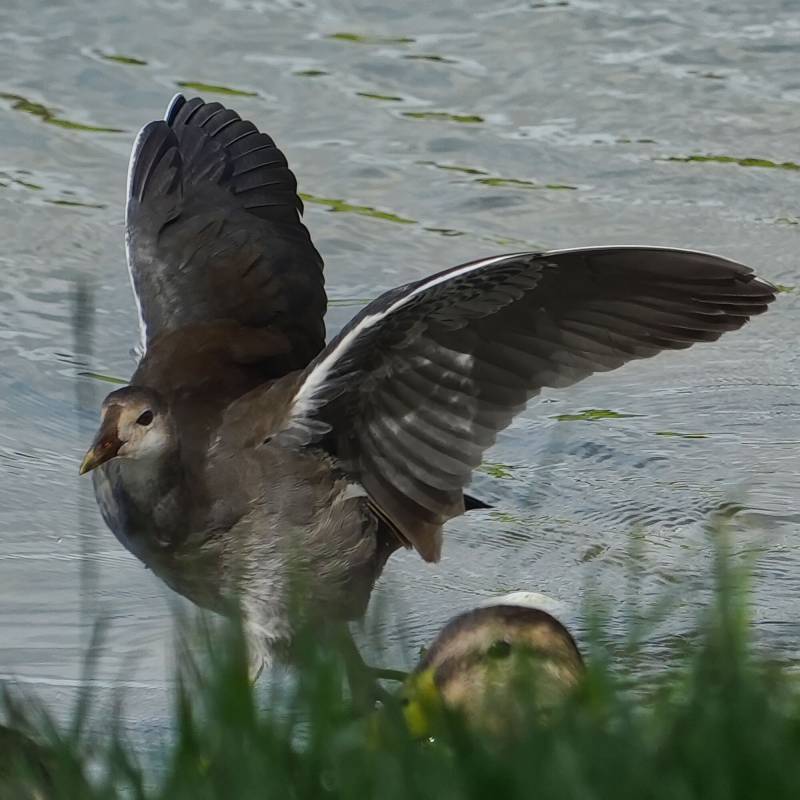
Here, a group of friends is hanging out. I targeted the flapping juvenile gallinule.
Once again, we have terrific detail and sharp focus, even with weeds blocking the view.
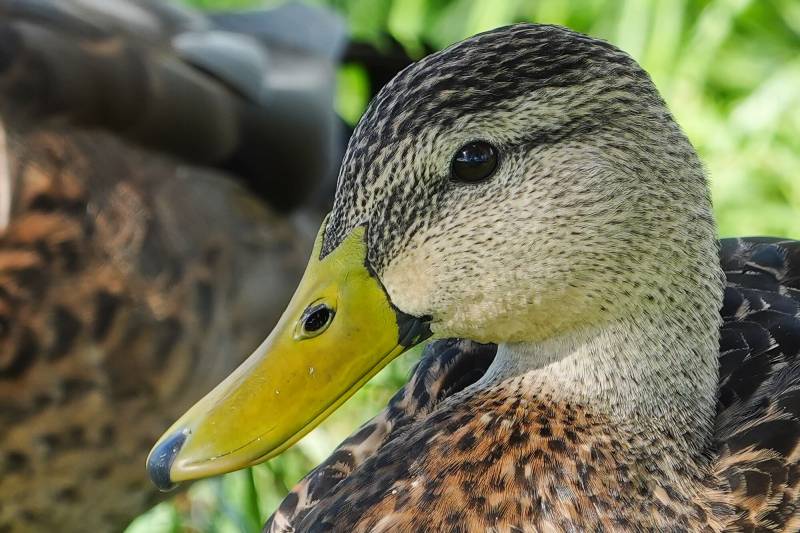
These mottled ducks paused for a photo.
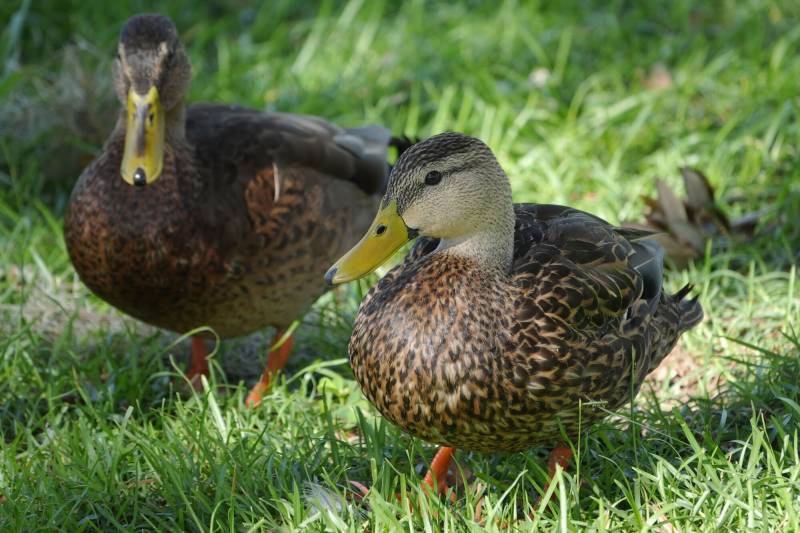
I continue to be impressed with the level of detail the 1″ sensor can render, even in tight crops.
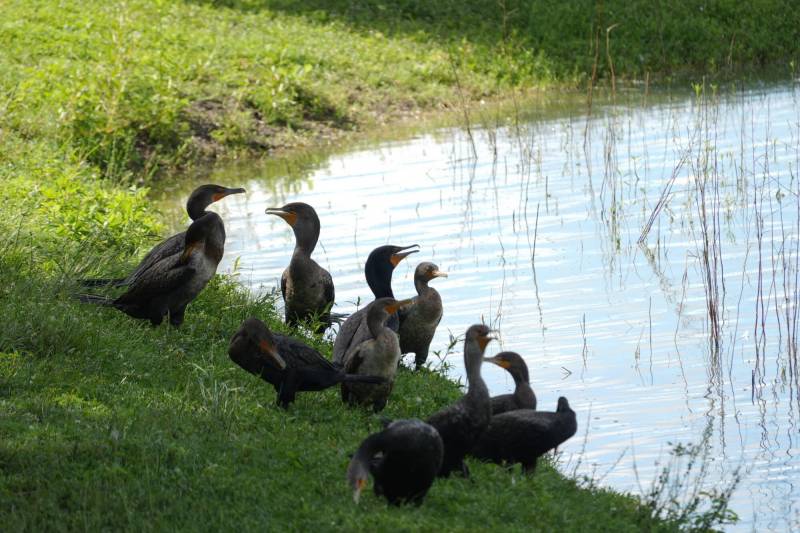
A group of cormorants was holding a business meeting.
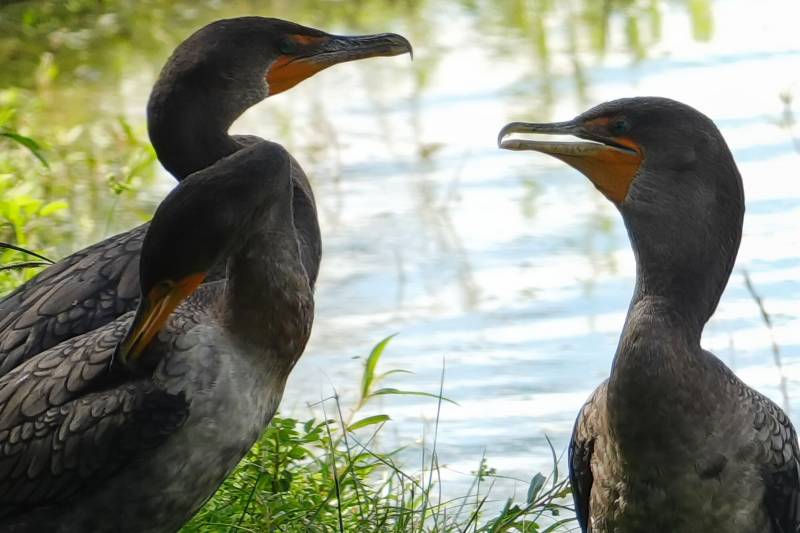
With the eyes in sharp focus, you can even make out the thin extended tips on their beaks.
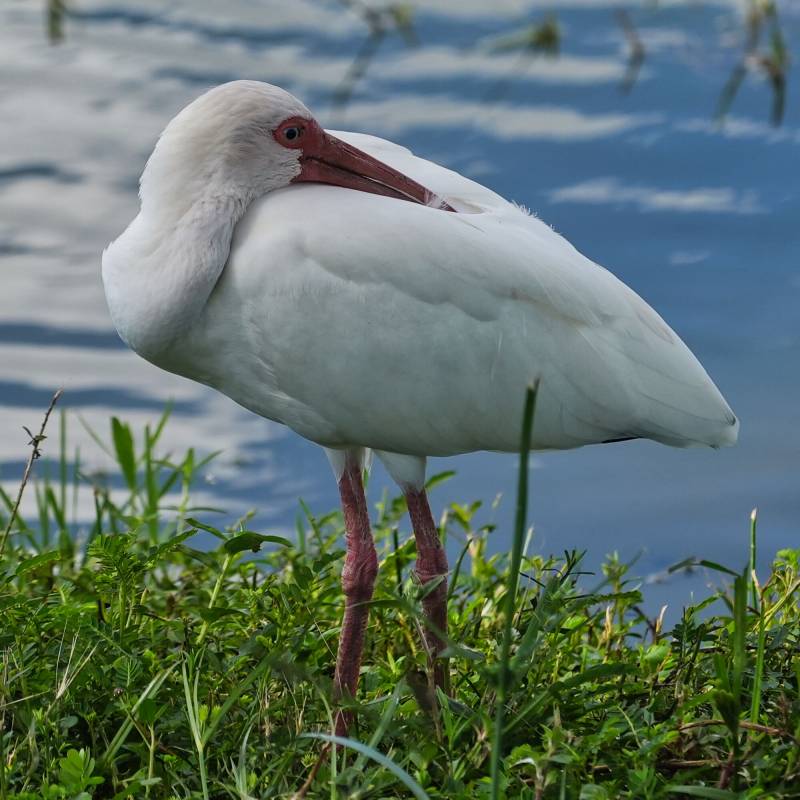
A white ibis had its beak tucked into its feathers, resting.
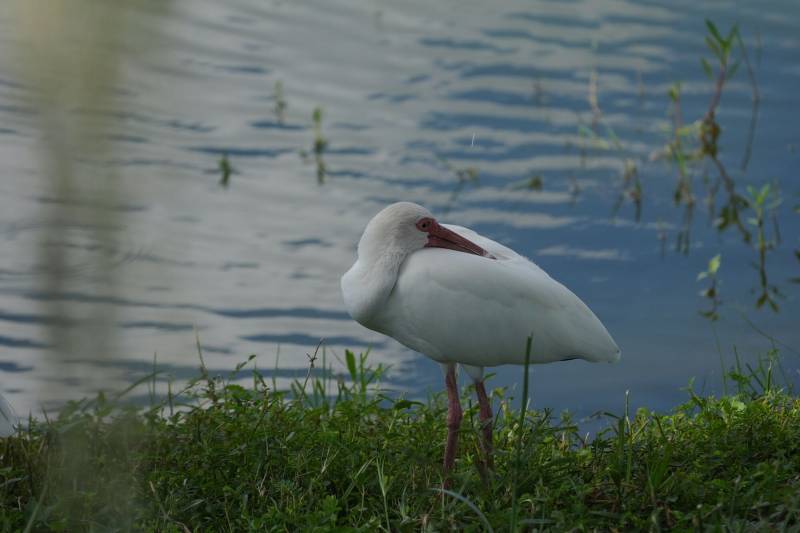
The camera captured excellent detail in the neck feathers and the sharp blue eye. With the aperture wide open, I also got terrific separation from the background and nice, creamy bokeh- the out-of-focus background that makes the subject pop.
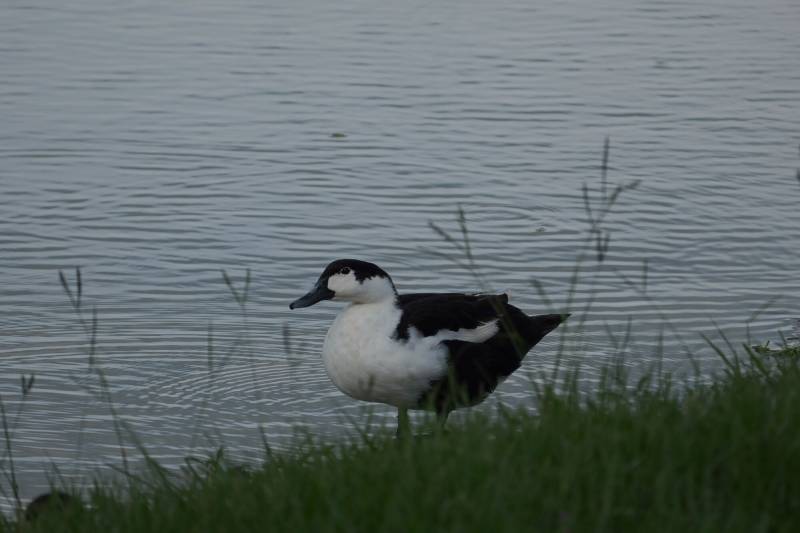
This magpie duck was standing alone.
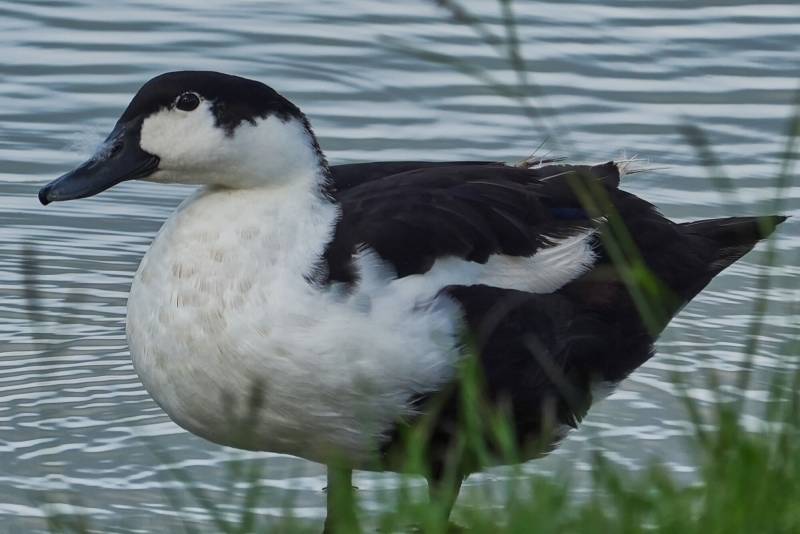
Cropping close really makes the dark black eye pop. You can also see the subtle textures in both the white and black feathers.
I shot this as the wood stork was walking by.
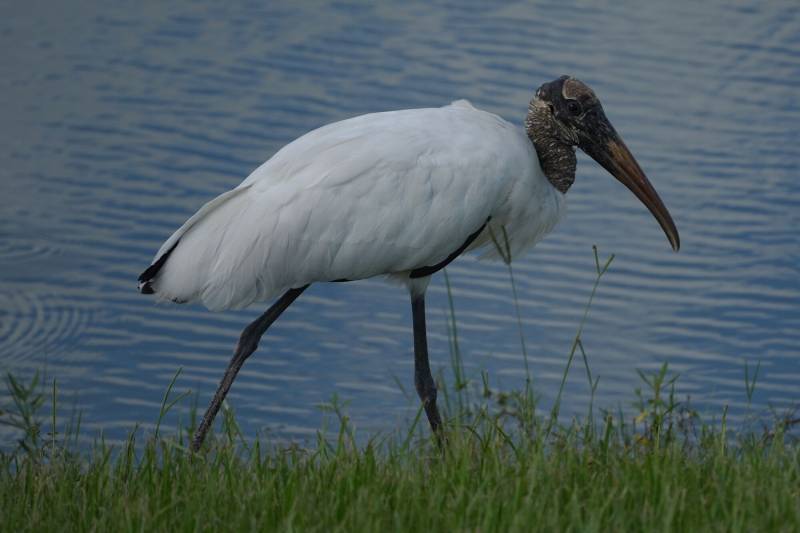
The camera kept the focus locked on the eye as it moved across.
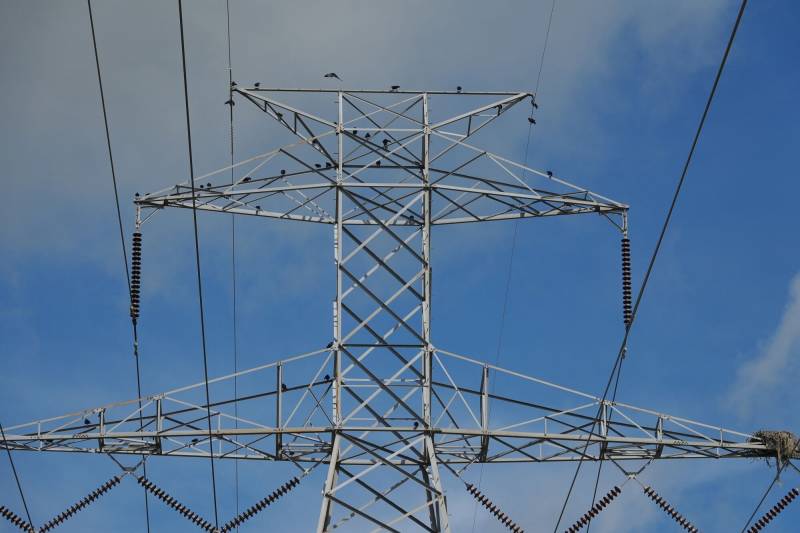
A huge group of crows was hanging out on a power tower.
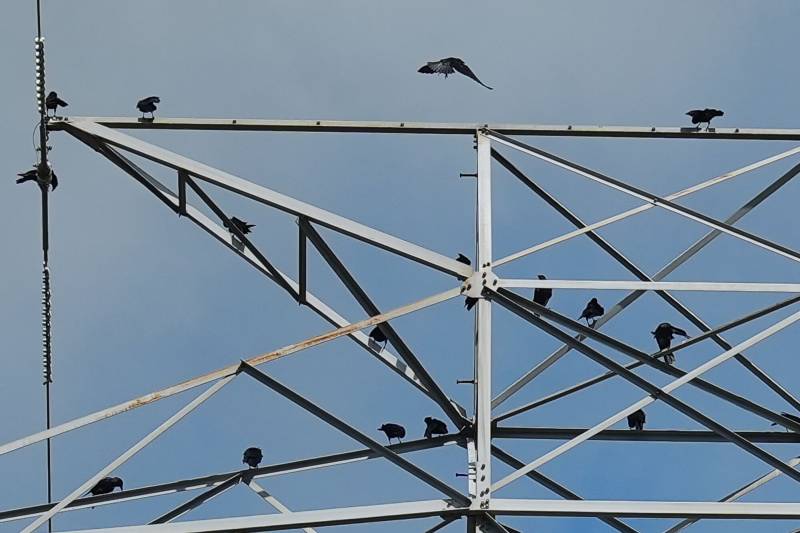
Cropping in closer, we can see nice detail in the birds as well as the bolts in the tower.
We’ve had a lot of rain lately, so mushrooms have been popping up everywhere.
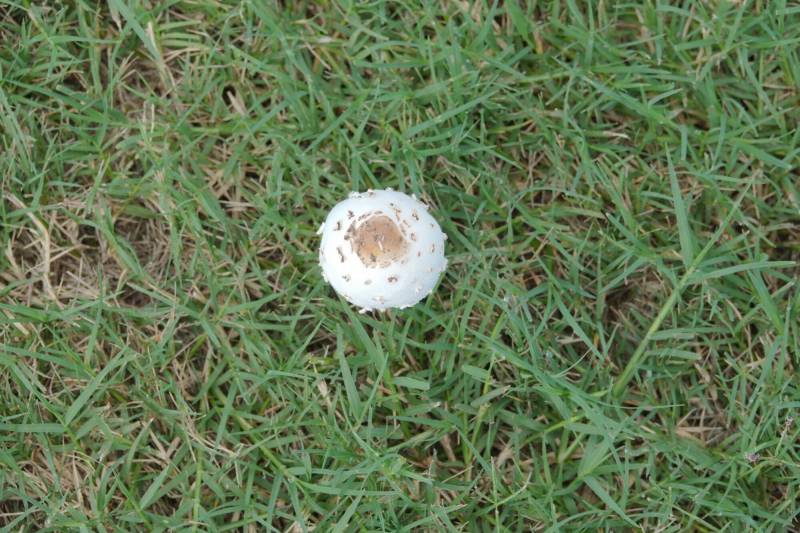
This shows nice detail of the texture on the cap.

I shot this from a distance and zoomed in. I also closed the aperture to f/16 to get more depth of field.

The mushrooms were perhaps 12″-18″ apart, but the small aperture let me keep everything in sharp focus.

Another group of mushrooms at a distance, zoomed in with the optical zoom.
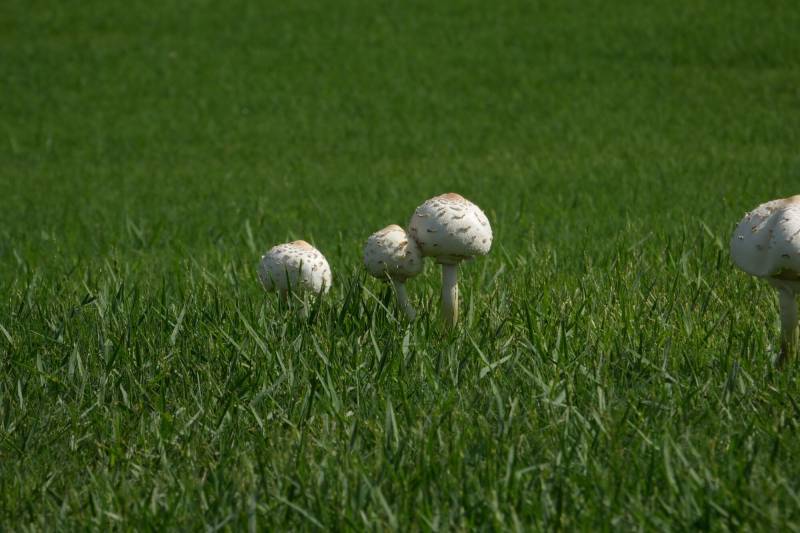
I love the small details on the caps.

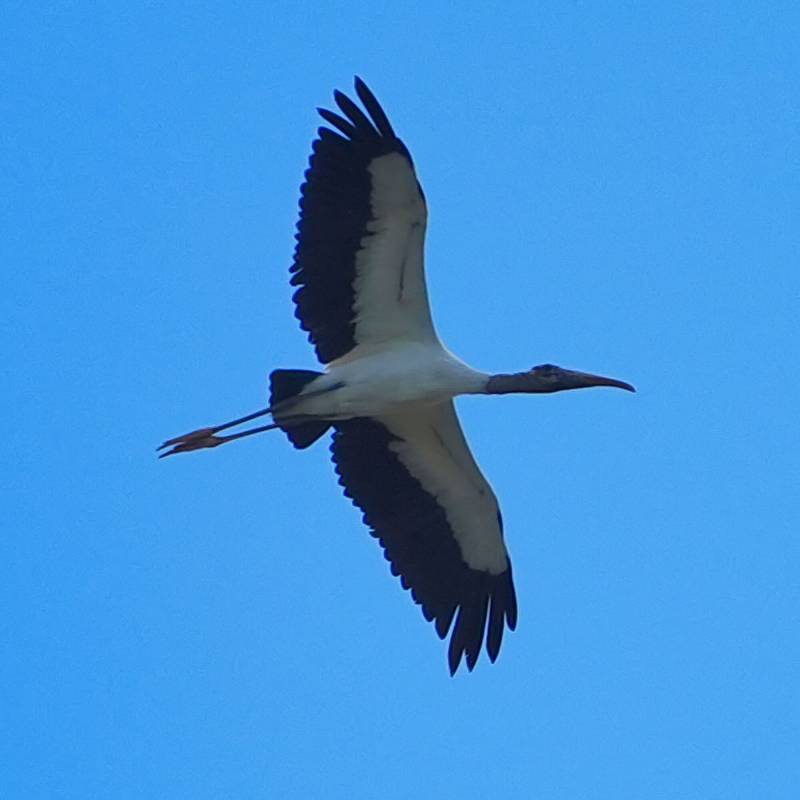
A wood stock flew overhead.
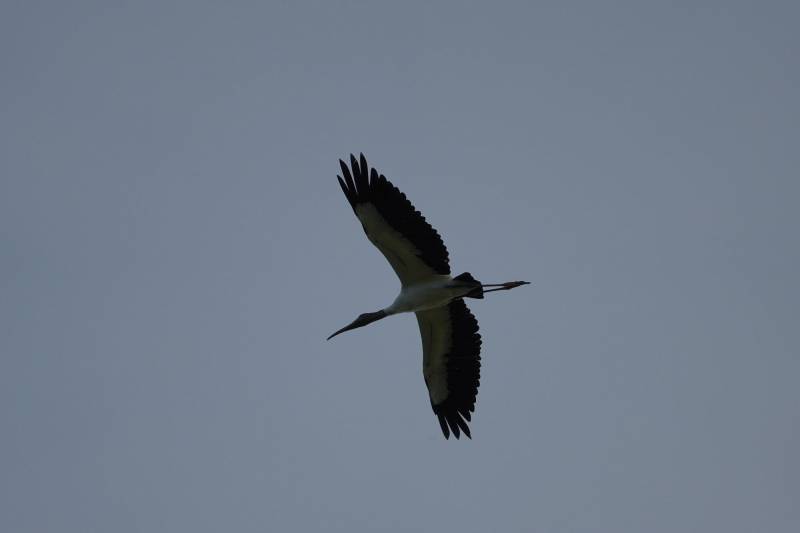
The tracking autofocus kept the bird locked in focus as it flew by. The overcast sky didn’t offer much contrast.
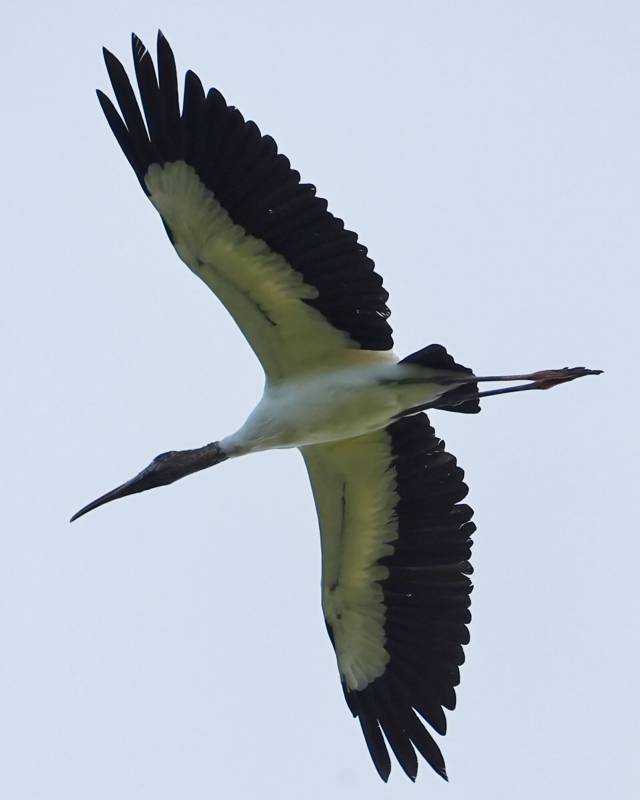
It flew past the clouds as it continued climbing.
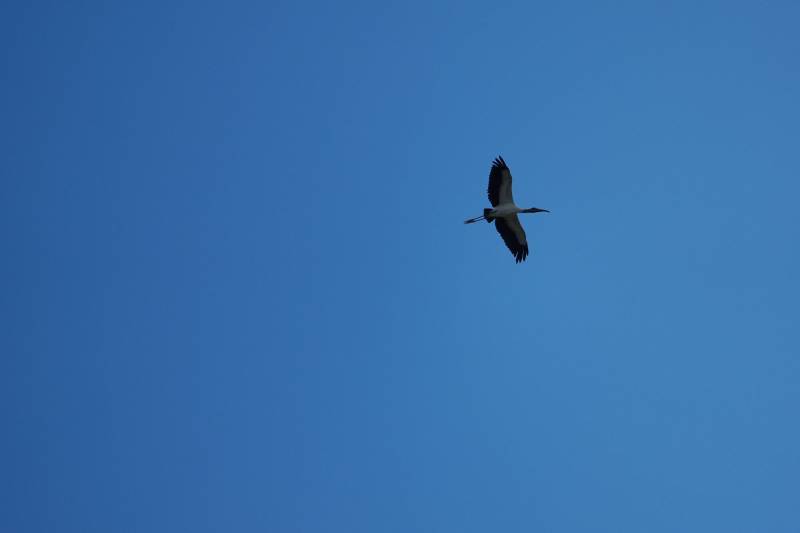
Look at how small it was in the full photo, and the excellent detail the crop produced.
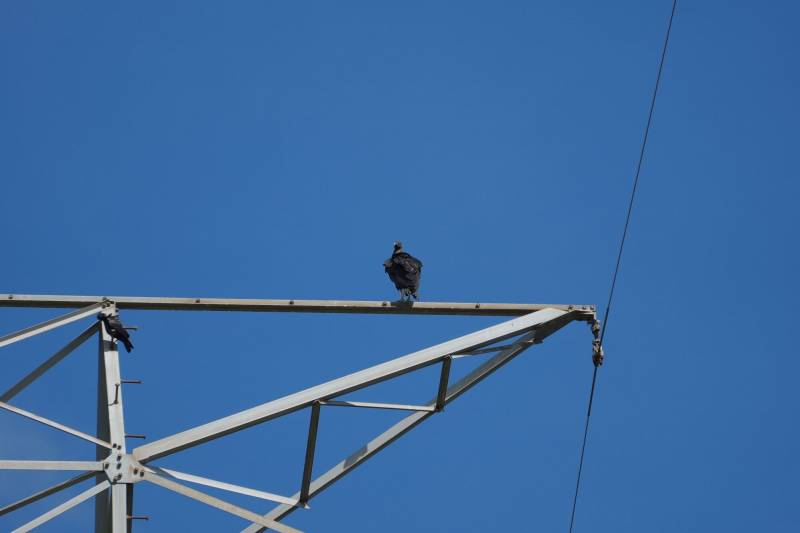
I spotted a black vulture on the very top of a tall power tower. This photo was zoomed all the way in to 600mm.
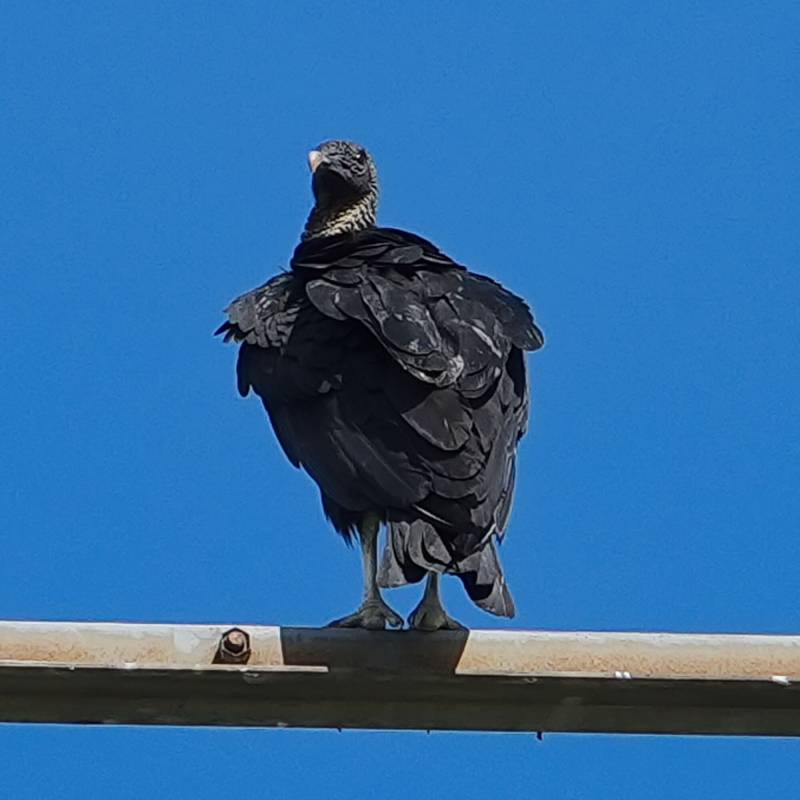
Cropping in tight on the bird still produced excellent detail in the face and feathers.
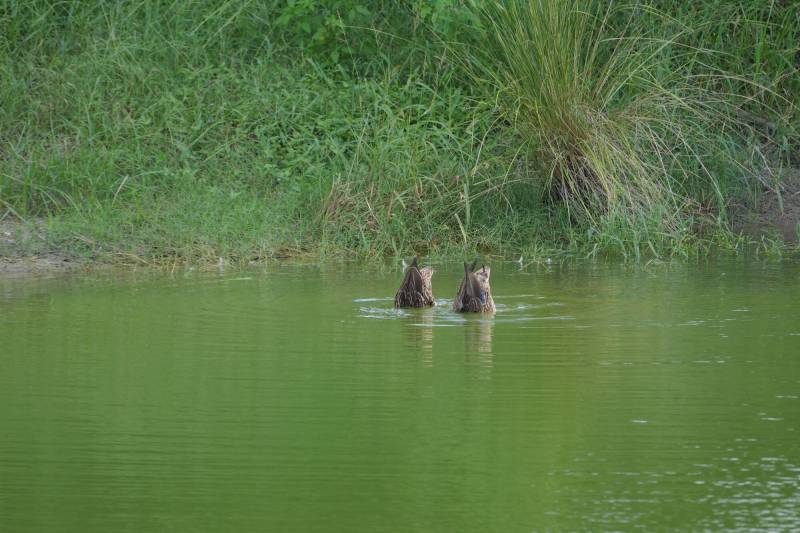
I couldn’t resist snapping a couple of mottled duck butts.
Look at the terrific detail in the feather pattern.
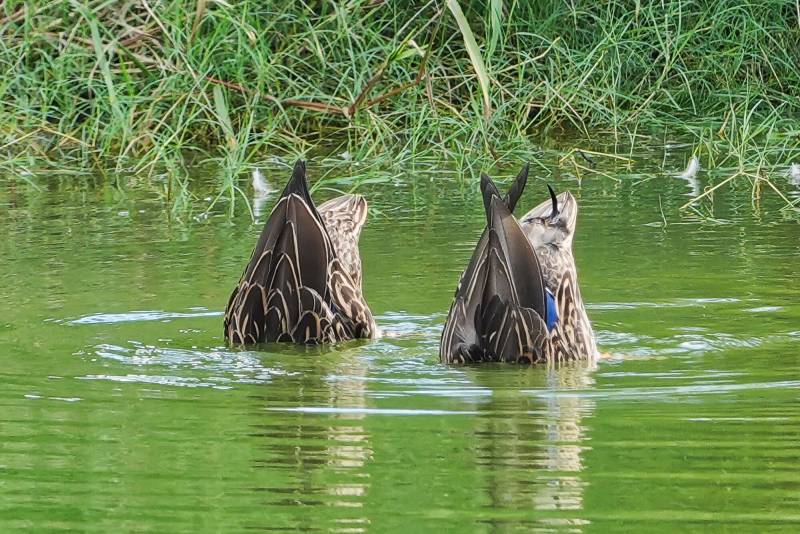
One finally came up for air.
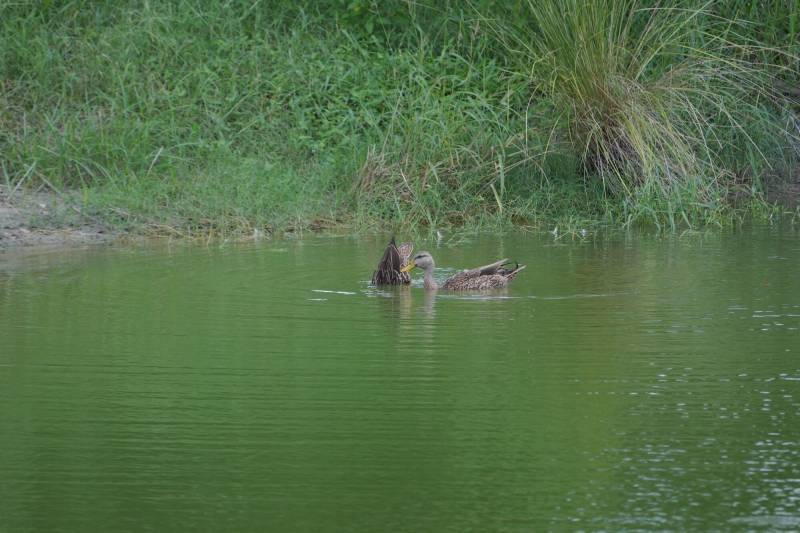
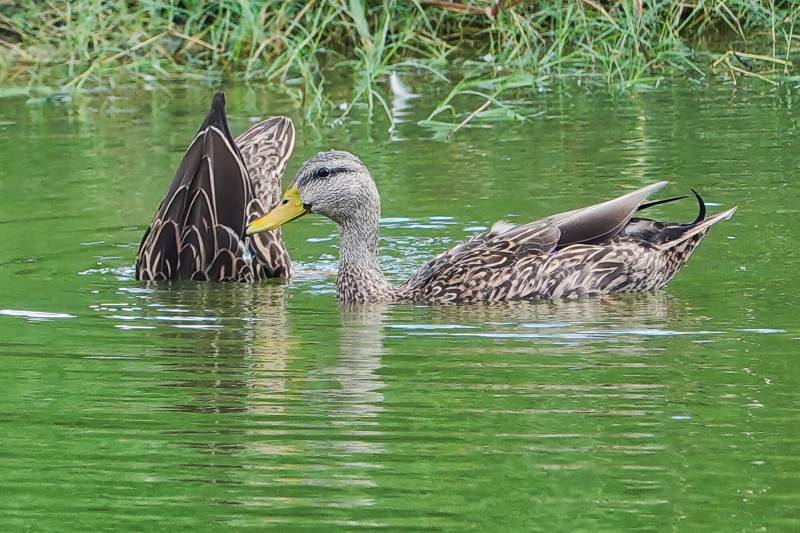
The eye is super sharp in this photo.
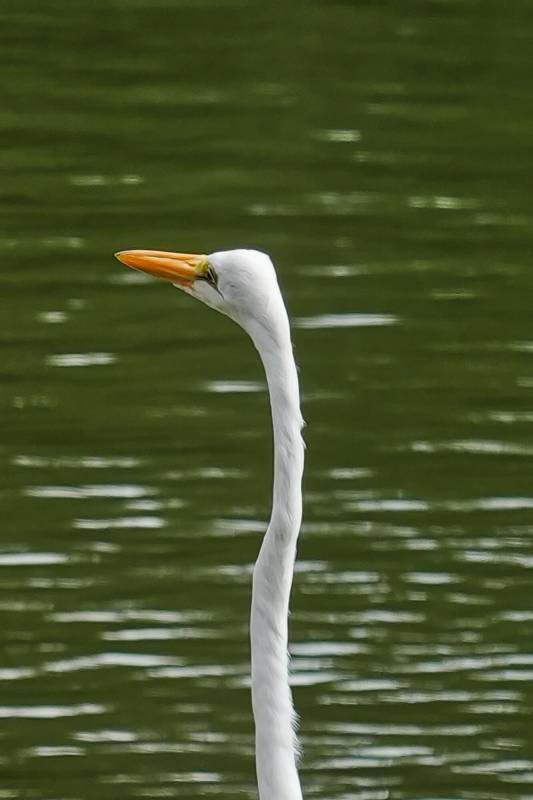
A great egret was wading in the water.
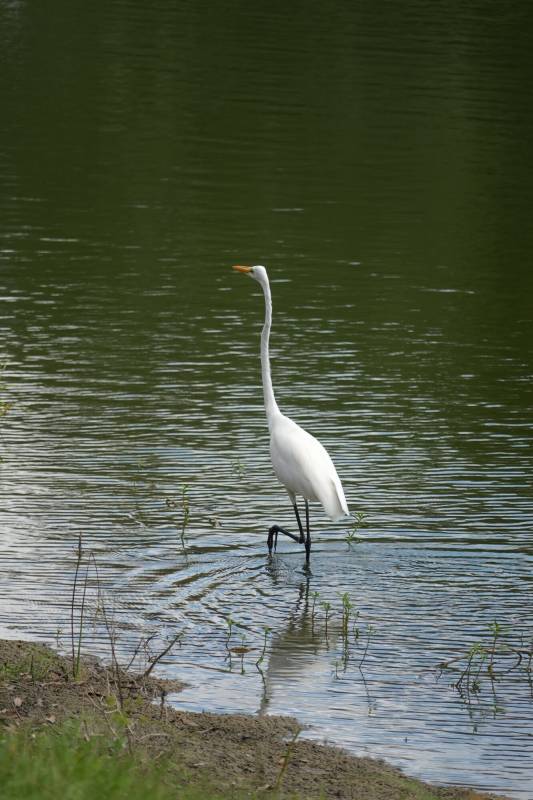
Even at an angle, the camera captured the eye as the focal point. Look at the fin feathers along the back of the neck.
A group of ibises was standing by the water.
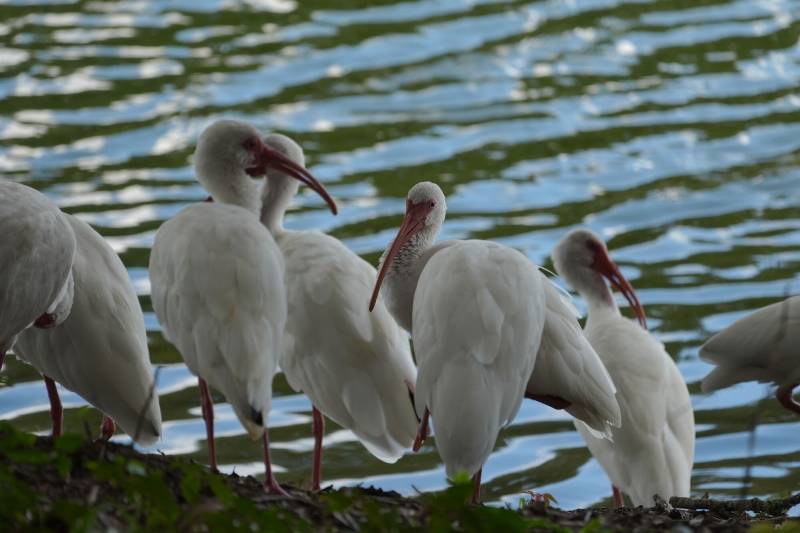
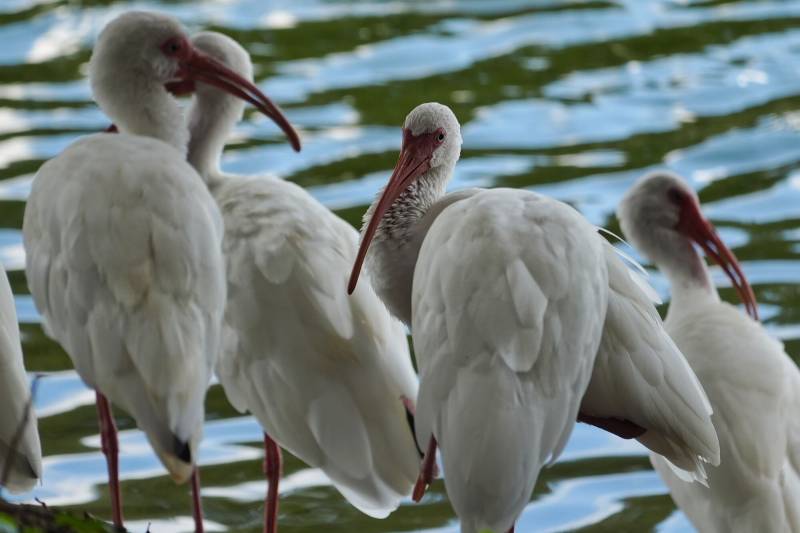
The camera immediately selected the center bird as the focal point. I had the aperture wide open, so the closer and farther birds fell out of focus.
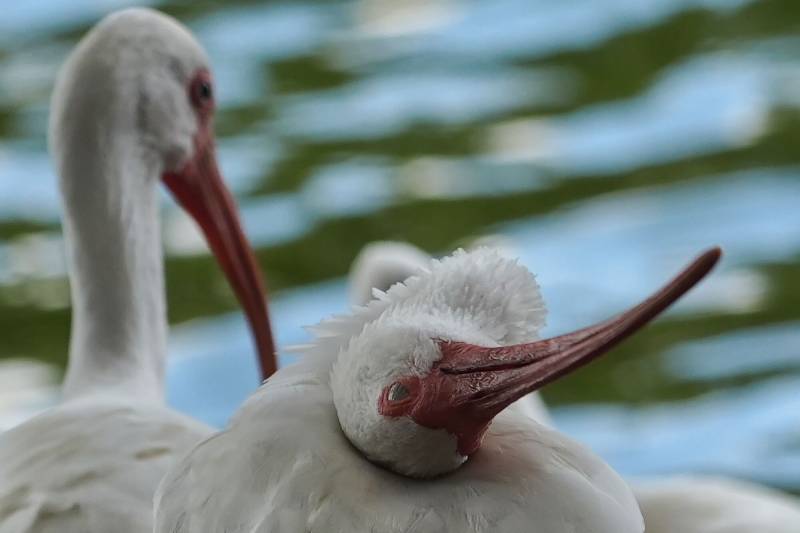
This was just a fun photo to wrap up that day’s shoot.

Even upside down, the camera locked right on the eye.
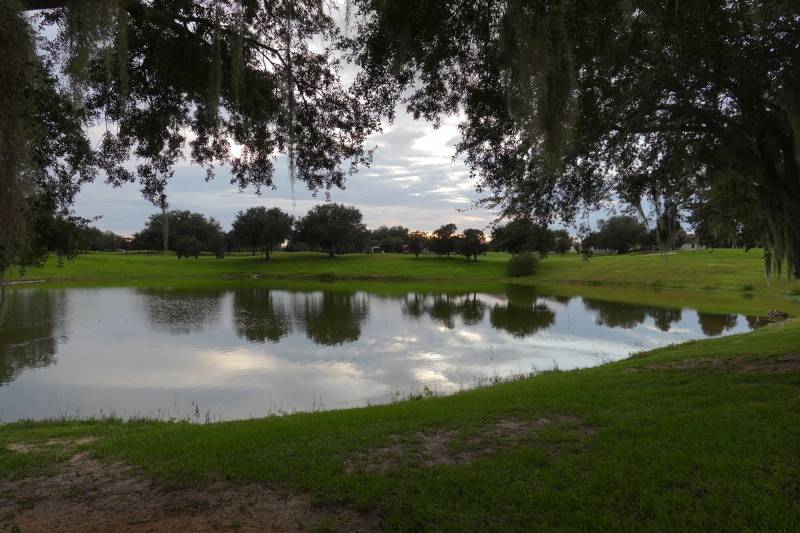
I went out a couple of days later, just before sunset, as a storm was rolling in. The lighting was less than perfect, allowing me to push the camera a bit and see how it does in lower light. Here’s a landscape shot just before sunset, straight out of the camera.
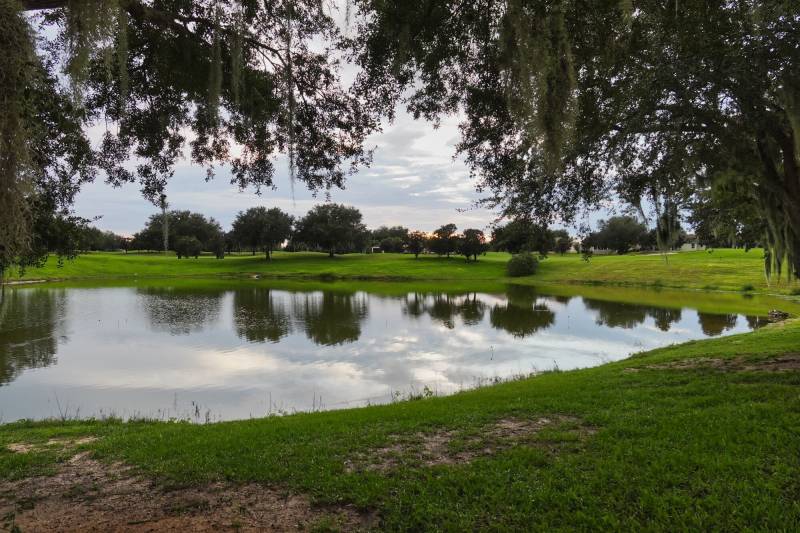
A minor edit to boost shadows produced a great image with nice dynamic range. I was impressed, given the flat and dim lighting.
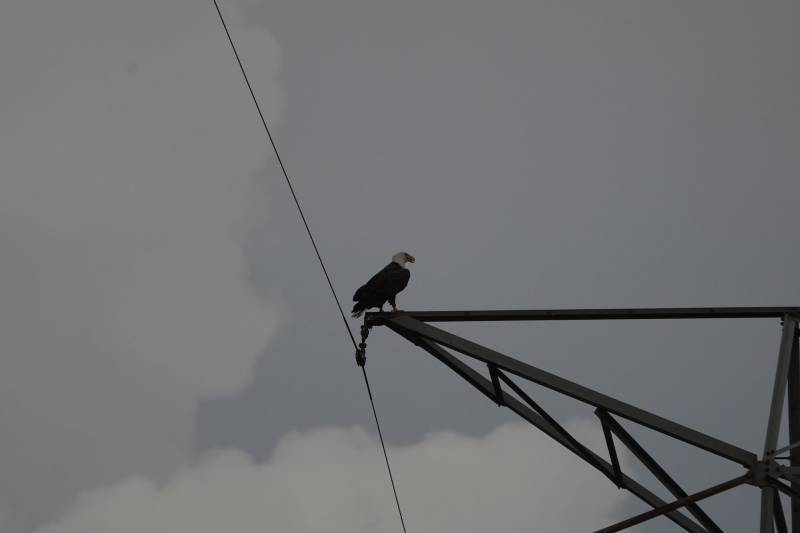
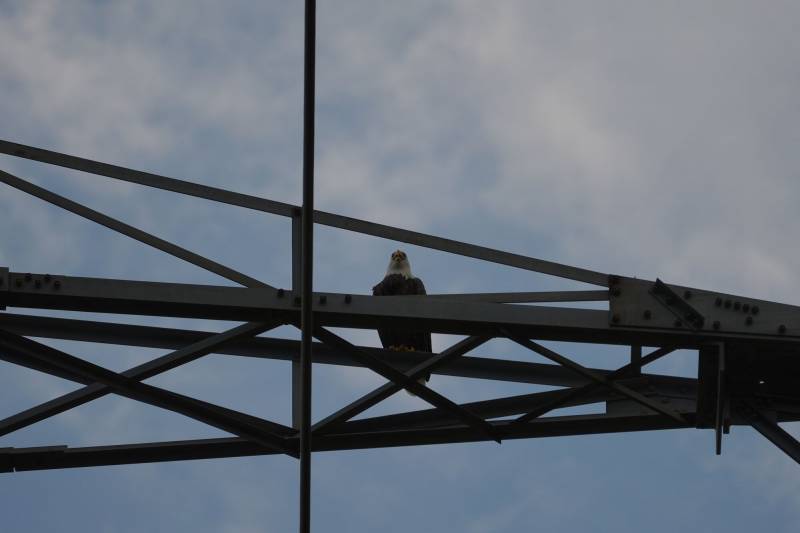
A couple of bald eagles were up on power towers as a storm rolled in. This meant that the lighting was less than ideal.
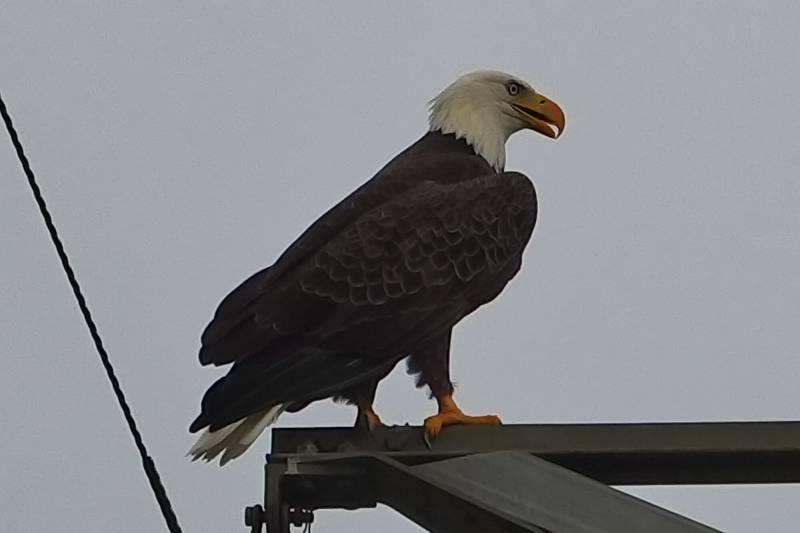
Still, the camera produced excellent detail, even in challenging lighting conditions.
This one took off, of course, heading away from me.
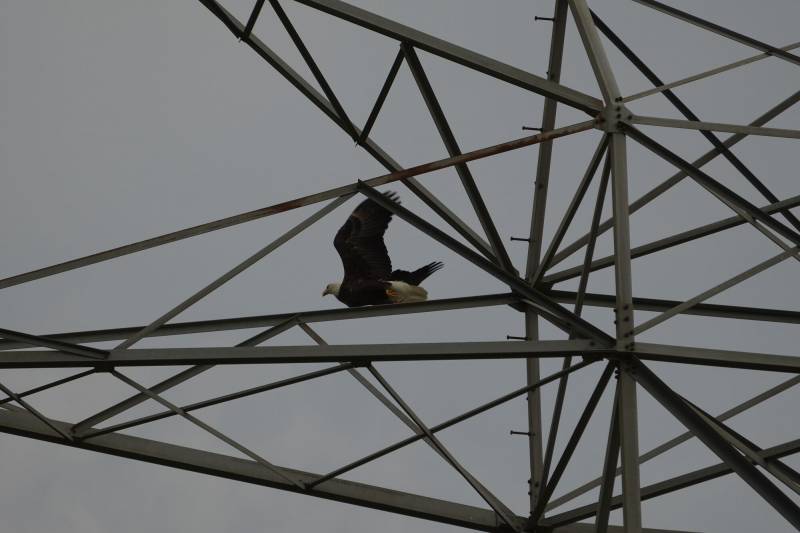
The camera kept focus locked on the eyes, even with all the structure in front of the bird.
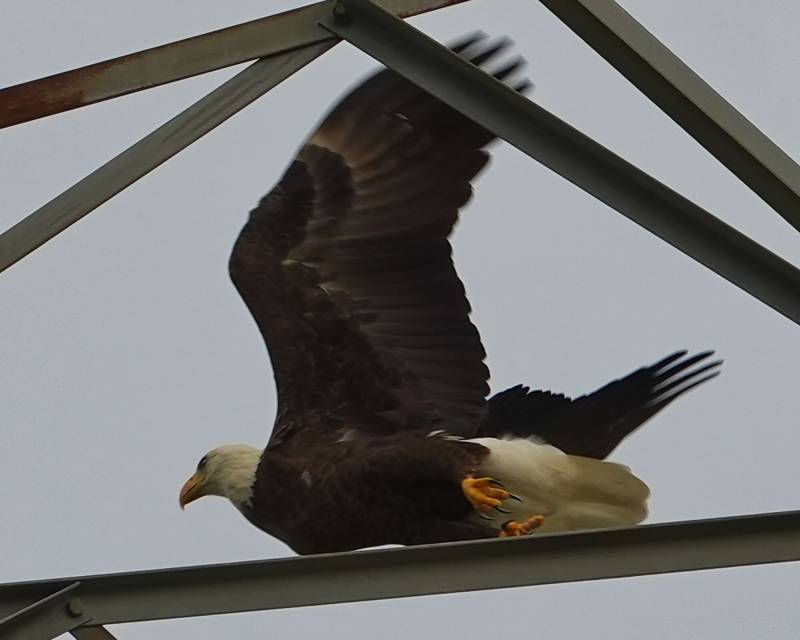
Just a couple more eagles to show how well the RX10V performs in poor lighting.
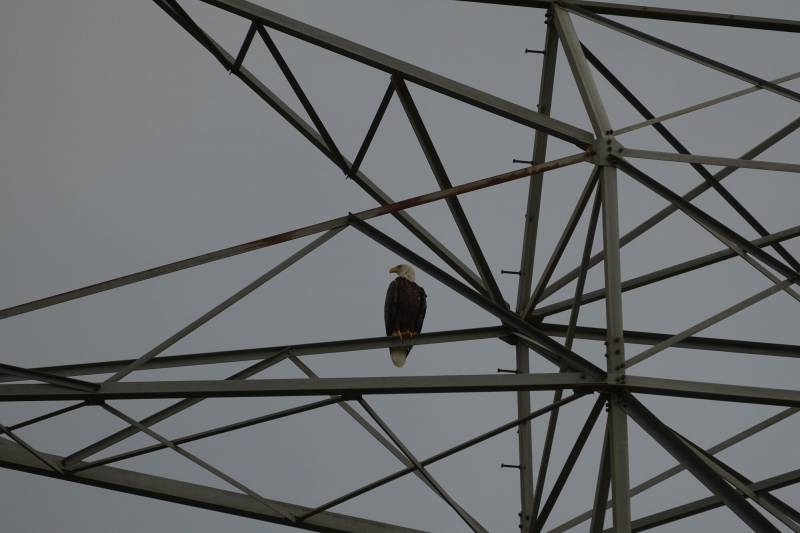
A crop and shadow boost gets a great image.
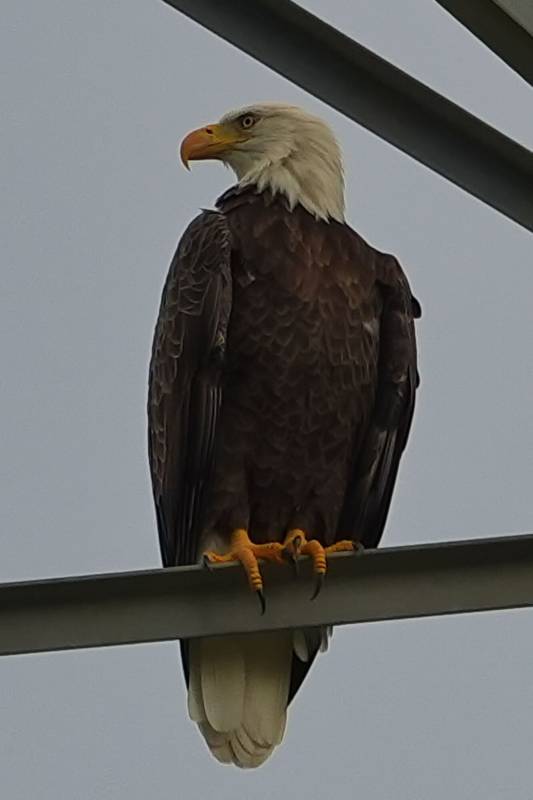
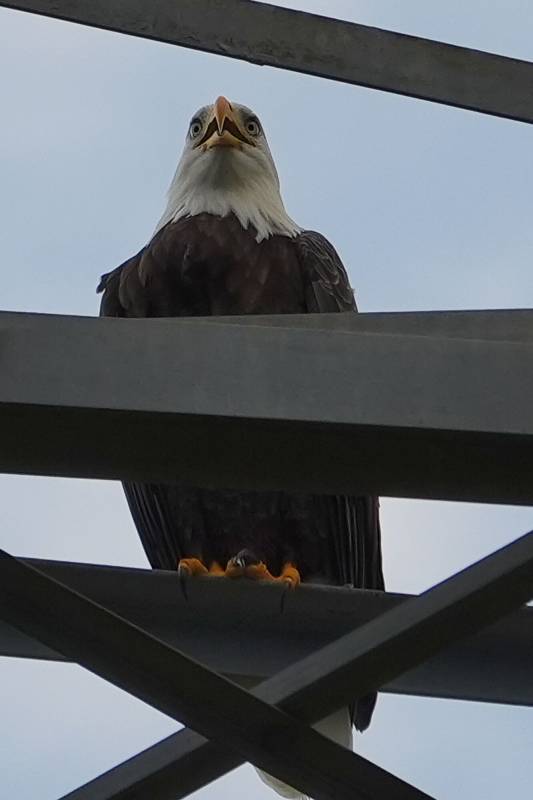
I couldn’t resist this one when it looked right out at me. But there was so much more to see when cropping tighter in post-processing.
What eyes! And those feet!
I have been very pleased with the quality of the images the Sony RX10V produces. As I continue to use the camera, I keep tweaking the custom mode settings. I also save them regularly in a Camset file so I don’t lose anything.
For birders, there is one gotcha with this camera.
With a typical SLR-style camera, you can zoom in and focus on a target, perhaps a bird in a nest. Then, you can let the camera go into power-saving mode while waiting for action. When something starts happening, a touch of the shutter wakes the camera, and it is already on-target and focused. When the RX10V goes into power-saving mode, the lens retracts into its storage position. A touch of the shutter wakes the camera up, but then you have to zoom back in and refocus. For most people, it is a small thing, but it’s worth noting.
Because the camera has a motor-driven zoom rather than either a push/pull or twist zoom, zooming is slower than with a traditional zoom lens, and it can be a little fiddly to get it exactly where you want. In practice, it is a fairly minor quibble, and using the zoom ring can minimize that impact, but it is different from a traditional manual zoom.
The other possible complaint is the price. At just under $2,300, it surely isn’t an impulse purchase. But when you consider that you get a quality Zeiss 24mm-600mm zoom, you have to do some math. Checking prices for Sony lenses, you’d need to drop $1,000 for a 24mm-70mm lens, $1,700 for a 70mm-200mm lens, and another $2,100 for a 200mm-600mm lens to get the same zoom range. You’d also need to spend an additional $1,100 or more on a camera body. That’s nearly $6,000!
In addition, you’d be carrying more than 10 pounds of lenses and swapping them in the field to get the shot you want. Granted, that isn’t a truly fair comparison, as those lenses have wider apertures and such, and the camera would have a bigger sensor, but still, the RX10V puts all that into one 2.5-pound package. OK, it can’t produce the same image quality that a camera with a larger sensor can, but for 99.5% of the photographers out there, it is not only “good enough”, but it is way more than that.
I have only touched on things that this camera can do. I would have to write a novel to adequately cover everything. I will just say that while this camera isn’t perfect, it is as close to perfect as I have ever seen as a tool for a travel photographer.
Final Thoughts
Is the Sony RX10V High Zoom Digital Camera the best at anything it does? Absolutely not. Its 1″ sensor doesn’t produce as high-resolution images as an APS-C, Micro 4/3, or full-frame sensor. It is also not as sensitive to light as any of those sensors. The zoom has some compromises. It has only a single SD card slot. The lens could be faster, as it is essentially an f4 lens.
Ok, so we have some complaints. The RX10V isn’t the best at anything. But here is the game-changer. The Sony RX10V is pretty darn good at everything it does. It can take terrific photos in most situations with its full automatic setting. For accomplished photographers, the RX10V lets you control everything about the camera. Not just exposure and focus points, but everything about how the camera operates. You can tailor this camera to the way you approach photography.
It produces absolutely fantastic images and video. Its improved AI autofocus with target identification is awesome. Its tracking focus locks on moving targets. Its color reproduction is terrific. Its 25X zoom range is incredible. And it does all this in an easy-to-carry, weather-sealed, 2.5-pound package. This now has a permanent home in my travel photography backpack, displacing my heavier MFT camera, heavy zoom lens, and second camera. My travel just got several pounds lighter. In my not-so-humble opinion, I can confidently say that the Sony RX10V High Zoom Digital Camera is the best travel camera solution going today.
The Sony RX10V 25x High Zoom Digital Camera retails for $2,299.99; it is available directly from the manufacturer and other retailers, including Amazon.
Source: Personal purchase
What I Like: Outstanding lens and zoom range; Amazing autofocus and AI object detection; Incredible shooting mode customizations are possible; Camset files let you protect your customizations and share them with other RX10V users; Excellent image quality; It is lightweight; Weather sealing
What Needs Improvement: The learning curve is steep; No built-in flash; The rear screen only flips out and is horizontal, but it would be nice to fold out to the side and flip over; There is only one SD card slot


Be the first to comment on "Sony RX10V 25x High Zoom Digital Camera Review: The Ultimate Travel Camera Finally Gets an Update"