
Govee is back with another attempt to make the wall behind your TV do more than sit there, and the new Govee TV Backlight 3 arrives with a more serious camera system, denser lighting, and broader smart home support than before. Launched today in the US and Europe, the kit is designed for people who like the idea of ambient lighting that follows what’s on-screen, but don’t want to run HDMI boxes, swap cables, or turn movie night into a small wiring project. Pricing starts at $109.99 for 55″ to 65″ TVs and $139.99 for 75″ to 85″ TVs.
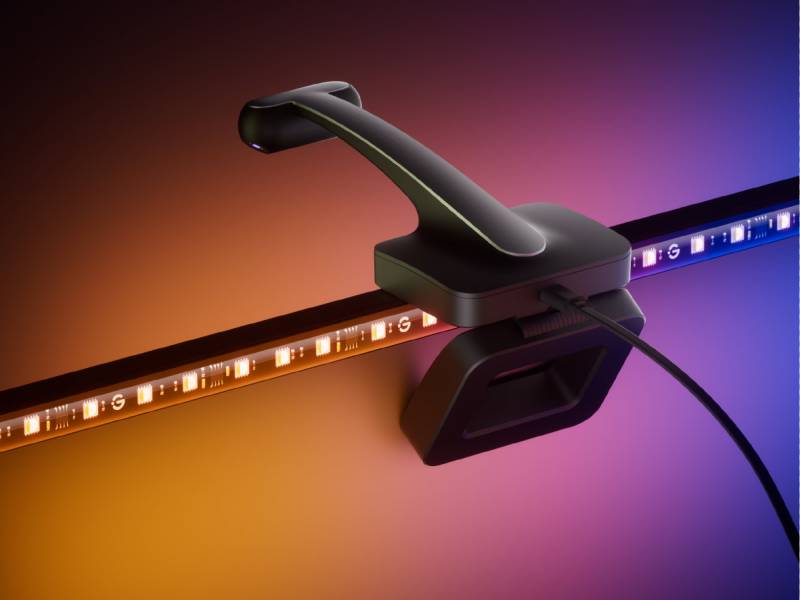
A Smarter Backlight, with the Camera Still Doing the Watching
The TV Backlight 3 is Govee’s latest camera-based ambient lighting system, which monitors the colors on your television screen and uses that information to drive the LED strip mounted behind the TV. That approach has one obvious advantage: it doesn’t care what you’re watching or where the signal comes from. Streaming stick, game console, cable box, built-in TV app, or Blu-ray player, the camera is looking at the screen itself rather than relying on an HDMI passthrough box.
The trade-off, as always with camera-based systems, is that accuracy depends on how well the camera sees your screen and how neatly the software interprets what’s happening. Govee is trying to improve that with what it describes as the industry’s first hybrid glass-plastic dual-camera lens in a TV backlight, using a 1G+3P lens structure. Plainly put, that means one glass element and three plastic lens elements are working together to capture a cleaner view of the screen.
That matters because a backlight like this lives or dies by color matching. If the screen shows a deep orange sunset, but the wall glows red-pink like a nervous traffic light, the illusion breaks quickly. Govee says the new system delivers 4-million-pixel resolving power, doubling the previous generation and improving overall image clarity by about 30% compared with conventional 2-megapixel lenses.
Why the Lens and Sensor Details Matter
The technical pitch here is that glass helps with light transmission, while the plastic elements help shape and focus the image more precisely. Together, they’re meant to reduce chromatic aberration, a type of color fringing or distortion that can make edges look less clean. For a TV backlight, sharper edge detection should help the system better understand where one color area ends and another begins.
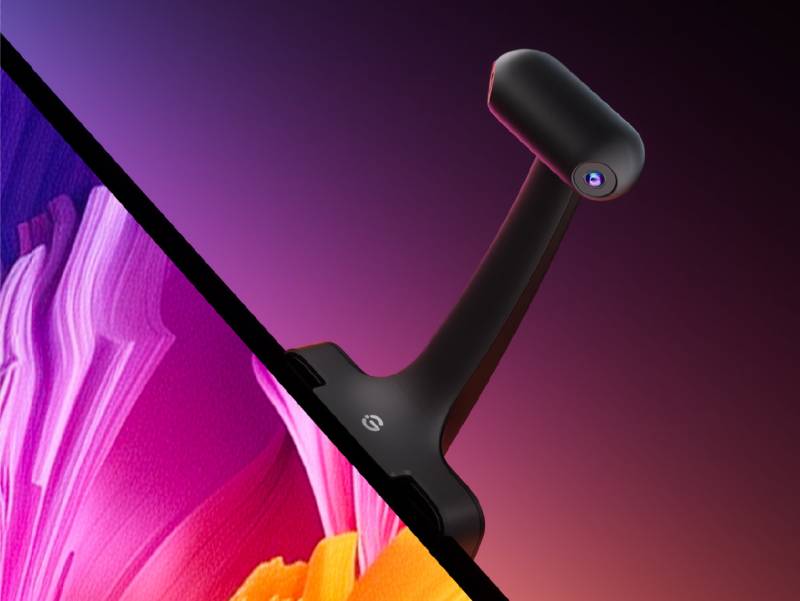
Govee has also added an expanded red-spectrum infrared filter intended to improve the system’s reading of warm tones. That’s useful because reds, oranges, and soft amber lighting can be tricky for ambient systems to reproduce convincingly. A candlelit dinner scene, a desert landscape, or a sports arena washed in warm lighting shouldn’t all become the same vague orange halo.
The camera setup is paired with a 1080p image sensor running at 30 frames per second. That means it captures a full HD image 30 times per second, then uses that information to keep the lights moving with the action. You don’t need to care about the frame rate as a spec-sheet flex, but you may care if you’re watching a fast basketball game or playing something with rapid scene changes, and don’t want the lighting lagging behind as it stops for snacks.
More Zones Should Mean Less Blob Lighting
Rather than throwing one general color behind the television, the Govee TV Backlight 3 divides the screen into up to 24 independent zones. Each zone analyzes a different section of the picture and sends a matching color to the corresponding part of the light strip.
That’s the difference between a simple blue glow behind the whole TV during an ocean scene and a more layered effect where the left side might lean deep blue, the top might brighten with sky tones, and the lower edge might pick up a warmer reflection. It’s still ambient lighting, not a second display, so expectations should stay grounded. But more zones can make the effect feel less like a party trick, and more like the image is softly extending past the TV’s frame.
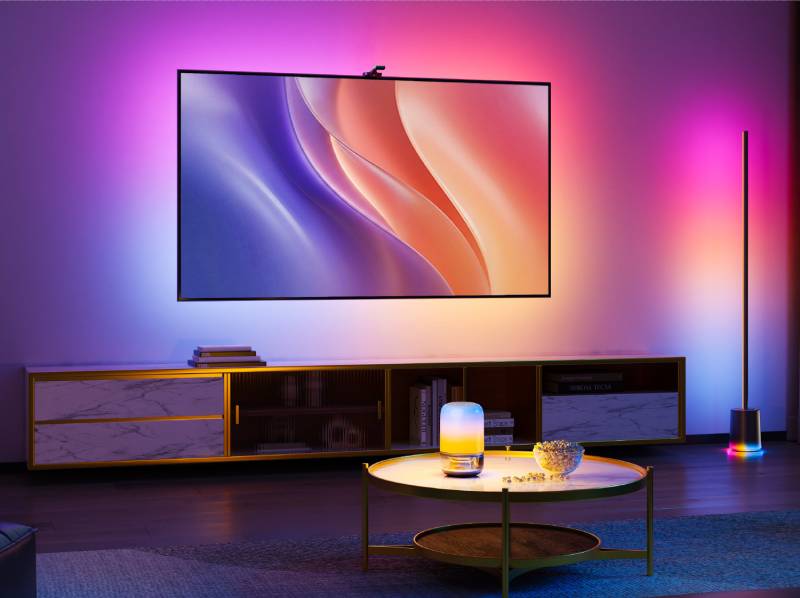
Govee also uses AI content filters that adjust lighting behavior based on what’s playing. A thriller might get more restrained, moody lighting, while animation can lean brighter and more colorful. Documentaries may get warmer, softer treatment. The value of that depends on how well the system reads the room, but the idea is sensible: not every show benefits from the same level of visual enthusiasm.
The Light Strip Gets a White Channel
The Govee TV Backlight 3 uses high-density 4-in-1 RGBWIC LEDs. RGB refers to red, green, and blue LEDs, while the W adds a dedicated white channel. That’s important because white made by mixing red, green, and blue can look a little artificial, especially in softer scenes. A dedicated white channel can help produce more natural-looking highlights and cleaner low-saturation colors.
The strip includes 60 LEDs per meter and is rated for about 20% more brightness than the previous generation. More LEDs can also mean smoother transitions, since the strip has more individual points of light to work with. That should help reduce harsh jumps in color when a scene moves from shadow to highlight, or when a bright object travels across the screen.
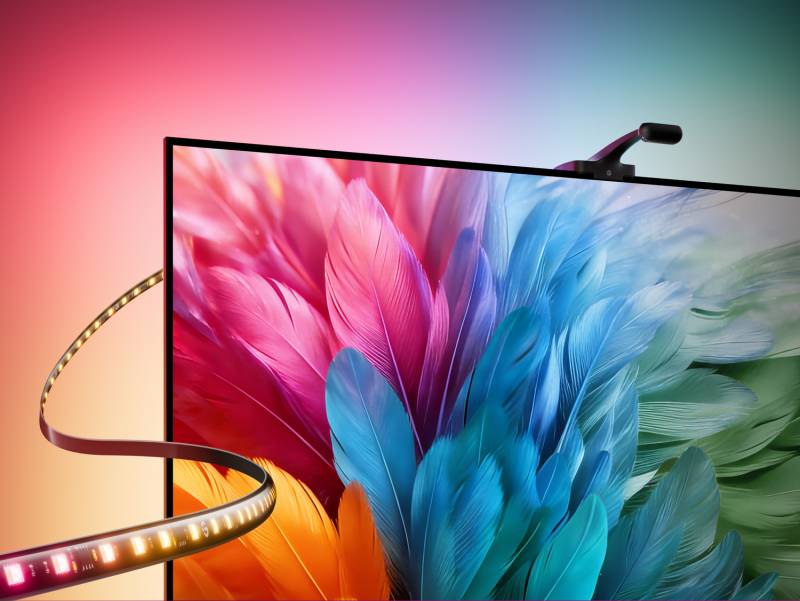
The Govee TV Backlight 3 also has built-in color algorithms, including gamma calibration and white-light blending. Gamma calibration helps adjust how brightness levels are interpreted, so darker scenes don’t get crushed into murky lighting and bright scenes don’t overwhelm everything. White-light blending helps the system handle subtler colors, which is where cheaper ambient lighting can start to look like it’s guessing.
Setup Is Meant to Stay Simple
The camera module is designed to be small enough to visually disappear once installed, with Govee comparing it to something smaller than a thumb drive. Installation uses a high-bond adhesive, so there’s no drilling, no special tools, and no electrician required. You peel and stick the camera, align it, attach the strip behind the TV, and use the Govee Home App to finish setup.
That simplicity is part of the appeal. This isn’t for someone trying to build a fully calibrated home theater with every cable hidden inside the wall. It’s for the person who wants movie night, sports, gaming, and streaming to feel a little more immersive without buying a new TV or rearranging the living room around a single accessory.
Smart Home Support Rounds Out the Package
Once installed, the Govee TV Backlight 3 works through the Govee Home App, where you can choose preset scenes, enable Music Mode, and sync lighting across a room using DreamView. DreamView can connect up to 10 compatible Govee devices, including lamps, strips, and bulbs, so the TV lighting can spread beyond the wall behind the screen.
That could be fun for a game room or a family room where the TV is already the focal point. It could also be too much in a calm living room, because not every space needs to behave like the inside of an arcade cabinet. Thankfully, smart lighting is usually at its best when you can dial it back.
The Govee TV Backlight 3 also supports Matter and integrates with Alexa, Apple HomeKit, Google Home, and Samsung SmartThings. Matter is the newer smart home standard designed to help devices work across different platforms, so this should be easier to integrate into a mixed smart home setup without fully committing to one ecosystem.
Pricing and Availability
The Govee TV Backlight 3 is available now in the US and Europe through Amazon and the Govee site. The version for 55″ to 65″ TVs is priced at $109.99, while the larger kit for 75″ to 85″ TVs costs $139.99.
That puts it in impulse-upgrade territory for people who already like ambient lighting, but still high enough that accuracy matters. If Govee’s new camera system delivers cleaner color matching and smoother transitions in everyday viewing, this could be a worthwhile living room upgrade. If you mostly watch the news with the lights on, well, your wall may be perfectly happy staying unemployed.

Be the first to comment on "Govee TV Backlight 3 Wants to Make Your TV Wall Work a Little Harder"